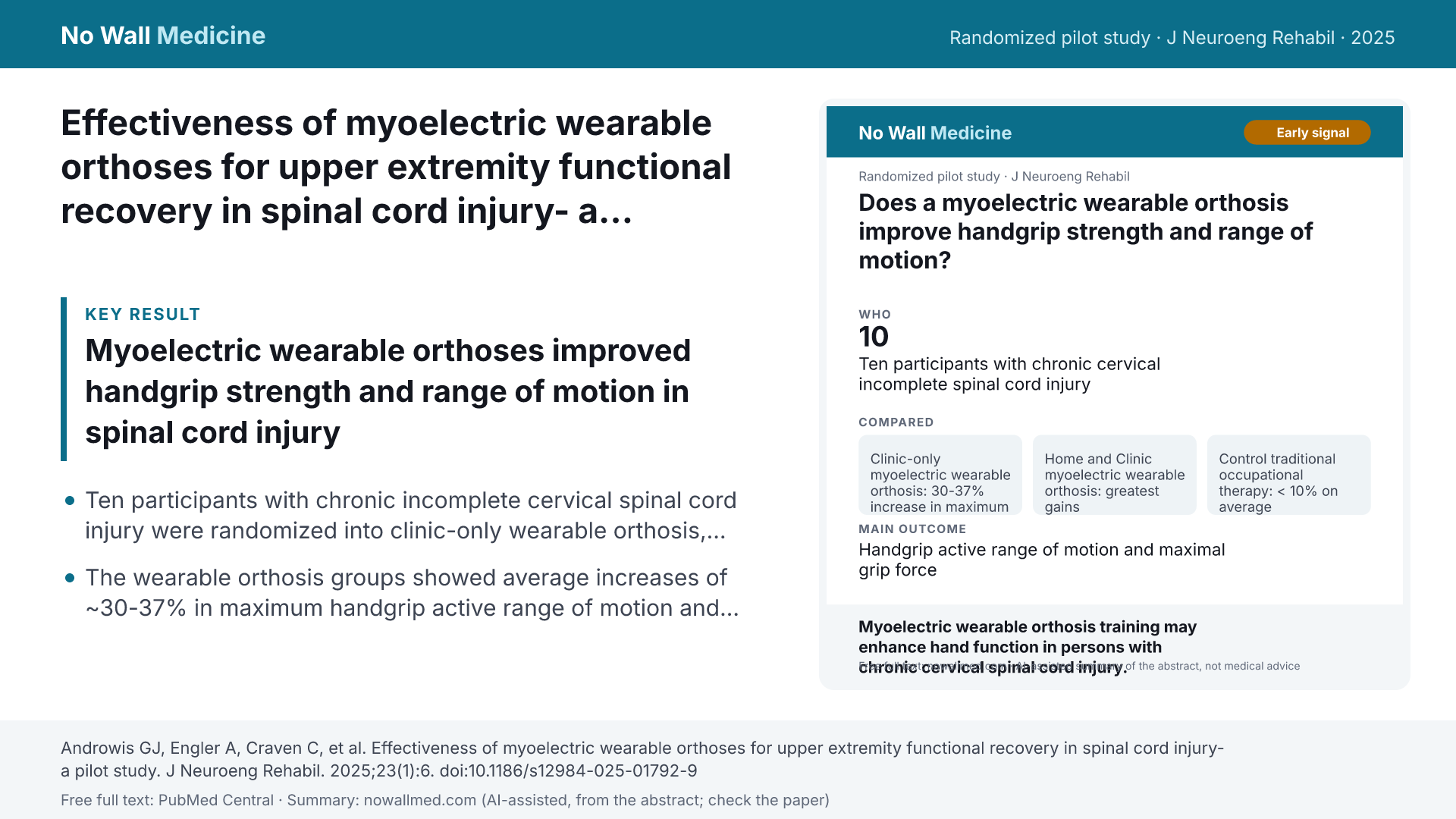
Myoelectric wearable orthoses improved handgrip strength and range of motion in spinal cord injury
Effectiveness of myoelectric wearable orthoses for upper extremity functional recovery in spinal cord injury- a pilot study
Randomized pilot studyEarly signal
Does a myoelectric wearable orthosis improve handgrip strength and range of motion?
Who
10
Ten participants with chronic cervical incomplete spinal cord injury
Compared
Clinic-only myoelectric wearable orthosis: 30-37% increase in maximum handgrip active range of motion
Home and Clinic myoelectric wearable orthosis: greatest gains
Control traditional occupational therapy: < 10% on average
Main outcome
Handgrip active range of motion and maximal grip force
Bottom line: Myoelectric wearable orthosis training may enhance hand function in persons with chronic cervical spinal cord injury.
J Neuroeng Rehabil · 2025-12-02 · Save PNG
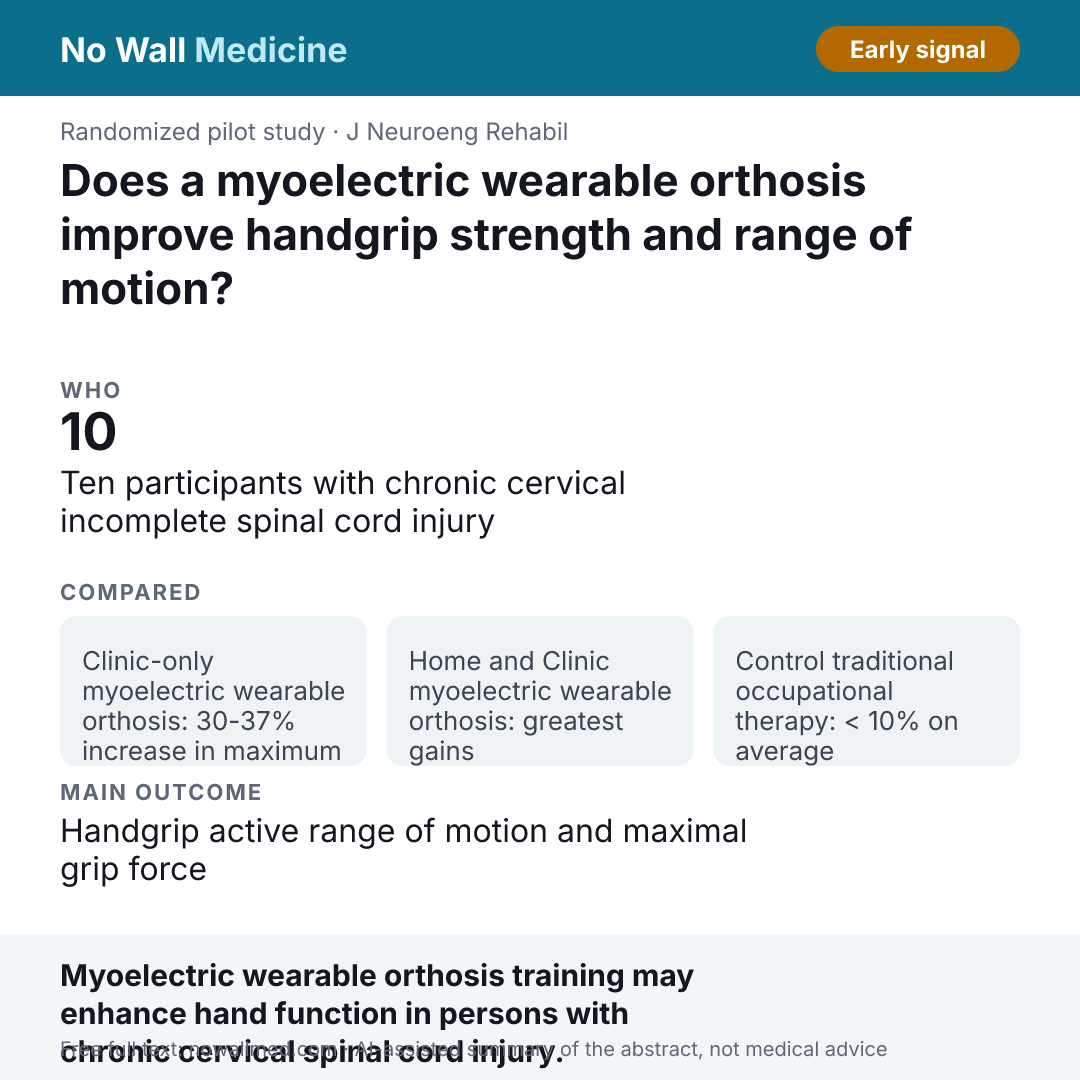
Clinical question: Does a myoelectric wearable orthosis improve handgrip strength and range of motion?
Key points
- Ten participants with chronic incomplete cervical spinal cord injury were randomized into clinic-only wearable orthosis, home and clinic wearable orthosis, or traditional occupational therapy groups.
- The wearable orthosis groups showed average increases of ~30-37% in maximum handgrip active range of motion and ~28-30% in maximum grip force compared to baseline.
- The traditional occupational therapy control group showed minimal changes of <10% on average.
Headline and key points written with AI from the paper’s abstract, with every number checked against it. Read the paper before relying on them.
Was this summary helpful?
Subject terms
Headline, design, result, key points, caveat and citation as plain text.
Cite this article
Androwis GJ, Engler A, Craven C, et al. Effectiveness of myoelectric wearable orthoses for upper extremity functional recovery in spinal cord injury- a pilot study. J Neuroeng Rehabil. 2025;23(1):6. doi:10.1186/s12984-025-01792-9
Spotted a mistake? Suggest a correction