Dynamic hand orthosis added to task training shows no extra benefit for subacute stroke patients
Upper Limb Training with a Dynamic Hand Orthosis in Early Subacute Stroke: A Pilot Randomized Trial
Pilot randomized trialNo clear difference
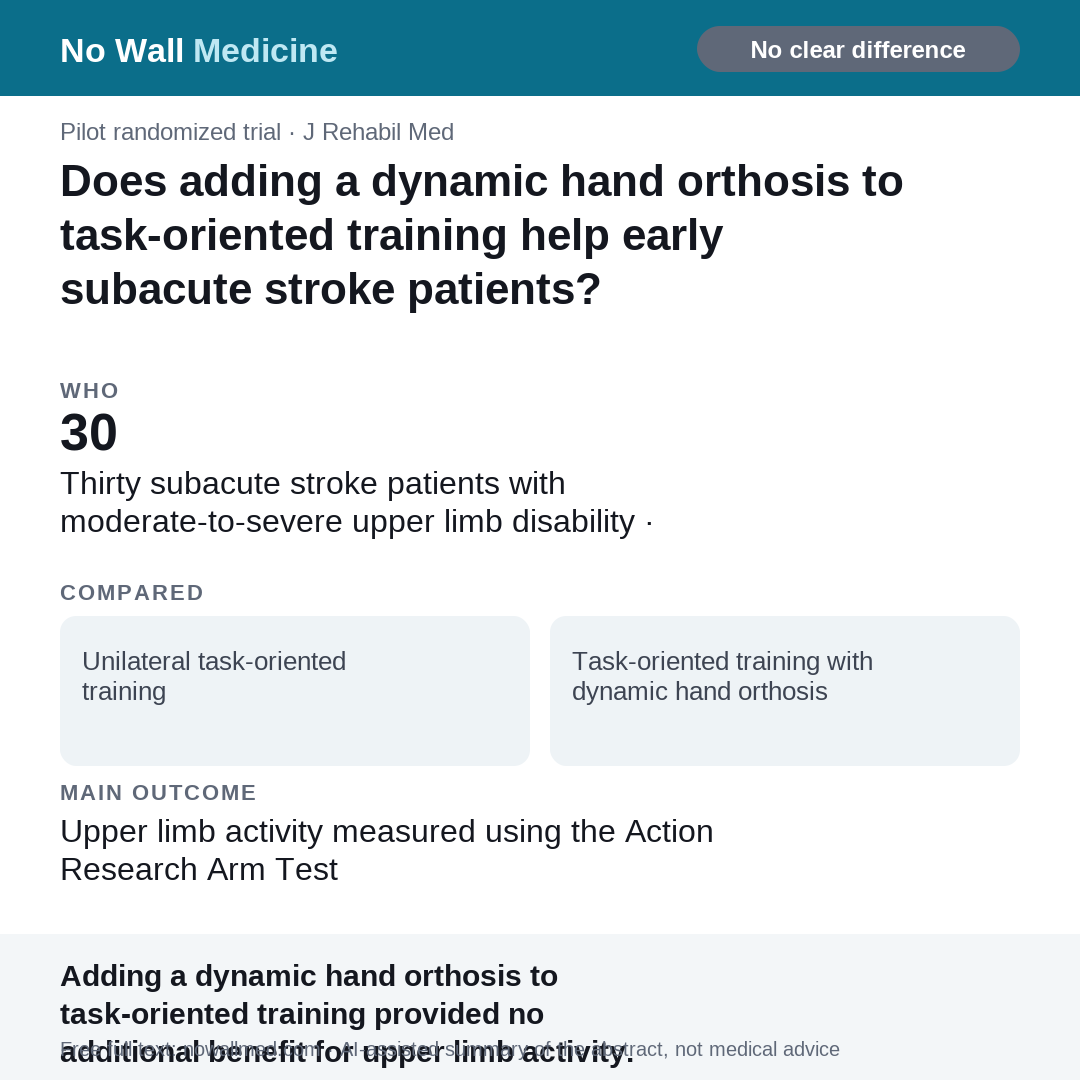
Does adding a dynamic hand orthosis to task-oriented training help early subacute stroke patients?
Who
30
Thirty subacute stroke patients with moderate-to-severe upper limb disability · Rehabilitation hospital
Compared
Unilateral task-oriented training
Task-oriented training with dynamic hand orthosis
Main outcome
Upper limb activity measured using the Action Research Arm Test
Result: mean difference 4/57, 95% confidence interval (95% CI) -5 to 13
Bottom line: Adding a dynamic hand orthosis to task-oriented training provided no additional benefit for upper limb activity.
J Rehabil Med · 2022-04-07Download image
Clinical question: Does adding a dynamic hand orthosis to task-oriented training help early subacute stroke patients?
Why it matters: It is unknown if adding a dynamic hand orthosis to task-oriented training provides additional benefits for upper limb activity in the early subacute stroke period.
Key points
- Thirty subacute stroke patients with moderate-to-severe upper limb disability were randomized to receive task-oriented training alone or with a dynamic hand orthosis.
- The addition of the hand orthosis showed no difference in the Action Research Arm Test, which measures upper limb activity, with a mean difference of 4/57.
- No differences were found between the groups for secondary outcomes including grip strength, the Nine-hole Peg Test, or the Fugl-Meyer Assessment for upper extremity.
Headline and key points written with AI from the paper’s abstract, with every number checked against it. Read the paper before relying on them.
Was this summary helpful?
Subject terms
Cite this article
Wong Y, Li CJ, Ada L, Zhang T, Månum G, Langhammer B. Upper Limb Training with a Dynamic Hand Orthosis in Early Subacute Stroke: A Pilot Randomized Trial. J Rehabil Med. 2022. doi:10.2340/jrm.v54.2231
Spotted a mistake? Suggest a correction
Top studies every Monday
The week’s key trials and guidelines in your specialties, plus any topics you follow. By email, free.
Get the weekly digest