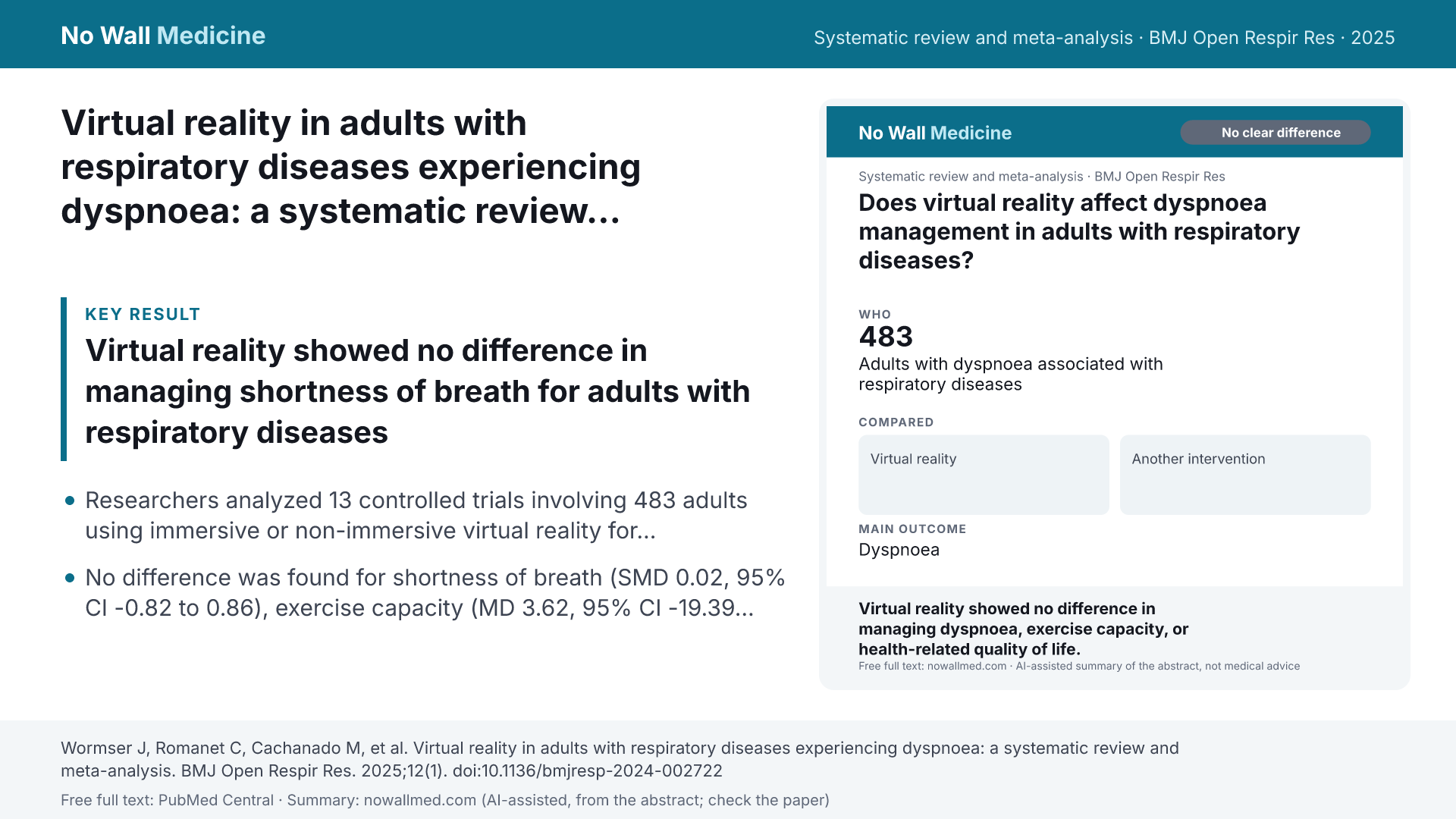
Virtual reality showed no difference in managing shortness of breath for adults with respiratory diseases
Virtual reality in adults with respiratory diseases experiencing dyspnoea: a systematic review and meta-analysis
Systematic review and meta-analysisNo clear difference
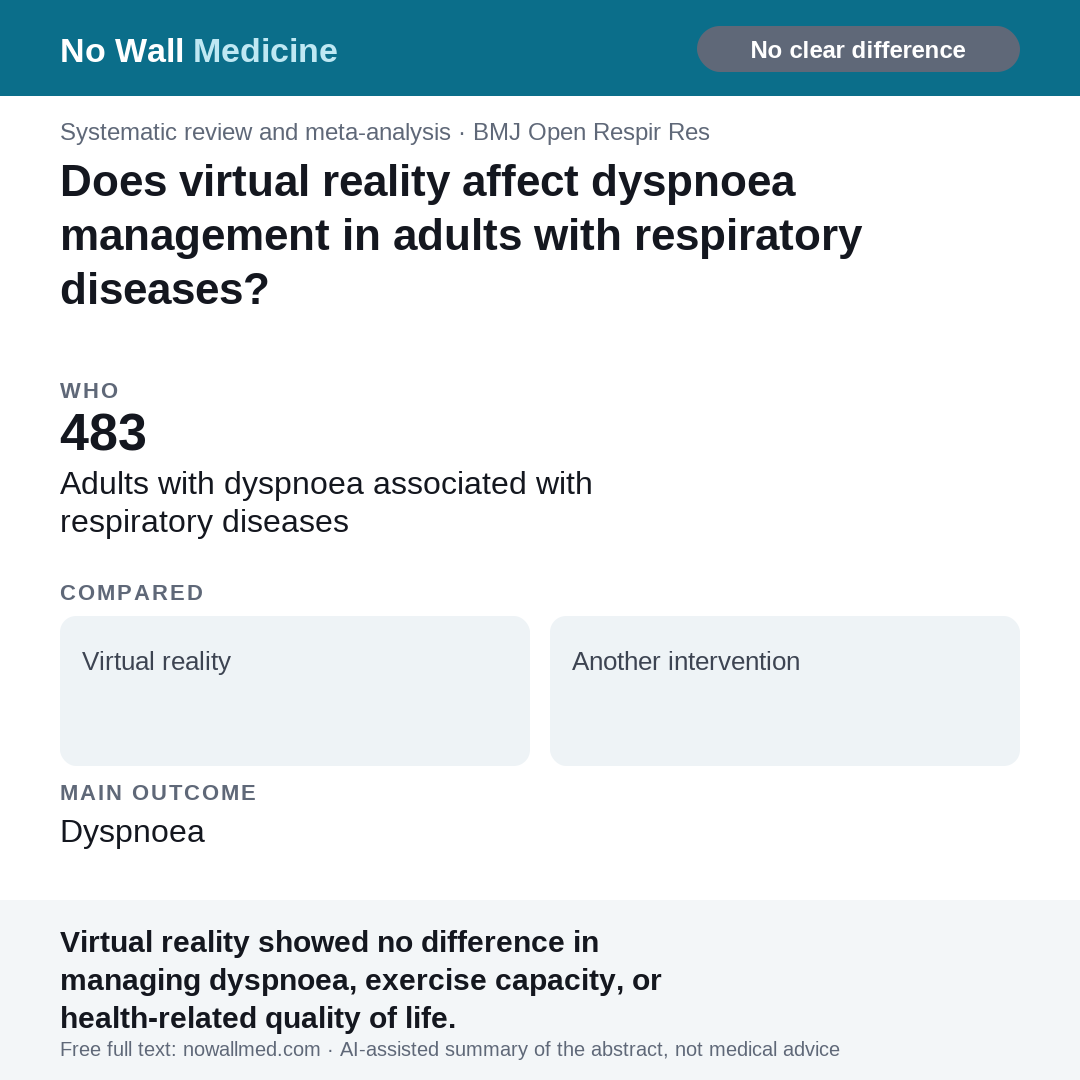
Does virtual reality affect dyspnoea management in adults with respiratory diseases?
Who
483
Adults with dyspnoea associated with respiratory diseases
Compared
Virtual reality
Another intervention
Main outcome
Dyspnoea
Result: standardised mean difference 0.02 (95% CI -0.82 to 0.86)
Bottom line: Virtual reality showed no difference in managing dyspnoea, exercise capacity, or health-related quality of life.
Limitation: Evidence is very uncertain due to risk of bias, imprecision and heterogeneity.
BMJ Open Respir Res · 2025-09-10Download image
Clinical question: Does virtual reality affect dyspnoea management in adults with respiratory diseases?
Why it matters: The effects of virtual reality on managing shortness of breath in adults with respiratory diseases are not clearly established.
Key points
- Researchers analyzed 13 controlled trials involving 483 adults using immersive or non-immersive virtual reality for shortness of breath.
- No difference was found for shortness of breath (SMD 0.02, 95% CI -0.82 to 0.86), exercise capacity (MD 3.62, 95% CI -19.39 to 26.63), or health-related quality of life (MD -11.81, 95% CI -42.95 to 19.33).
- The data available were insufficient to conduct a pooled analysis for muscle function.
Limitation the authors note: The evidence is very uncertain due to risk of bias, imprecision, and heterogeneity.
Headline and key points written with AI from the paper’s abstract, with every number checked against it. Read the paper before relying on them.
Was this summary helpful?
Abstract
Objectives
Our aim was to evaluate virtual reality's effects in dyspnoea's management. Methods
Information sources: Trials were identified through a systematic search carried out on MEDLINE, Web of Science, Scopus and CINAHL until 17 March 2025. Eligibility criteria
Eligible studies were controlled trials including adults with dyspnoea associated with respiratory diseases, for whom virtual reality was implemented and compared with another intervention. Risk of bias: Risk of bias (ROB) was assessed using the ROB 2 tool. Synthesis of results
The primary outcome was dyspnoea. Secondary outcomes included exercise capacity, health-related quality of life (HRQOL) and muscle function. Effect size was expressed using standardised mean difference (SMD) or MD for primary and secondary outcomes, respectively (random-effects model). We used the Grading of Recommendations Assessment, Development and Evaluation approach to judge the certainty of evidence. Results
Included studies: 13 studies were selected, including 483 adults and using non-immersive tools (n=7) or immersive tools (n=6). Risk of bias in these studies was low (n=1), some concerns (n=8) and high risk (n=4). Synthesis of results
No difference was found in dyspnoea (8 studies, 224 participants; SMD 0.02, 95% CI -0.82 to 0.86, I2=88.2%), exercise capacity (5 studies, 183 participants; MD 3.62, 95% CI -19.39 to 26.63, I2=39.8%) and in HRQOL (4 studies, 127 participants; MD -11.81, 95% CI -42.95 to 19.33, I2=98.9%). The data available were insufficient to conduct a pooled analysis for muscle function. Conclusions
Limitations of evidence: The evidence is very uncertain about virtual reality's effects on dyspnoea due to risk of bias, imprecision and heterogeneity. Interpretation
Further studies are needed and should explore various aspects of the application of immersive virtual reality. Prospero registration number
CRD42023443280.
Abstract reproduced under the article’s CC BY NC licence.
Subject terms
Cite this article
Wormser J, Romanet C, Cachanado M, Youinou M, Chatellier G, Torres Sánchez I. Virtual reality in adults with respiratory diseases experiencing dyspnoea: a systematic review and meta-analysis. BMJ Open Respir Res. 2025. doi:10.1136/bmjresp-2024-002722
Spotted a mistake? Suggest a correction