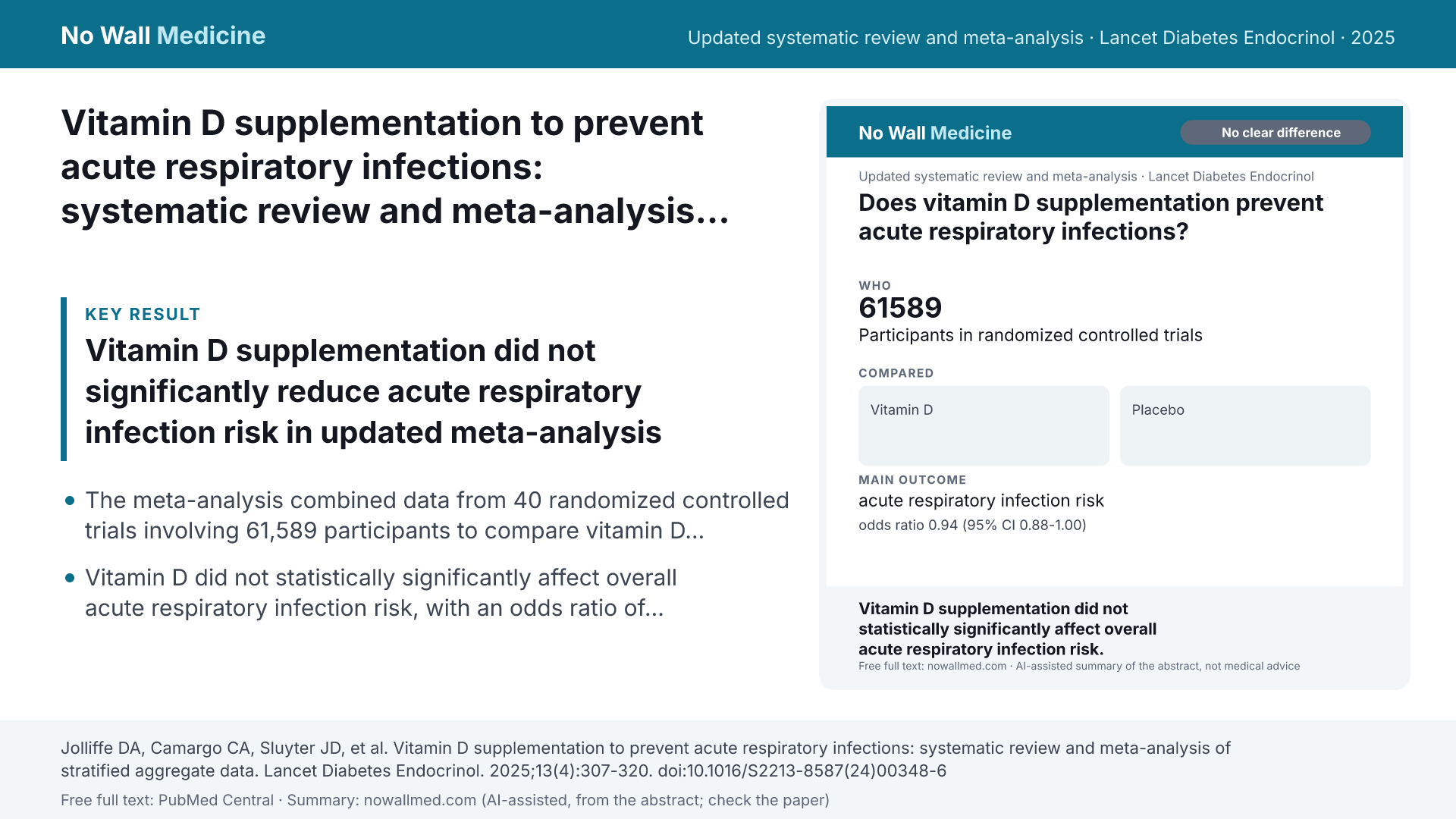
Vitamin D supplementation did not significantly reduce acute respiratory infection risk in updated meta-analysis
Vitamin D supplementation to prevent acute respiratory infections: systematic review and meta-analysis of stratified aggregate data
Updated systematic review and meta-analysisNo clear difference
Does vitamin D supplementation prevent acute respiratory infections?
Who
61589
Participants in randomized controlled trials
Compared
Vitamin D
Placebo
Main outcome
acute respiratory infection risk
Result: odds ratio 0.94 (95% CI 0.88-1.00)
Bottom line: Vitamin D supplementation did not statistically significantly affect overall acute respiratory infection risk.
Lancet Diabetes Endocrinol · 2025-02-21 · Save PNG
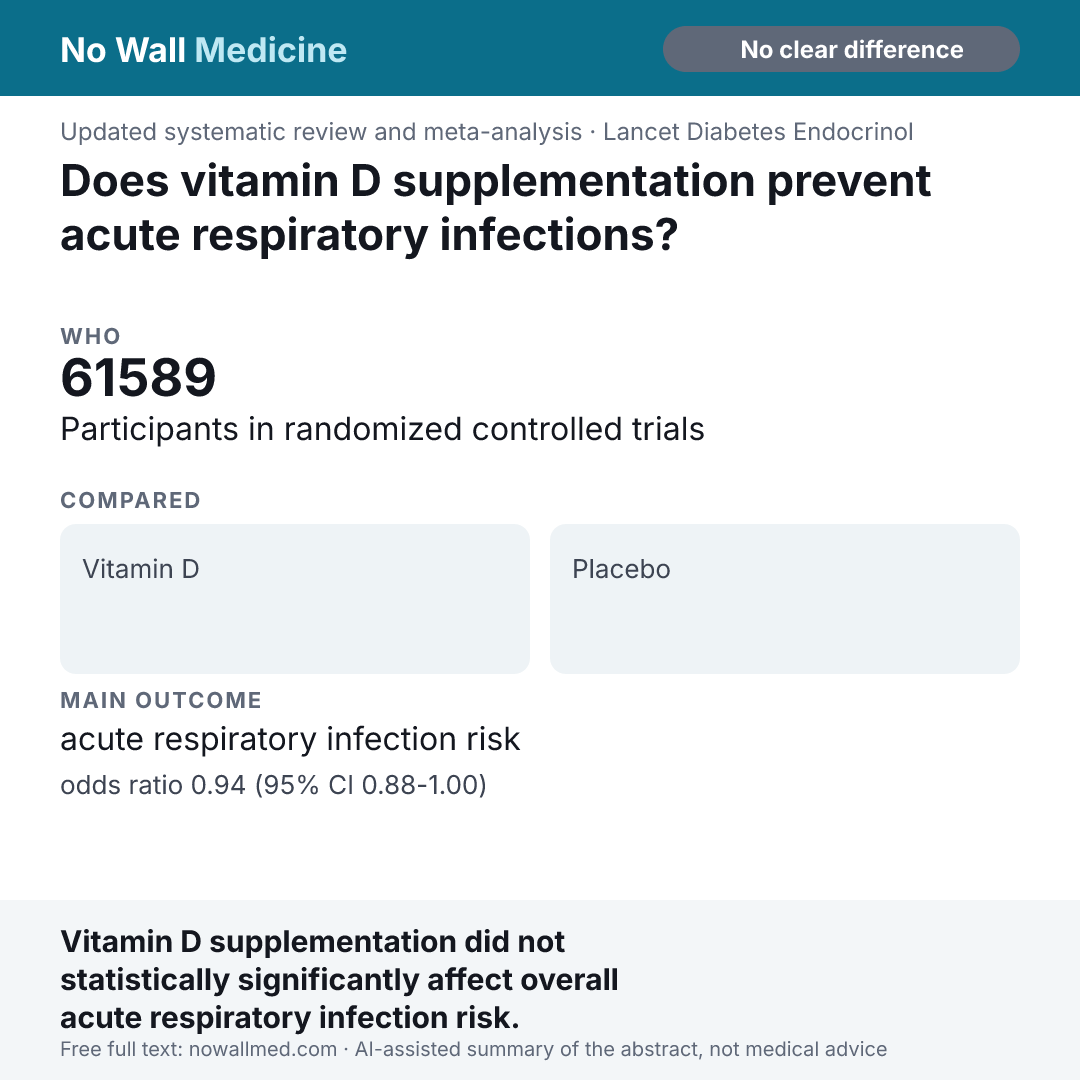
Clinical question: Does vitamin D supplementation prevent acute respiratory infections?
Why it matters: Applies to general populations studied in randomized trials; suggests vitamin D supplementation is not a statistically significant preventive measure for acute respiratory infections.
Key points
- The meta-analysis combined data from 40 randomized controlled trials involving 61,589 participants to compare vitamin D with placebo.
- Vitamin D did not statistically significantly affect overall acute respiratory infection risk, with an odds ratio of 0.94 (95% CI 0.88-1.00).
- Subgroup analyses found no evidence that age, baseline vitamin D status, or dosing regimen changed the effect on infection risk.
Headline and key points written with AI from the paper’s abstract, with every number checked against it. Read the paper before relying on them.
Was this summary helpful?
Abstract
Background
A 2021 meta-analysis of 37 randomised controlled trials (RCTs) of vitamin D supplementation for prevention of acute respiratory infections (ARIs) revealed a statistically significant protective effect of the intervention (odds ratio [OR] 0·92 [95% CI 0·86 to 0·99]). Since then, six eligible RCTs have been completed, including one large trial (n=15 804). We aimed to re-examine the link between vitamin D supplementation and prevention of ARIs. Methods
Updated systematic review and meta-analysis of data from RCTs of vitamin D for ARI prevention using a random effects model. Subgroup analyses were done to determine whether effects of vitamin D on risk of ARI varied according to baseline 25-hydroxyvitamin D (25[OH]D) concentration, dosing regimen, or age. We searched MEDLINE, EMBASE, the Cochrane Central Register of Controlled Trials, Web of Science, and the ClinicalTrials.gov between May 1, 2020 (end-date of search of our previous meta-analysis) and April 30, 2024. No language restrictions were imposed. Double-blind RCTs supplementing vitamin D for any duration, with placebo or lower-dose vitamin D control, were eligible if approved by a Research Ethics Committee and if ARI incidence was collected prospectively and pre-specified as an efficacy outcome. Aggregate data, stratified by baseline 25(OH)D concentration and age, were obtained from study authors. The study was registered with PROSPERO (no. CRD42024527191). Findings
We identified six new RCTs (19 337 participants). Data were obtained for 16 085 (83·2%) participants in three new RCTs and combined with data from 48 488 participants in 43 RCTs identified in our previous meta-analysis. For the primary comparison of any vitamin D versus placebo, the intervention did not statistically significantly affect overall ARI risk (OR 0·94 [95% CI 0·88-1·00], p=0·057; 40 studies; 61 589 participants; I2=26·4%). Pre-specified subgroup analysis did not reveal evidence of effect modification by age, baseline vitamin D status, dosing frequency, or dose size. Vitamin D did not influence the proportion of participants experiencing at least one serious adverse event (OR 0·96 [95% CI 0·90-1·04]; 38 studies; I2=0·0%). A funnel plot showed left-sided asymmetry (p=0·0020, Egger's test). Interpretation
This updated meta-analysis yielded a similar point estimate for the overall effect of vitamin D supplementation on ARI risk to that obtained previously, but the 95% CI for this effect estimate now includes 1·00, indicating no statistically significant protection. Funding
None.
Abstract reproduced under the article’s CC BY licence.
Subject terms
Headline, design, result, key points, caveat and citation as plain text.
Cite this article
Jolliffe DA, Camargo CA, Sluyter JD, et al. Vitamin D supplementation to prevent acute respiratory infections: systematic review and meta-analysis of stratified aggregate data. Lancet Diabetes Endocrinol. 2025;13(4):307-320. doi:10.1016/S2213-8587(24)00348-6
Spotted a mistake? Suggest a correction