Volatile sedation was associated with increased mortality in critically ill patients on mechanical ventilation
Volatile sedation in critically ill adults undergoing mechanical ventilation: a meta-analysis of randomized controlled trials
Meta-analysis of 21 randomized controlled trialsHarm found
Does volatile sedation reduce mortality compared to intravenous sedation in critically ill adults?
Who
2367
Critically ill adults undergoing invasive mechanical ventilation
Compared
Volatile sedation: 262/1107
Intravenous sedation: 218/1106
Main outcome
Mortality at the longest follow-up
Result: relative risk 1.17 (95% confidence interval, 1.02 to 1.35)
Bottom line: Volatile sedation may increase mortality compared to intravenous sedation in mechanically ventilated critically ill adults.
Limitation: Trial sequential analysis suggested a lack of definitive conclusion due to insufficient sample size.
Crit Care · 2025-06-05Download image
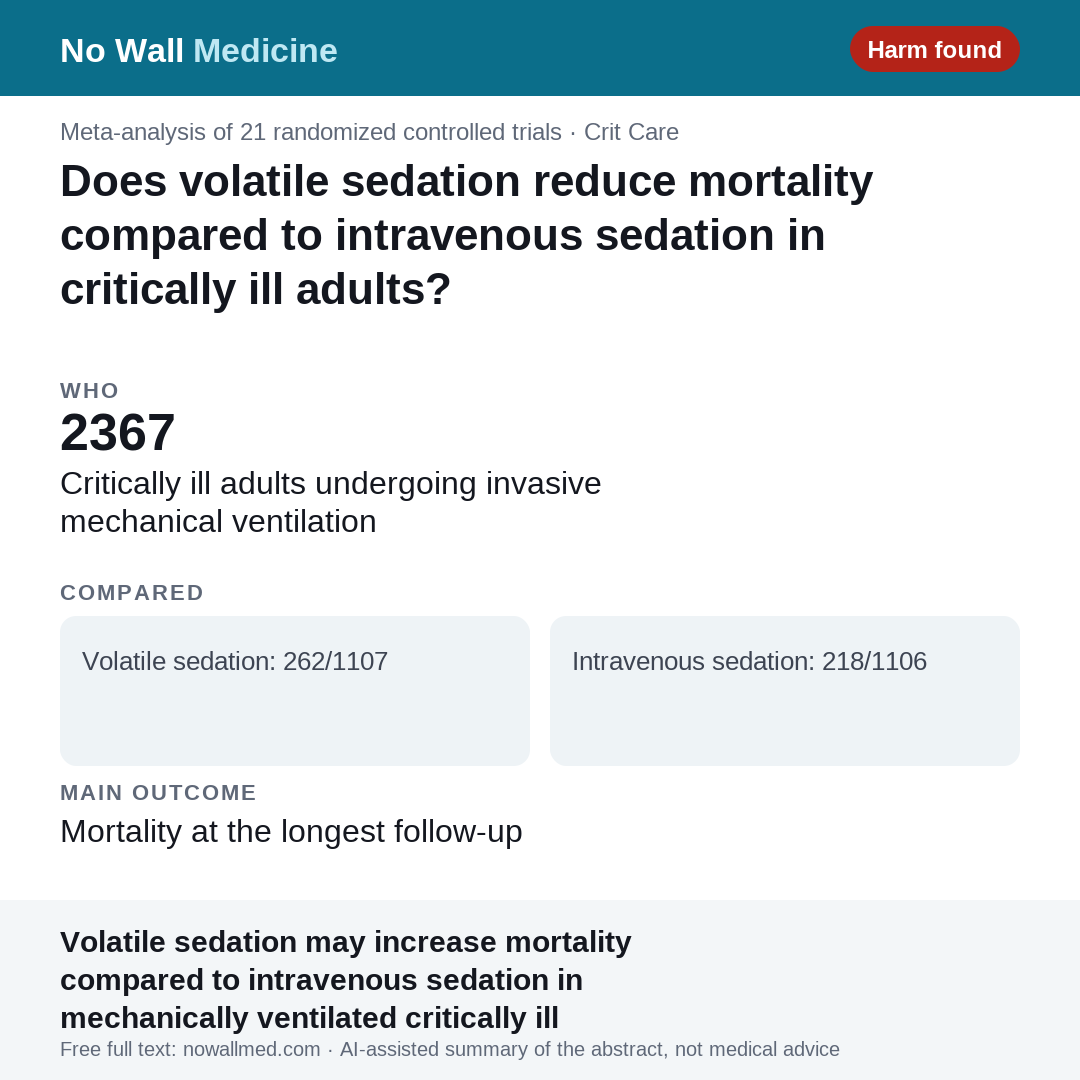
Clinical question: Does volatile sedation reduce mortality compared to intravenous sedation in critically ill adults?
Why it matters: It is unclear if the potential lung-protective effects of volatile sedation translate into improvements in clinically relevant outcomes like mortality.
Key points
- Researchers analyzed 21 randomized controlled trials involving 2367 patients to compare volatile sedation with intravenous sedation.
- Volatile sedation was associated with increased mortality at the longest follow-up compared to intravenous sedation (262/1107 vs. 218/1106; relative risk: 1.17; 95% confidence interval, 1.02 to 1.35).
- The time from stopping sedation to removing the breathing tube was slightly shorter with volatile sedation by a mean difference of -90.62 min (95% confidence interval, -124.64 to -56.60).
Limitation the authors note: Trial sequential analysis suggested a lack of definitive conclusion because the required sample size was 12,080.
Headline and key points written with AI from the paper’s abstract, with every number checked against it. Read the paper before relying on them.
Topics
Cite this article
Yamamoto T, Kotani Y, Akutagawa K, Nagayama T, Tomimatsu M, Tonai M. Volatile sedation in critically ill adults undergoing mechanical ventilation: a meta-analysis of randomized controlled trials. Crit Care. 2025. doi:10.1186/s13054-025-05467-8
Spotted a mistake? Suggest a correction