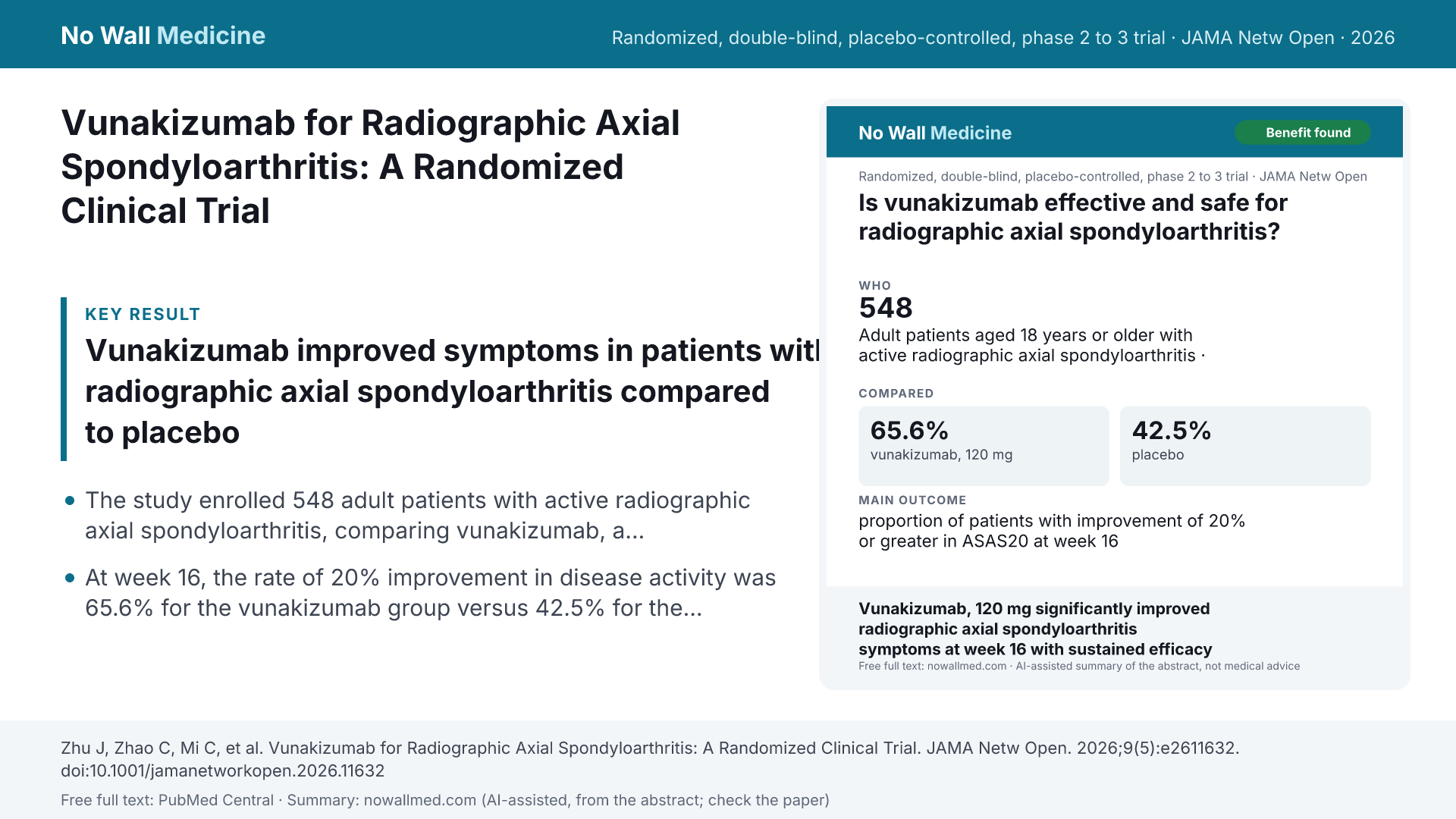
Vunakizumab improved symptoms in patients with radiographic axial spondyloarthritis compared to placebo
Vunakizumab for Radiographic Axial Spondyloarthritis: A Randomized Clinical Trial
Randomized, double-blind, placebo-controlled, phase 2 to 3 trialBenefit found
Is vunakizumab effective and safe for radiographic axial spondyloarthritis?
Who
548
Adult patients aged 18 years or older with active radiographic axial spondyloarthritis · 38 hospitals in China
Compared
65.6%vunakizumab, 120 mg
42.5%placebo
Main outcome
proportion of patients with improvement of 20% or greater in ASAS20 at week 16
Result: difference, 23.2% (95% CI, 11.8%-34.0%)
Bottom line: Vunakizumab, 120 mg significantly improved radiographic axial spondyloarthritis symptoms at week 16 with sustained efficacy through 32 weeks.
JAMA Netw Open · 2026-05-01 · Save PNG
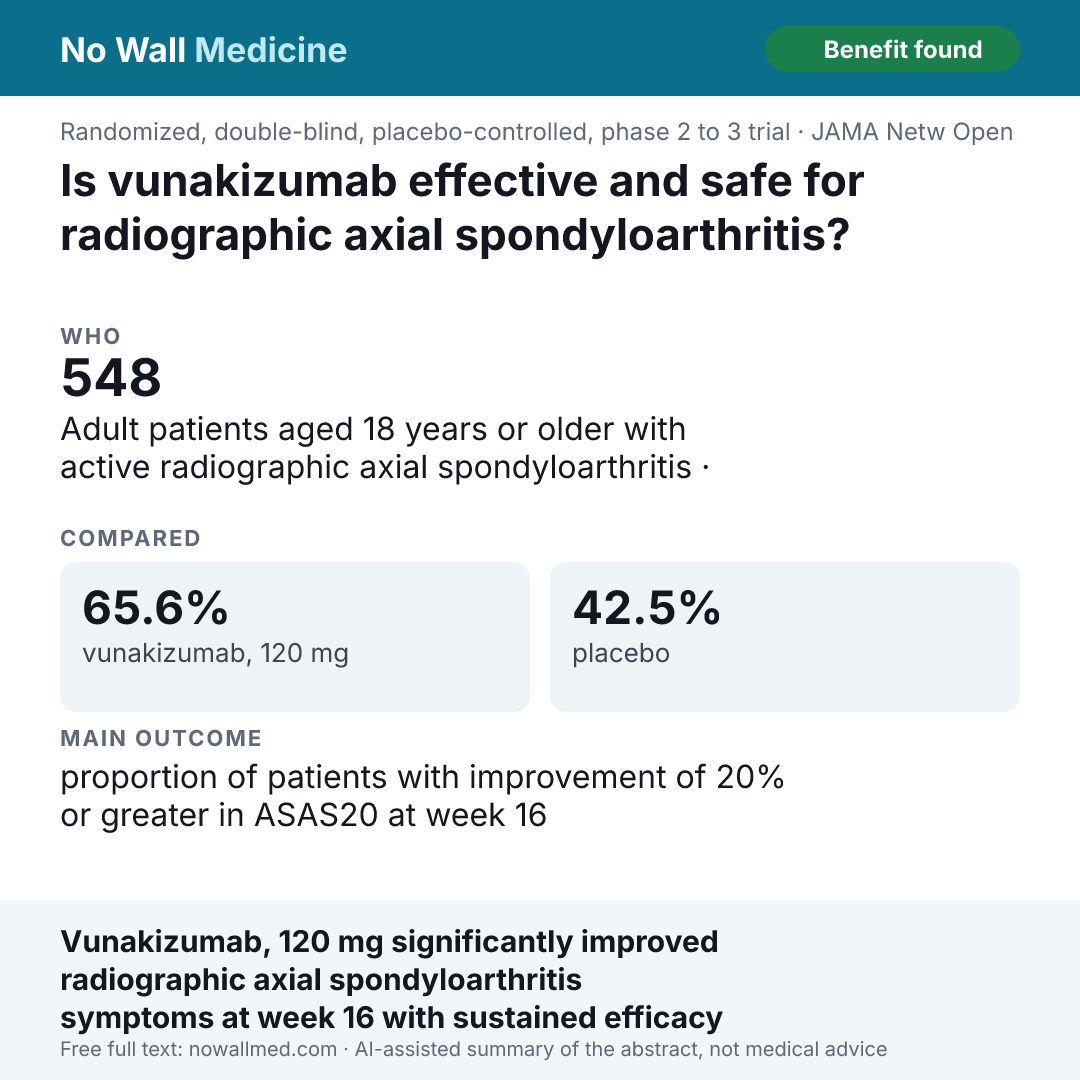
Clinical question: Is vunakizumab effective and safe for radiographic axial spondyloarthritis?
Why it matters: Many patients with ankylosing spondylitis experience inadequate responses or intolerance to currently available therapies.
In absolute numbers
vunakizumab, 120 mg: 65.6% · placebo: 42.5% → a difference of 23.1 percentage points, so about 5 people would need the treatment for 1 more to benefit (number needed to treat) over the trial’s follow-up.
Worked out by us from the two group results above, not reported by the authors. Check the paper for the exact outcome and timing.
Key points
- The study enrolled 548 adult patients with active radiographic axial spondyloarthritis, comparing vunakizumab, a monoclonal antibody targeting interleukin 17A, to a placebo.
- At week 16, the rate of 20% improvement in disease activity was 65.6% for the vunakizumab group versus 42.5% for the placebo group.
- The incidence of adverse events was 83.7% in the vunakizumab group and 81.5% in the placebo group.
Headline and key points written with AI from the paper’s abstract, with every number checked against it. Read the paper before relying on them.
Was this summary helpful?
Subject terms
Headline, design, result, key points, caveat and citation as plain text.
Cite this article
Zhu J, Zhao C, Mi C, et al. Vunakizumab for Radiographic Axial Spondyloarthritis: A Randomized Clinical Trial. JAMA Netw Open. 2026;9(5):e2611632. doi:10.1001/jamanetworkopen.2026.11632
Spotted a mistake? Suggest a correction