Wearable activity trackers increased physical activity and step counts in older adults
Wearable Activity Tracker-Based Interventions for Physical Activity, Body Composition, and Physical Function Among Community-Dwelling Older Adults: Systematic Review and Meta-Analysis of Randomized Controlled Trials
Systematic review and meta-analysis of randomized controlled trialsMixed results
Do wearable activity tracker interventions improve physical activity, body composition, and physical function in older adults?
Who
4566
Community-dwelling older adults
Compared
Wearable activity tracker-based interventions
Usual care
Main outcome
Physical activity, body composition, and physical function
Result: standardized mean difference 0.28 (95% CI 0.10 to 0.47) for physical activity time
Bottom line: Wearable activity trackers increased physical activity time and daily step counts but did not improve body composition or physical function.
Limitation: low- to moderate-certainty evidence
J Med Internet Res · 2025-04-03Download image
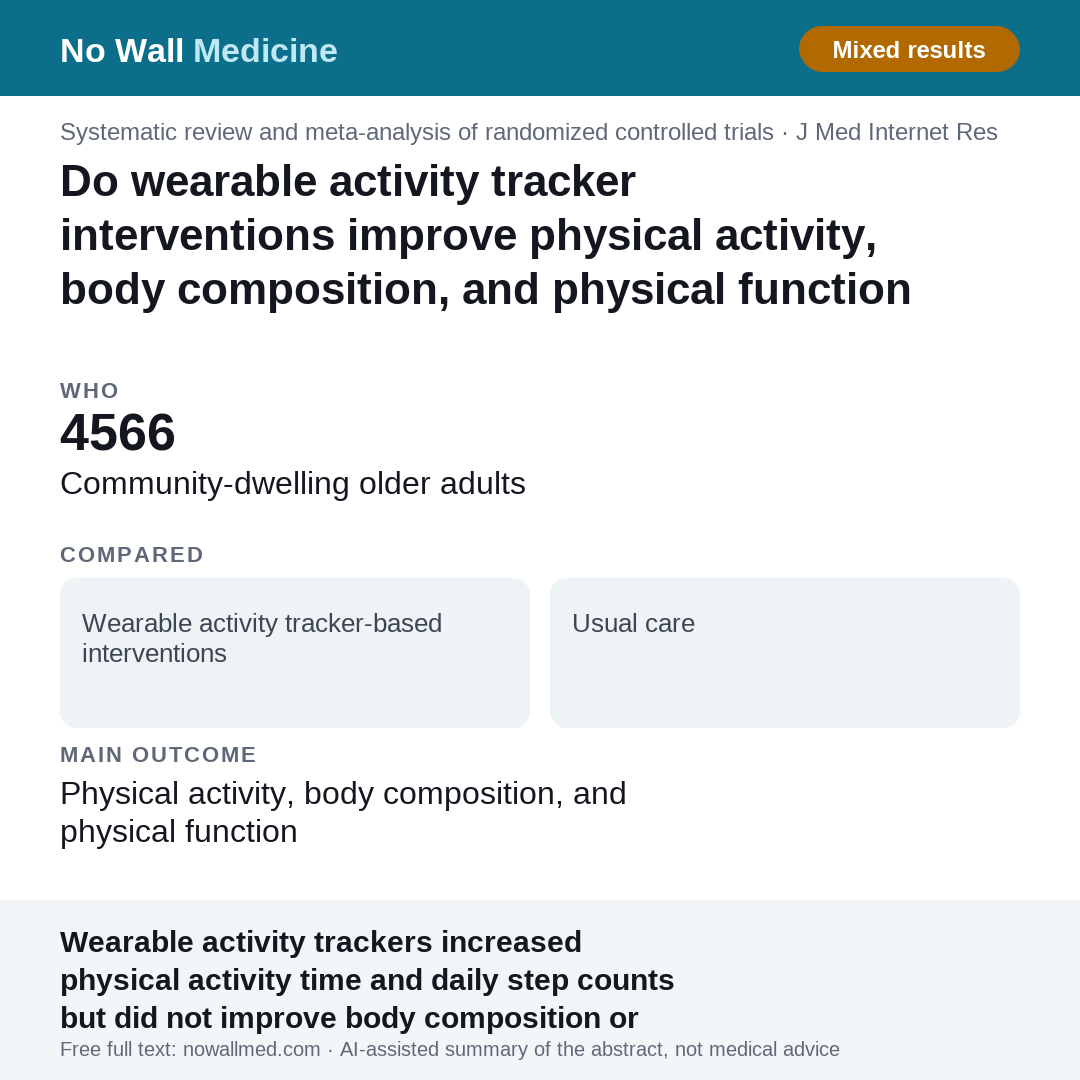
Clinical question: Do wearable activity tracker interventions improve physical activity, body composition, and physical function in older adults?
Why it matters: The effectiveness of wearable activity tracker-based interventions on physical activity, body composition, and physical function among community-dwelling older adults remains debated.
Key points
- Researchers analyzed 23 randomized controlled trials involving 4566 community-dwelling older adults to evaluate wearable activity tracker interventions.
- Interventions increased physical activity time (standardized mean difference 0.28) and daily step counts (standardized mean difference 0.58) immediately after the intervention compared to usual care.
- The interventions did not show a significant impact on body mass index, body fat, the timed up and go test, or the chair stand test.
Headline and key points written with AI from the paper’s abstract, with every number checked against it. Read the paper before relying on them.
Topics
Cite this article
Li R, Li Y, Wang L, Li L, Fu C, Hu D. Wearable Activity Tracker-Based Interventions for Physical Activity, Body Composition, and Physical Function Among Community-Dwelling Older Adults: Systematic Review and Meta-Analysis of Randomized Controlled Trials. J Med Internet Res. 2025. doi:10.2196/59507
Spotted a mistake? Suggest a correction