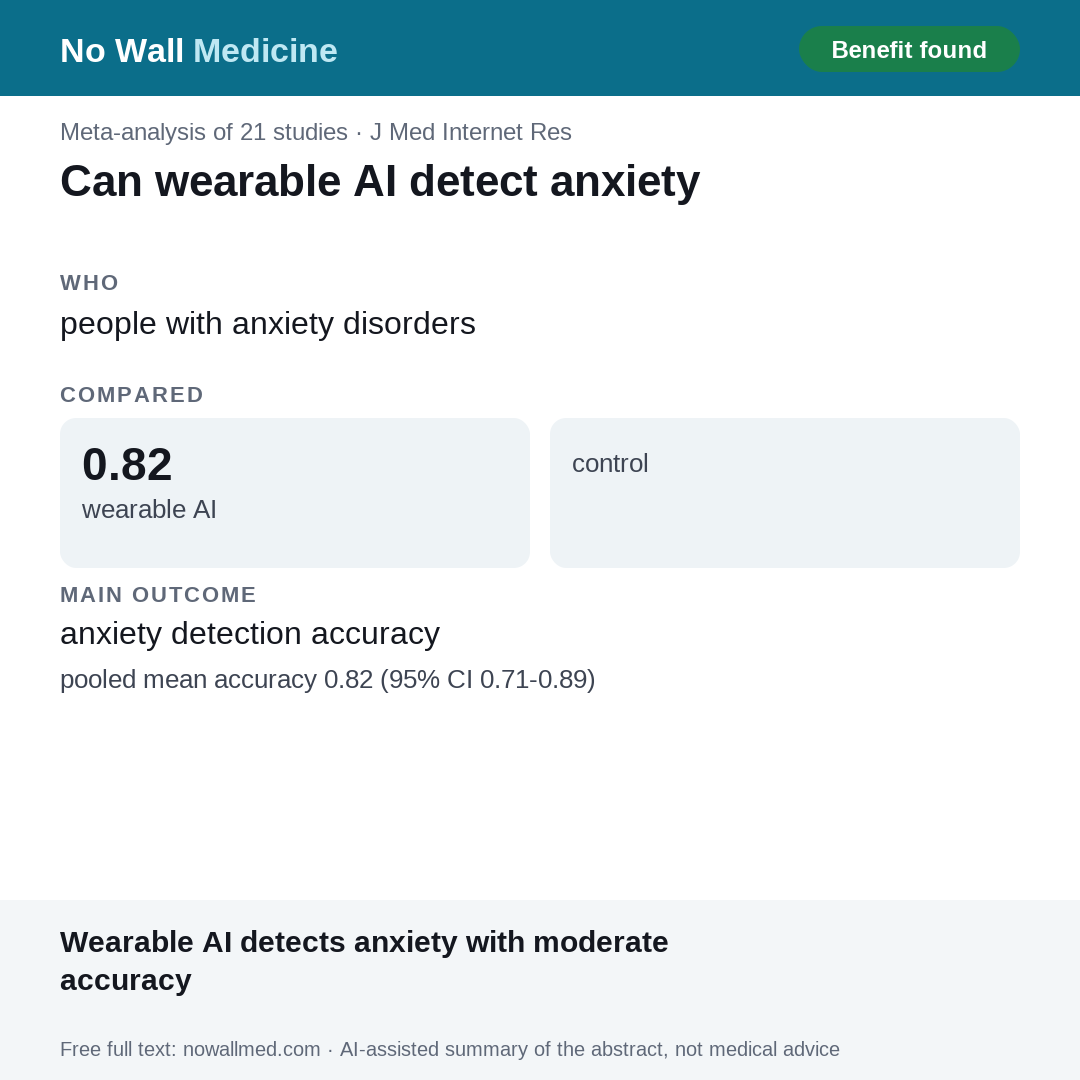
Wearable artificial intelligence showed a pooled mean accuracy of 0.82 for detecting anxiety
Wearable Artificial Intelligence for Detecting Anxiety: Systematic Review and Meta-Analysis
Meta-analysis of 21 studiesBenefit found
Can wearable AI detect anxiety
Who
people with anxiety disorders
Compared
0.82wearable AI (95% CI 0.71-0.89)
control
Main outcome
anxiety detection accuracy
Result: pooled mean accuracy 0.82 (95% CI 0.71-0.89)
Bottom line: Wearable AI detects anxiety with moderate accuracy
Limitation: not advanced enough for clinical use
J Med Internet Res · 2023-11-08Download image
Why it matters: Current anxiety assessments often rely on subjective self-reports or clinician interviews, creating a need for objective and early detection methods.
Key points
- Researchers conducted a systematic review and meta-analysis of 21 studies to assess how wearable artificial intelligence, which combines technology with wearable devices, performs in detecting anxiety.
- The meta-analysis of 17 studies showed a pooled mean accuracy of 0.82, a pooled mean sensitivity of 0.79, and a pooled mean specificity of 0.92.
- Subgroup analyses showed that performance was not moderated by the type of algorithm, wearable device, data type, or validation method used.
Headline and key points written with AI from the paper’s abstract, with every number checked against it. Read the paper before relying on them.
Topics
Cite this article
Abd-Alrazaq A, AlSaad R, Harfouche M, Aziz S, Ahmed A, Damseh R. Wearable Artificial Intelligence for Detecting Anxiety: Systematic Review and Meta-Analysis. J Med Internet Res. 2023. doi:10.2196/48754
Spotted a mistake? Suggest a correction
Top studies every Monday
The week’s key trials and guidelines in your specialties, plus any topics you follow. By email, free.
Get the weekly digest