Web-based sexual and reproductive health education shows moderate effects on adolescent knowledge and behavior
Web-based sexual and reproductive health education for adolescents aged 10-17 years: a systematic review and meta-analysis
Systematic review and meta-analysisBenefit found
Is web-based sexual and reproductive health education effective for adolescents aged 10-17 years?
Who
7876
Adolescents aged 10-17 years
Compared
Web-based sexual and reproductive health education
Control
Main outcome
Knowledge, attitudes, sexual behaviour, and self-efficacy
Result: knowledge SMD 0.59 (95% CI 0.60 to 0.94), attitudes SMD 0.16 (95% CI 0.11 to 0.22), sexual behaviour OR 0.75 (95% CI 0.60 to 0.94)
Bottom line: Web-based sexual and reproductive health education can enhance adolescents' knowledge, attitudes, and behaviour.
Limitation: Certainty of evidence limited by risk of bias, high heterogeneity, and use of only two databases.
BMJ Paediatr Open · 2025-10-31 · Save PNG
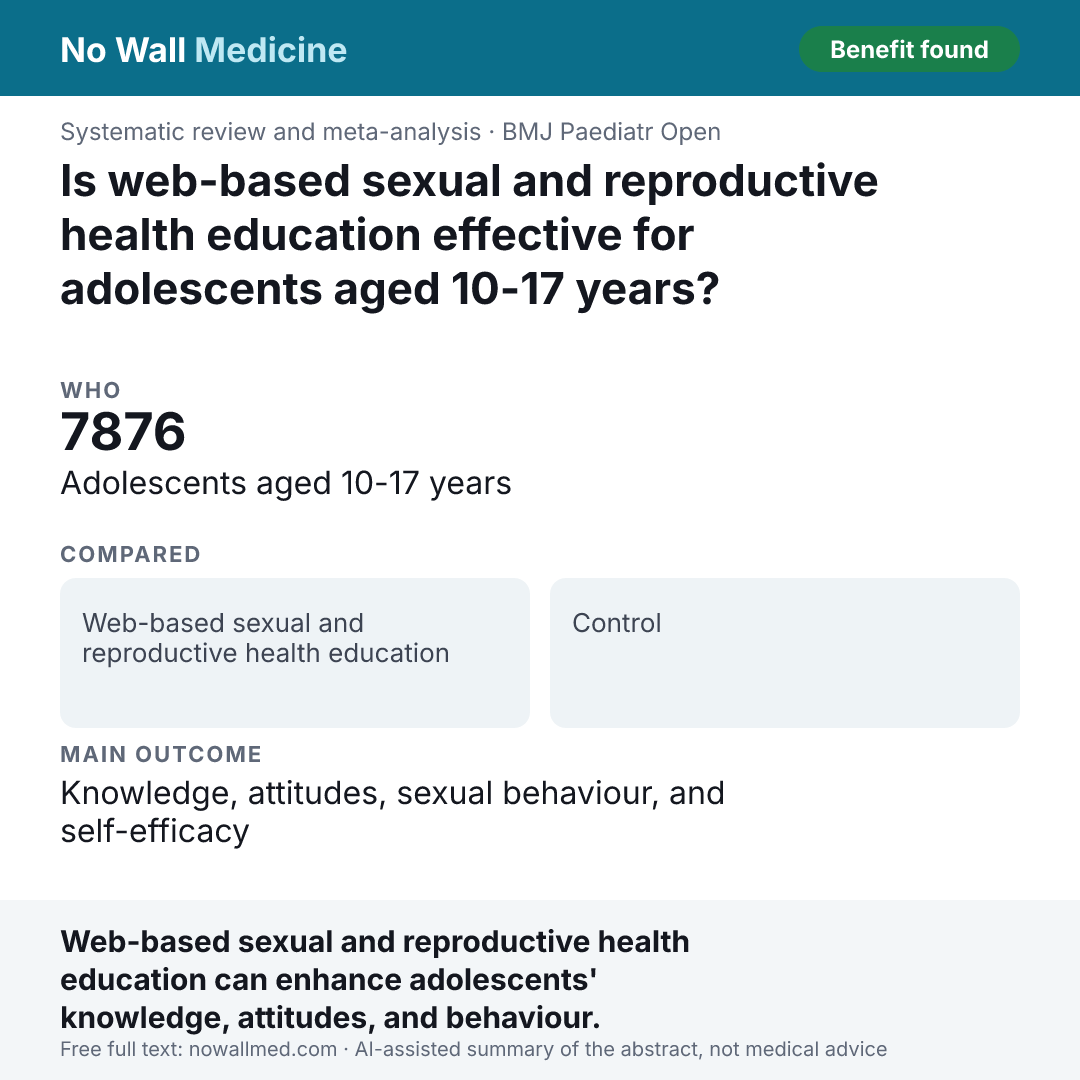
Clinical question: Is web-based sexual and reproductive health education effective for adolescents aged 10-17 years?
Why it matters: The effectiveness of web-based sexual and reproductive health education for adolescents aged 10-17 years had not been quantified in previous meta-analyses.
Key points
- Researchers analyzed 11 randomized controlled trials involving 7876 participants aged 10-17 years to evaluate web-based sexual and reproductive health education.
- The interventions showed a moderate effect on knowledge (SMD 0.59, 95% CI 0.60 to 0.94), a low effect on attitudes (SMD 0.16, 95% CI 0.11 to 0.22), and a moderate effect on sexual behavior (OR 0.75, 95% CI 0.60 to 0.94).
- The analysis found no significant effect on self-efficacy and could not reach a conclusion comparing web-based education to traditional face-to-face methods.
Limitation the authors note: The overall certainty of evidence is limited by risk of bias, high heterogeneity, and the use of only two databases.
Headline and key points written with AI from the paper’s abstract, with every number checked against it. Read the paper before relying on them.
Was this summary helpful?
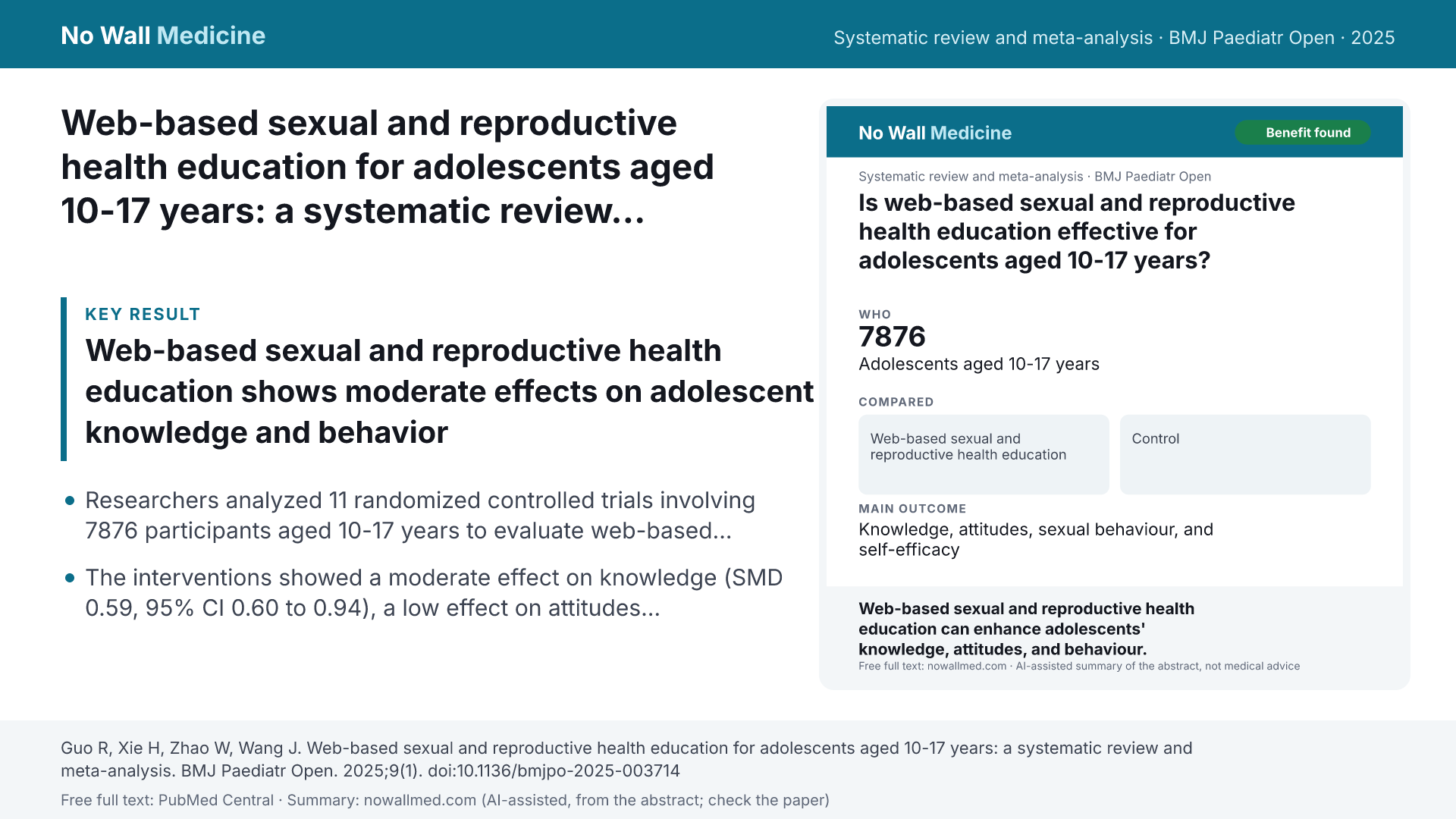
Abstract
Background
Sexual and reproductive health (SRH) education is crucial for adolescents aged 10-17 years, yet its effectiveness in this age group has not been quantified in prior meta-analyses. This study aims to address that gap. Objective
The objectives of this systematic review and meta-analysis were to (1) evaluate the effectiveness of web-based SRH education for adolescents aged 10-17 years and (2) explore potential factors influencing intervention effectiveness by synthesising study characteristics, including study design, theoretical foundation, implementation approach and follow-up duration. Data sources
We searched PubMed and Web of Science from database construction to October 2023. Eligibility criteria
This review included randomised controlled trials of web-based SRH education for adolescents aged 10-17 years. Study appraisal and synthesis methods
Data were extracted and examined by two researchers. The Cochrane risk-of-bias tool assessed the risk of bias. Analyses were divided into three groups, employing meta-analytic methodologies. Results
11 articles involving 7876 participants were analysed. This study revealed a moderate effect on knowledge (standardised mean difference (SMD) 0.59, 95% CI 0.60 to 0.94)), a low effect on attitudes (SMD 0.16, 95% CI 0.11 to 0.22) and a moderate effect on sexual behaviour (OR 0.75, 95% CI 0.60 to 0.94), with no significant effect on self-efficacy. Comparisons between web-based and traditional face-to-face SRH education were inconclusive due to limited studies and methodological heterogeneity. Limitations
The overall certainty of evidence is limited by risk of bias, high heterogeneity and the use of only two databases, which suggests that the findings should be interpreted with caution. Conclusions and implications of key findings
Web-based SRH education has potential in enhancing adolescents' knowledge, attitudes and behaviour. Future research must adhere to recognised reporting standards, thereby ensuring methodological consistency and enhancing the quality of evidence. Prospero registration number
CRD42023400504.
Abstract reproduced under the article’s CC BY NC licence.
Subject terms
Headline, design, result, key points, caveat and citation as plain text.
Cite this article
Guo R, Xie H, Zhao W, Wang J. Web-based sexual and reproductive health education for adolescents aged 10-17 years: a systematic review and meta-analysis. BMJ Paediatr Open. 2025;9(1). doi:10.1136/bmjpo-2025-003714
Spotted a mistake? Suggest a correction