Web-based sexual and reproductive health education for adolescents aged 10-17 years: a systematic review and meta-analysis
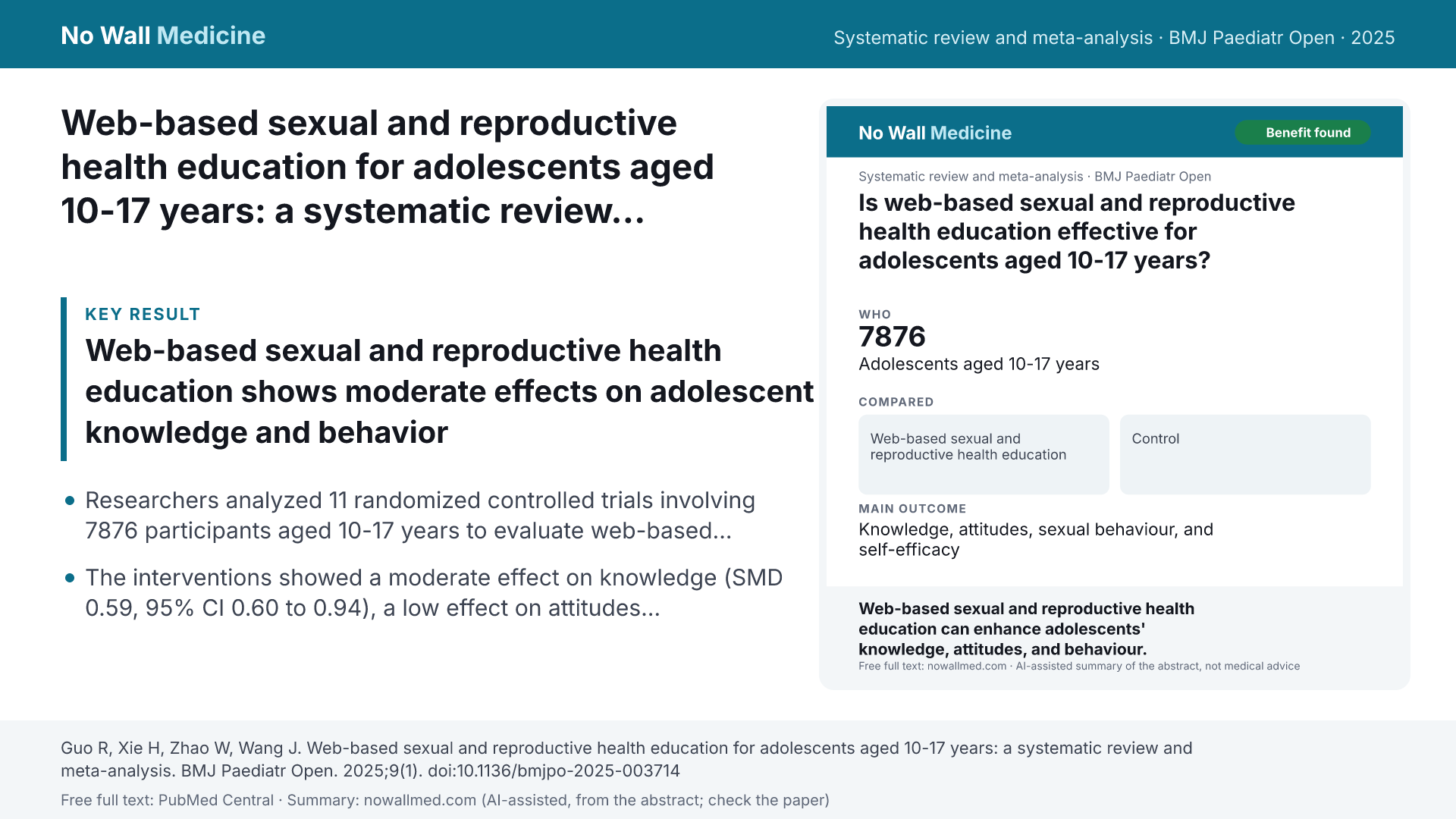
Key result: Web-based sexual and reproductive health education shows moderate effects on adolescent knowledge and behavior
Key points
- Researchers analyzed 11 randomized controlled trials involving 7876 participants aged 10-17 years to evaluate web-based sexual and reproductive health education.
- The interventions showed a moderate effect on knowledge (SMD 0.59, 95% CI 0.60 to 0.94), a low effect on attitudes (SMD 0.16, 95% CI 0.11 to 0.22), and a moderate effect on sexual behavior (OR 0.75, 95% CI 0.60 to 0.94).
- The analysis found no significant effect on self-efficacy and could not reach a conclusion comparing web-based education to traditional face-to-face methods.
Why it matters: The effectiveness of web-based sexual and reproductive health education for adolescents aged 10-17 years had not been quantified in previous meta-analyses.
Limitation the authors note: The overall certainty of evidence is limited by risk of bias, high heterogeneity, and the use of only two databases.
Discussion prompts
- Would these patients look like yours? Who was left out?
- Is the main outcome one that matters to patients?
- Is the difference large enough to change what you do?
Cite: Guo R, Xie H, Zhao W, Wang J. Web-based sexual and reproductive health education for adolescents aged 10-17 years: a systematic review and meta-analysis. BMJ Paediatr Open. 2025;9(1). doi:10.1136/bmjpo-2025-003714
Free full text: PubMed Central · Summary and visual abstract: nowallmed.com/a/web-based-sexual-and-reproductive-health-education-for-adolescents-mpa0pm/ (AI-assisted from the abstract; check the paper before relying on it).