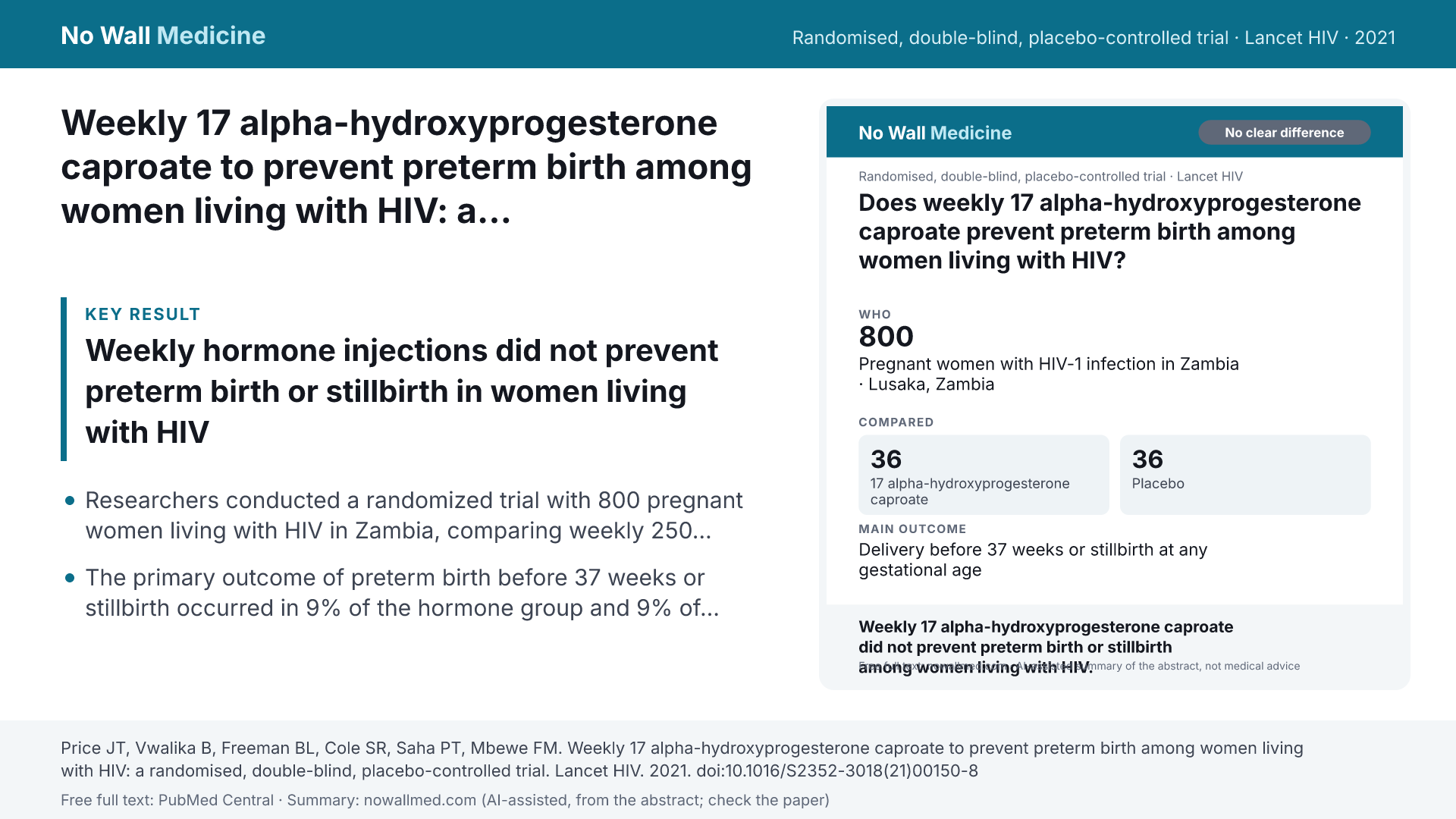
Weekly hormone injections did not prevent preterm birth or stillbirth in women living with HIV
Weekly 17 alpha-hydroxyprogesterone caproate to prevent preterm birth among women living with HIV: a randomised, double-blind, placebo-controlled trial
Randomised, double-blind, placebo-controlled trialNo clear difference
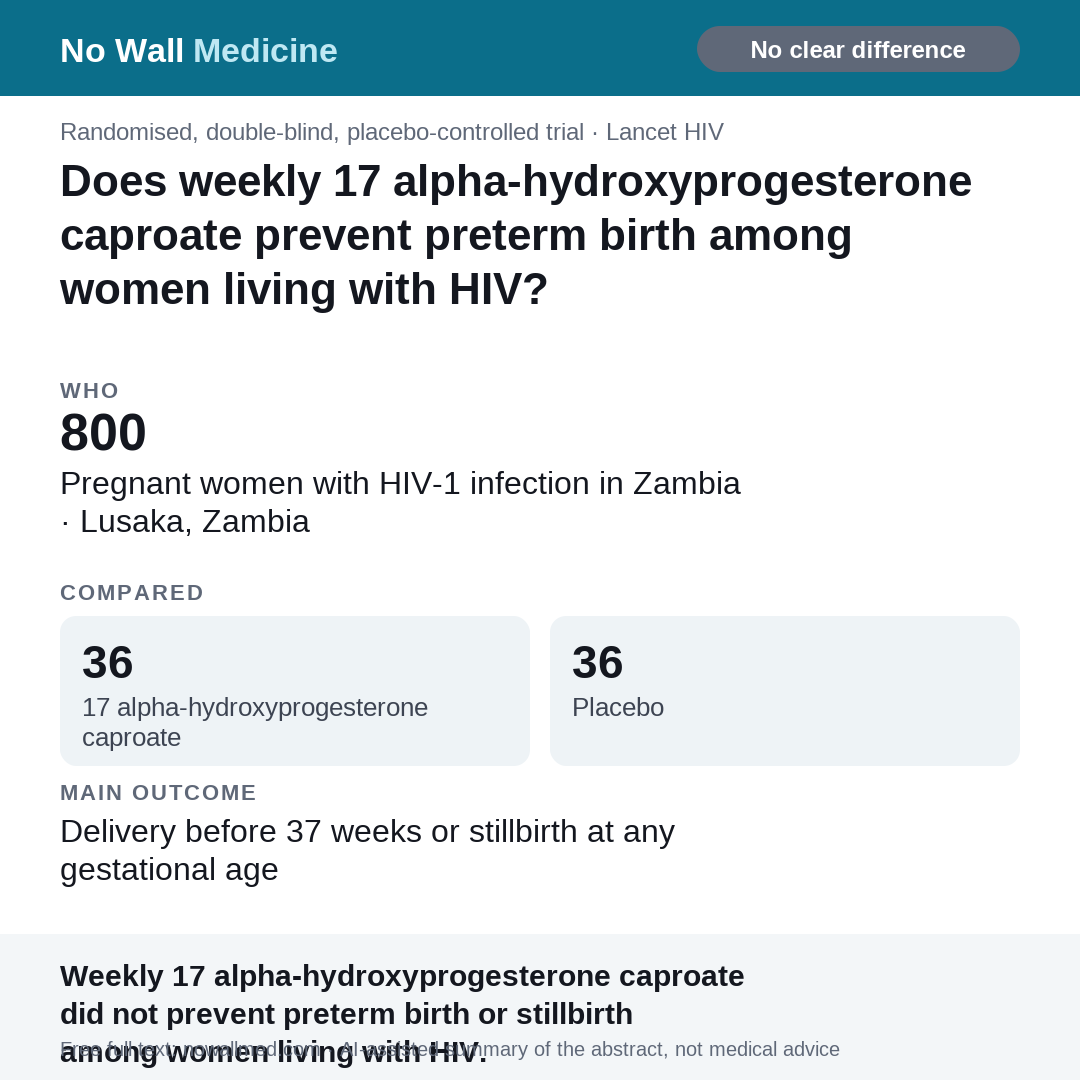
Does weekly 17 alpha-hydroxyprogesterone caproate prevent preterm birth among women living with HIV?
Who
800
Pregnant women with HIV-1 infection in Zambia · Lusaka, Zambia
Compared
3617 alpha-hydroxyprogesterone caproate (9%)
36Placebo (9%)
Main outcome
Delivery before 37 weeks or stillbirth at any gestational age
Result: risk difference 0·1, 95% CI -3·9 to 4·0
Bottom line: Weekly 17 alpha-hydroxyprogesterone caproate did not prevent preterm birth or stillbirth among women living with HIV.
Funded by: US National Institutes of Health and Bill and Melinda Gates Foundation
Lancet HIV · 2021-09-09Download image
Clinical question: Does weekly 17 alpha-hydroxyprogesterone caproate prevent preterm birth among women living with HIV?
Why it matters: It was unknown if 17 alpha-hydroxyprogesterone caproate could prevent preterm birth in women whose risk is specifically linked to HIV infection.
Key points
- Researchers conducted a randomized trial with 800 pregnant women living with HIV in Zambia, comparing weekly 250 mg injections of 17 alpha-hydroxyprogesterone caproate to a placebo.
- The primary outcome of preterm birth before 37 weeks or stillbirth occurred in 9% of the hormone group and 9% of the placebo group.
- Adverse events related to the intervention were reported by 18% of all participants, with no serious adverse events reported in either group.
Headline and key points written with AI from the paper’s abstract, with every number checked against it. Read the paper before relying on them.
Was this summary helpful?
Abstract
Background
Women with HIV face an increased risk of preterm birth. 17 alpha-hydroxyprogesterone caproate (17P) has been shown in some trials to reduce early delivery among women with a history of spontaneous preterm birth. We investigated whether 17P would reduce this risk among women with HIV. Methods
We did a randomised, double-blind, placebo-controlled trial in pregnant women with HIV at the University Teaching Hospital and Kamwala District Health Centre in Lusaka, Zambia. Eligible patients were women aged 18 years or older with confirmed HIV-1 infection, viable intrauterine singleton pregnancy at less than 24 weeks of gestation, and were receiving or intending to commence antiretroviral therapy during pregnancy. Exclusion criteria were major uterine or fetal anomaly; planned or in situ cervical cerclage; evidence of threatened miscarriage, preterm labour, or ruptured membranes at screening; medical contraindication to 17P; previous participation in the trial; or history of spontaneous preterm birth. Eligible participants provided written informed consent and were randomly assigned (1:1) to receive 250 mg intramuscular 17P or placebo once per week, starting between 16 and 24 weeks of gestation until delivery, stillbirth, or reaching term (37 weeks). Participants and study staff were masked to assignment, except for pharmacy staff who did random assignment and prepared injections but did not interact with participants. The primary outcome was a composite of delivery before 37 weeks or stillbirth at any gestational age. Patients attended weekly visits for study drug injections and antenatal care. We estimated the absolute and relative difference in risk of the primary outcome and safety events between treatment groups by intention to treat. This trial is registered with ClinicalTrials.gov, NCT03297216, and is complete. Findings
Between Feb 7, 2018 and Jan 13, 2020, we assessed 1042 women for inclusion into the study. 242 women were excluded after additional assessments, and 800 eligible patients were enrolled and randomly assigned to receive intramuscular 17P (n=399) or placebo (n=401). Baseline characteristics were similar between groups. Adherence to study drug injections was 98% in both groups, no patients were lost to follow-up, and the final post-partum visit was on Aug 6, 2020. 36 (9%) of 399 participants assigned to 17P had preterm birth or stillbirth, compared with 36 (9%) of 401 patients assigned to placebo (risk difference 0·1, 95% CI -3·9 to 4·0; relative risk 1·0, 95% CI 0·6 to 1·6; p=0·98). Intervention-related adverse events were reported by 140 (18%) of 800 participants and occurred in similar proportions in both randomisation groups. No serious adverse events were reported. Interpretation
Although 17P seems to be safe and acceptable to participants, available data do not support the use of the drug to prevent preterm birth among women whose risk derives solely from HIV infection. The low risk of preterm birth in both randomisation groups warrants further investigation. Funding
US National Institutes of Health and the Bill and Melinda Gates Foundation.
Abstract reproduced under the article’s CC BY licence.
Subject terms
Cite this article
Price JT, Vwalika B, Freeman BL, Cole SR, Saha PT, Mbewe FM. Weekly 17 alpha-hydroxyprogesterone caproate to prevent preterm birth among women living with HIV: a randomised, double-blind, placebo-controlled trial. Lancet HIV. 2021. doi:10.1016/S2352-3018(21)00150-8
Spotted a mistake? Suggest a correction
Top studies every Monday
The week’s key trials and guidelines in your specialties, plus any topics you follow. By email, free.
Get the weekly digest