Weight change among women using intramuscular depot medroxyprogesterone acetate, a copper intrauterine device, or a levonorgestrel implant for contraception: Findings from a randomised, multicentre, open-label trial
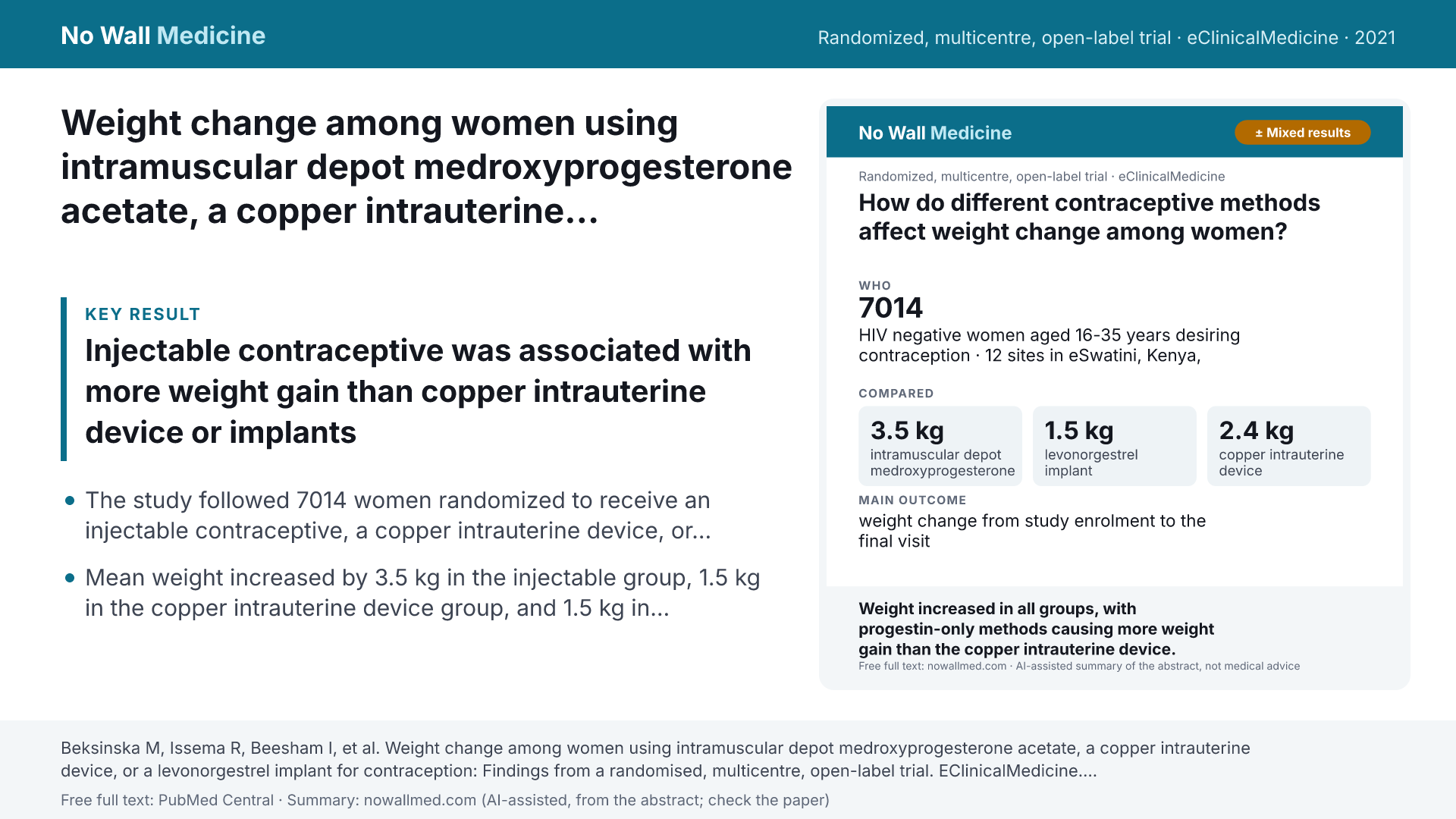
Key result: Injectable contraceptive was associated with more weight gain than copper intrauterine device or implants
Secondary analysis of a trialMixed results
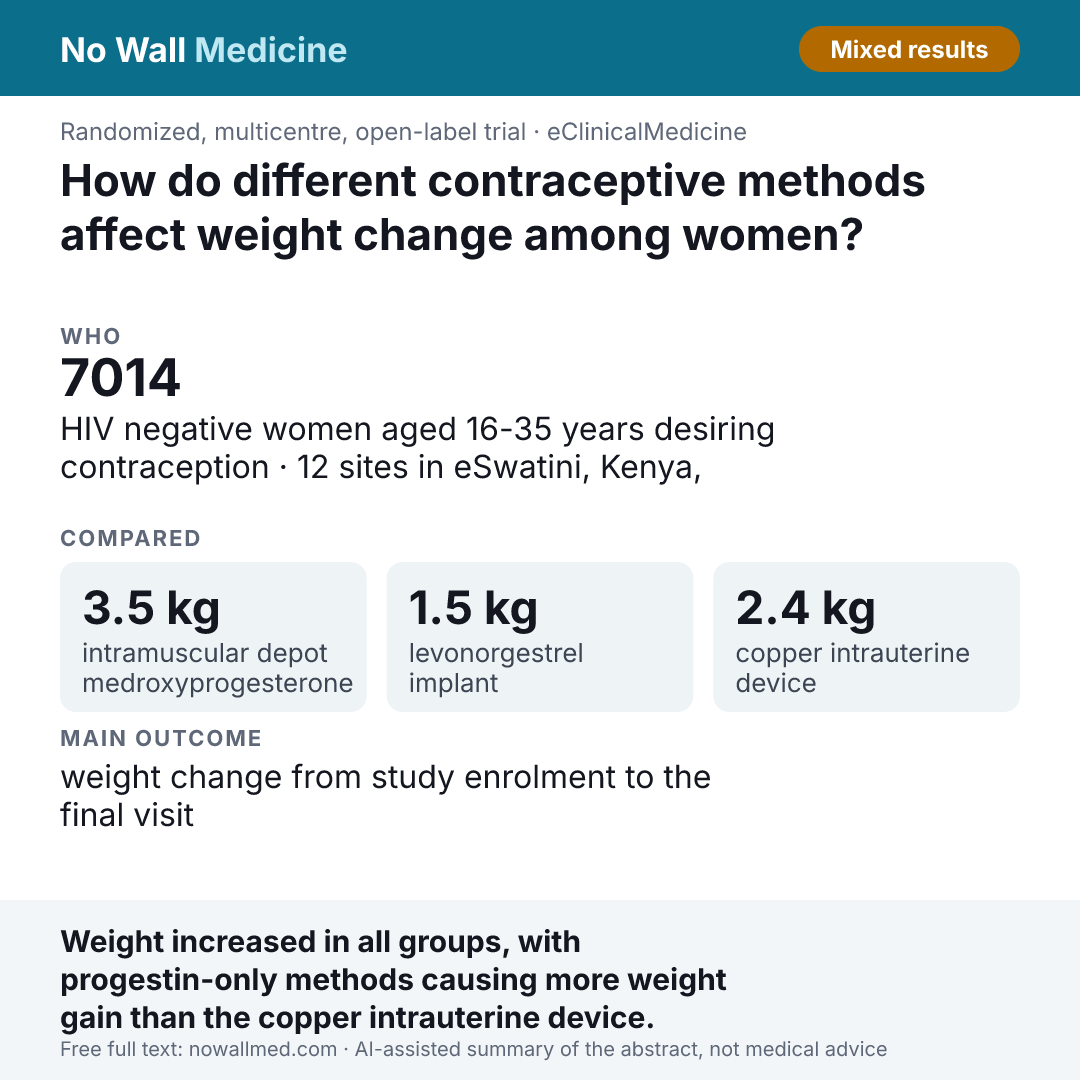
How do different contraceptive methods affect weight change among women?
Who
7014
HIV negative women aged 16-35 years desiring contraception · 12 sites in eSwatini, Kenya, South Africa and Zambia
Compared
3.5 kgintramuscular depot medroxyprogesterone acetate (SD = 6.3)
1.5 kglevonorgestrel implant (SD = 5.7)
2.4 kgcopper intrauterine device (SD = 5.9)
Main outcome
weight change from study enrolment to the final visit
Result: 2.02 kg (95% CI, 1.68, 2.36) for DMPA-IM versus copper IUD
Bottom line: Weight increased in all groups, with progestin-only methods causing more weight gain than the copper intrauterine device.
eClinicalMedicine · 2021-04-06 · Save PNG
Key points
- The study followed 7014 women randomized to receive an injectable contraceptive, a copper intrauterine device, or a hormone-releasing implant.
- Mean weight increased by 3.5 kg in the injectable group, 1.5 kg in the copper intrauterine device group, and 1.5 kg in the implant group.
- The injectable group showed a 2.02 kg greater weight increase compared to the copper intrauterine device group.
Discussion prompts
- Would these patients look like yours? Who was left out?
- Is the main outcome one that matters to patients?
- Is the difference large enough to change what you do?
Cite: Beksinska M, Issema R, Beesham I, et al. Weight change among women using intramuscular depot medroxyprogesterone acetate, a copper intrauterine device, or a levonorgestrel implant for contraception: Findings from a randomised, multicentre, open-label trial. EClinicalMedicine. 2021;34:100800. doi:10.1016/j.eclinm.2021.100800
Free full text: PubMed Central · Summary and visual abstract: nowallmed.com/a/weight-change-among-women-using-intramuscular-depot-1kbmucn/ (AI-assisted from the abstract; check the paper before relying on it).