Meta-analysis shows mild attentional bias toward sensory pain information in people with chronic pain
What can we learn about selective attention processes in individuals with chronic pain using reaction time tasks? A systematic review and meta-analysis
Systematic review and random-effects meta-analysisBenefit found
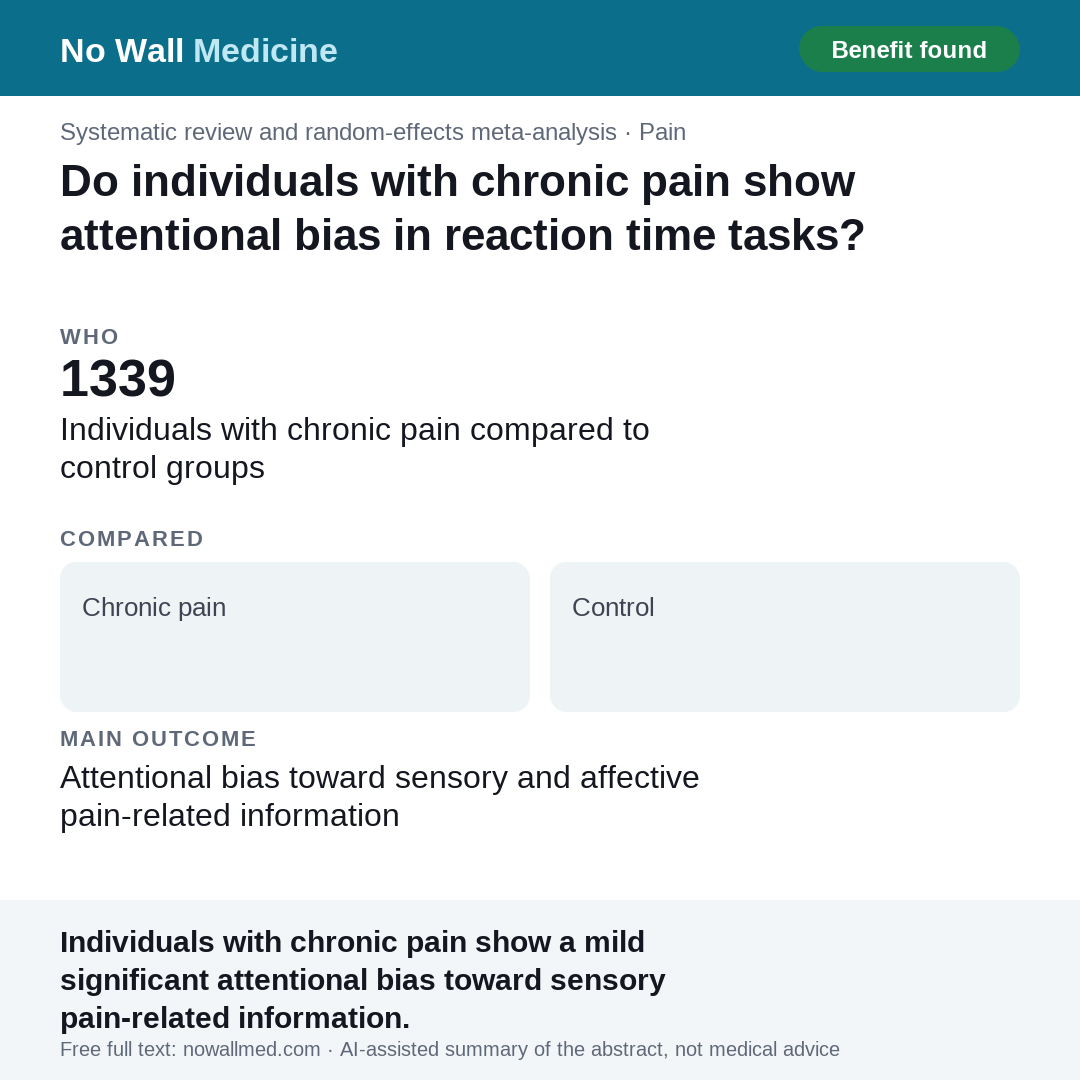
Do individuals with chronic pain show attentional bias in reaction time tasks?
Who
1339
Individuals with chronic pain compared to control groups
Compared
Chronic pain
Control
Main outcome
Attentional bias toward sensory and affective pain-related information
Result: sensory g = 0.28 (95% CI [0.16, 0.39])
Bottom line: Individuals with chronic pain show a mild significant attentional bias toward sensory pain-related information.
Limitation: Variation across studies did not allow for a decisive conclusion about stimulus or task type.
Pain · 2023-04-12Download image
Clinical question: Do individuals with chronic pain show attentional bias in reaction time tasks?
Why it matters: The specific selective attentional processes that underpin attentional bias in individuals with chronic pain are not always well outlined in existing literature.
Key points
- Researchers analyzed 34 studies involving 3154 participants and a meta-analysis subset of 15 studies with 1339 participants.
- The meta-analysis found a mild significant attentional bias toward sensory pain-related information (g = 0.28, 95% CI [0.16, 0.39], P = 0.038).
- Preliminary evidence showed a moderate bias toward affective pain-related information (g = 0.48, 95% CI [0.23, 0.72], P = 0.341).
Limitation the authors note: Variation across studies did not allow for a decisive conclusion about the role of stimulus, task type, or related attentional processes.
Headline and key points written with AI from the paper’s abstract, with every number checked against it. Read the paper before relying on them.
Topics
Cite this article
Abudoush AN, Noureen A, Panagioti M, Poliakoff E, Van Ryckeghem DML, Hodkinson A. What can we learn about selective attention processes in individuals with chronic pain using reaction time tasks? A systematic review and meta-analysis. Pain. 2023. doi:10.1097/j.pain.0000000000002885
Spotted a mistake? Suggest a correction
Top studies every Monday
The week’s key trials and guidelines in your specialties, plus any topics you follow. By email, free.
Get the weekly digest