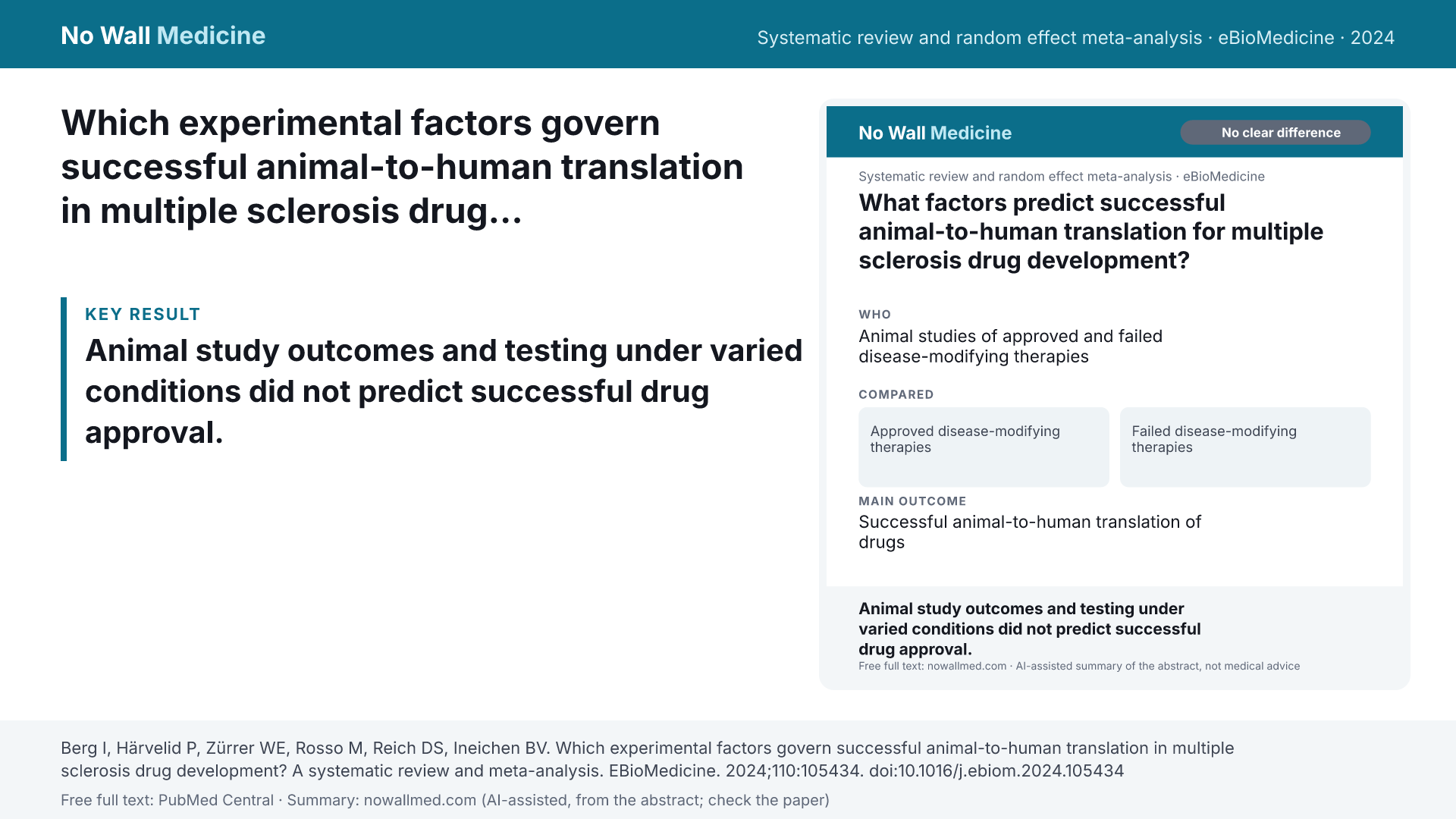
Which experimental factors govern successful animal-to-human translation in multiple sclerosis drug development? A systematic review and meta-analysis
Systematic review and random effect meta-analysisNo clear difference
What factors predict successful animal-to-human translation for multiple sclerosis drug development?
Who
Animal studies of approved and failed disease-modifying therapies
Compared
Approved disease-modifying therapies
Failed disease-modifying therapies
Main outcome
Successful animal-to-human translation of drugs
Bottom line: Animal study outcomes and testing under varied conditions did not predict successful drug approval.
Limitation: Limited experimental methods in animal research and disconnect between preclinical and clinical research.
Funded by: NIH, Swiss National Science Foundation, Universities Federation for Animal Welfare
eBioMedicine · 2024-11-07Download image
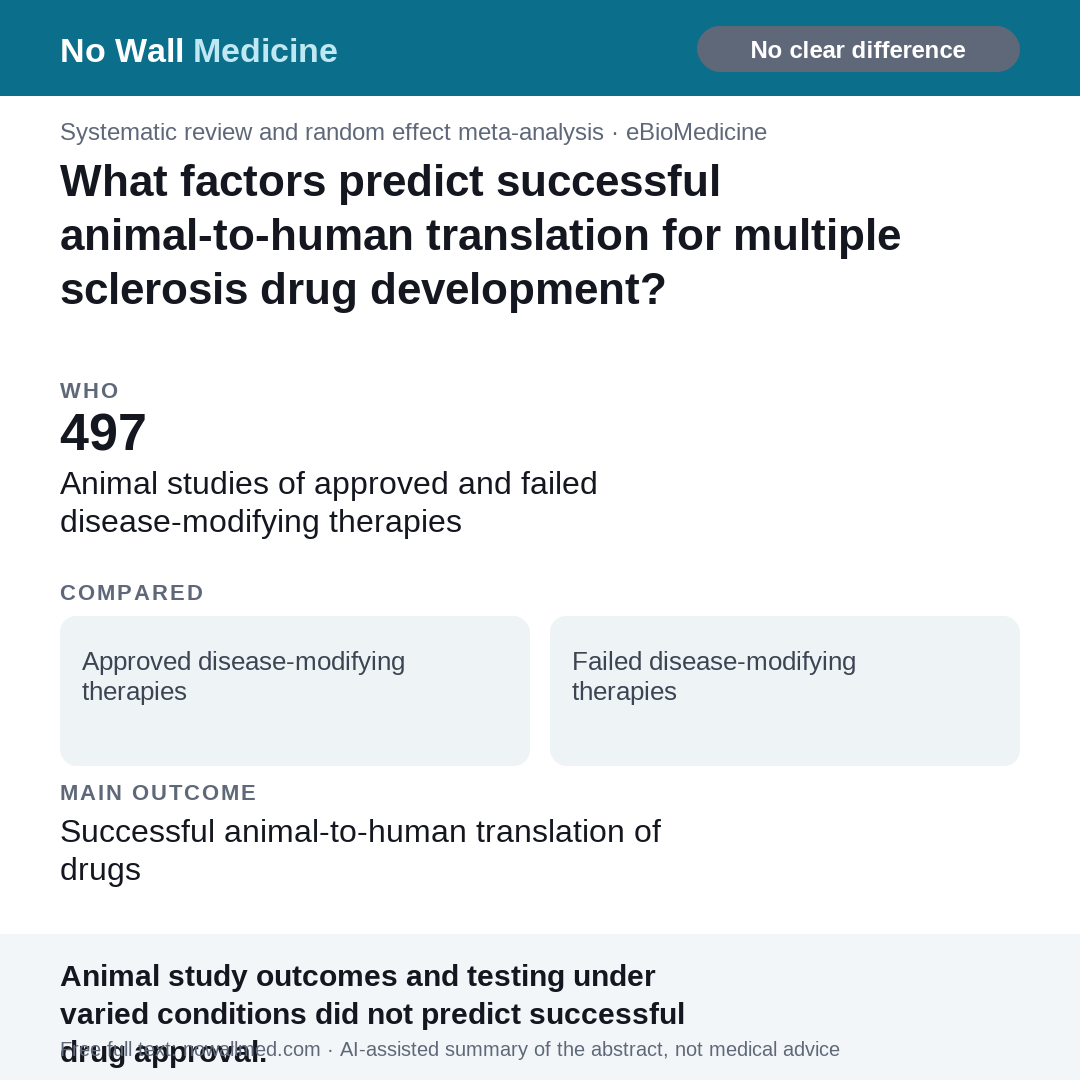
Clinical question: What factors predict successful animal-to-human translation for multiple sclerosis drug development?
Abstract
Background
Despite successes in multiple sclerosis (MS) drug development, the effectiveness of animal studies in predicting successful bench-to-bedside translation is uncertain. Our goal was to identify predictors of successful animal-to-human translation for MS by systematically comparing animal studies of approved disease-modifying therapies (DMTs) with those that failed in clinical trials due to efficacy or safety concerns. Methods
Systematic review of animal studies testing MS DMTs, identified from searches in PubMed and EMBASE. A random effect meta-analysis was fitted to the data to compare outcome effect sizes for approved versus failed DMTs. Effect sizes and testing under diverse experimental conditions were assessed as potential predictors for successful translation. Findings
We included 497 animal studies, covering 15 approved and 11 failed DMTs, tested in approximately 30'000 animals. DMTs were tested in a small repertoire of experimental parameters: about 86% of studies used experimental autoimmune encephalomyelitis (EAE), 80% used mice, and 76% used female animals. There was no association between animal study outcomes or testing DMTs under varied conditions (e.g., different laboratories or models) and successful approval. Surprisingly, 91% of animal studies were published after first-in-MS trial and 91% after official regulatory approval. Interpretation
Our findings emphasize the complexity in carrying drugs from animals to clinical practice. Specific challenges include limited experimental methods in animal research and a disconnect between preclinical and clinical research. We advocate for efforts to streamline drug development for MS to improve animal research's relevance for patients. Funding
NIH, Swiss National Science Foundation, Universities Federation for Animal Welfare.
Subject terms
Cite this article
Berg I, Härvelid P, Zürrer WE, Rosso M, Reich DS, Ineichen BV. Which experimental factors govern successful animal-to-human translation in multiple sclerosis drug development? A systematic review and meta-analysis. eBioMedicine. 2024. doi:10.1016/j.ebiom.2024.105434
Spotted a mistake? Suggest a correction