White Matter Hyperintensities as a Predictor of Aphasia Recovery
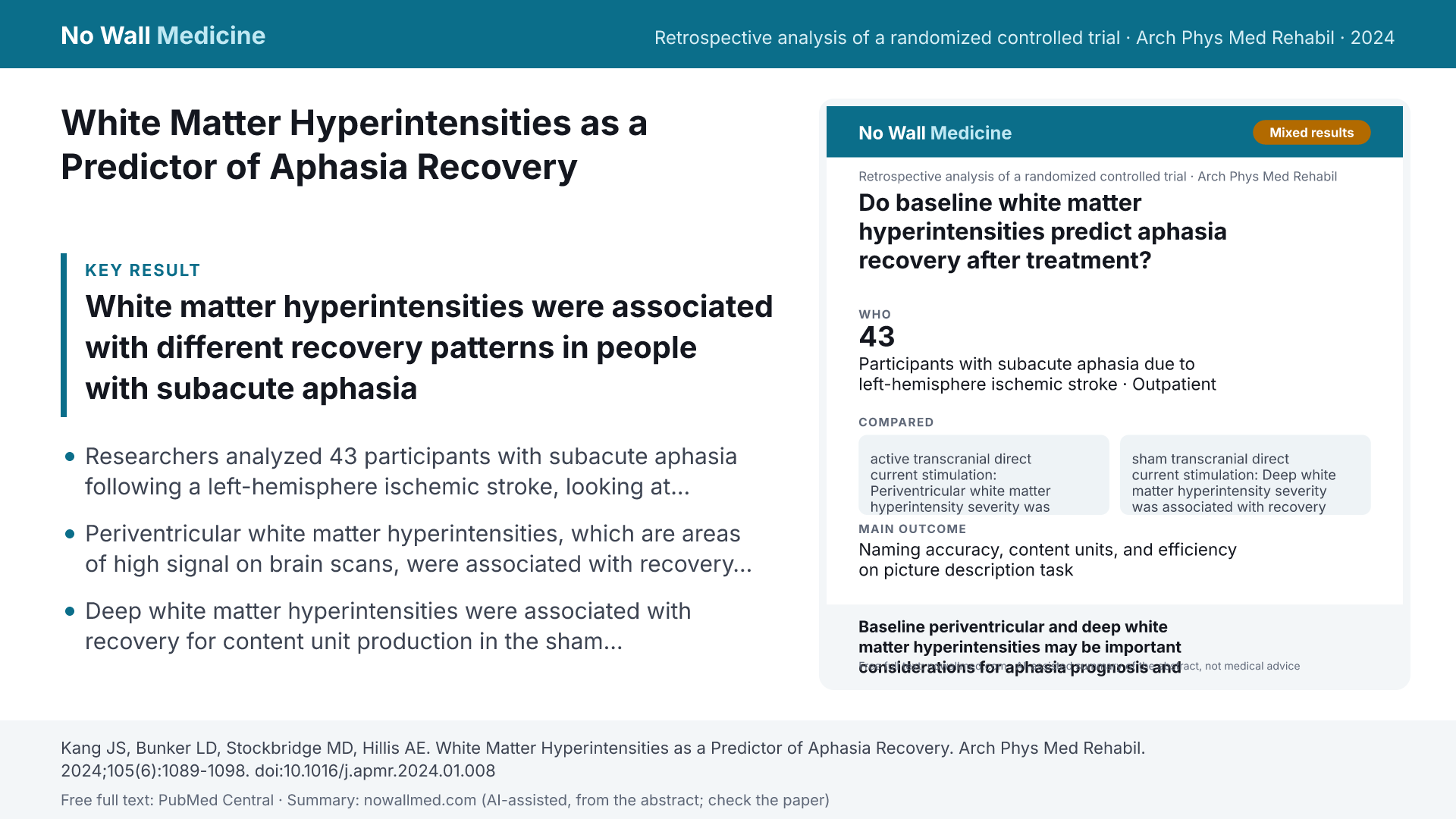
Key result: White matter hyperintensities were associated with different recovery patterns in people with subacute aphasia
Retrospective analysis of a randomized controlled trialMixed results
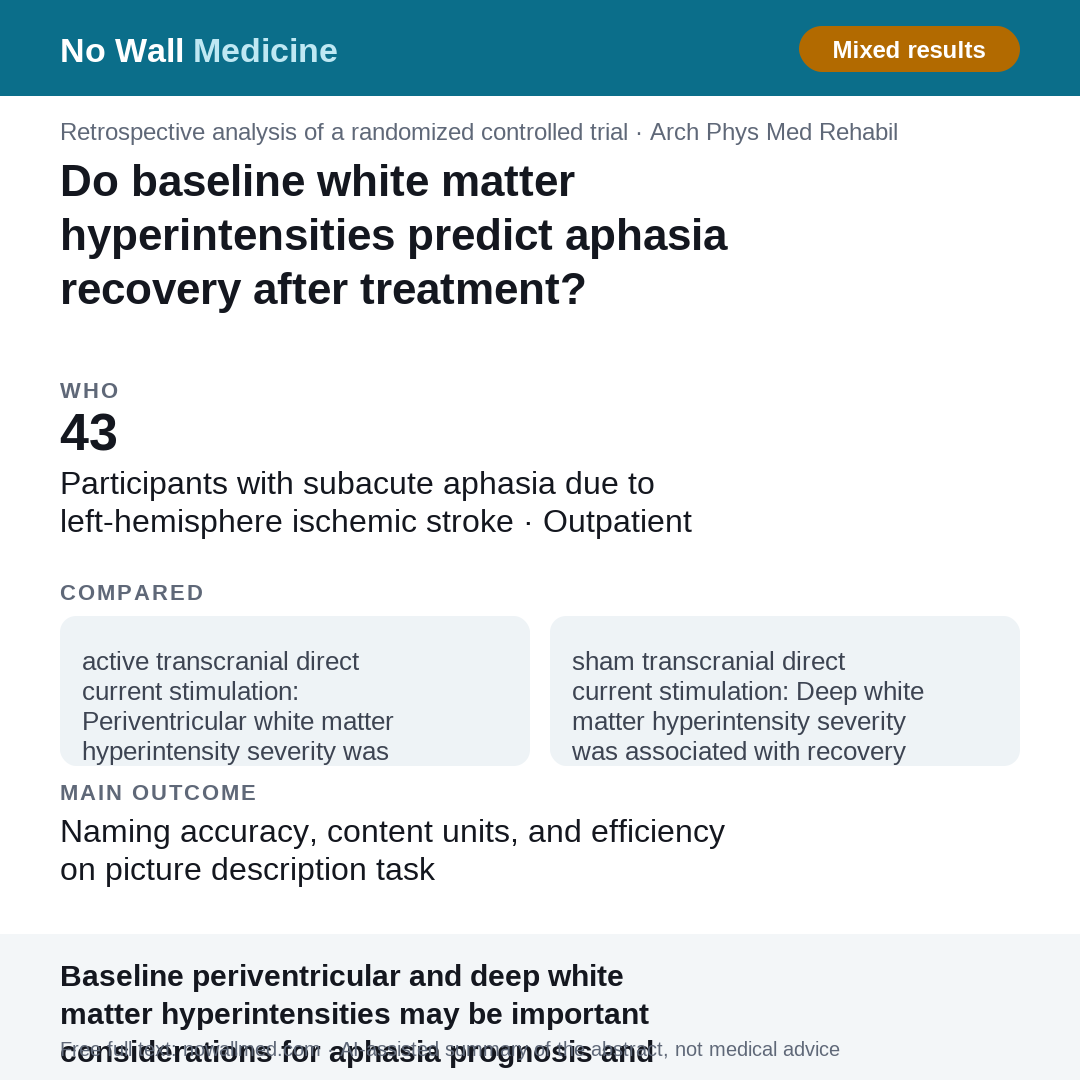
Do baseline white matter hyperintensities predict aphasia recovery after treatment?
Who
43
Participants with subacute aphasia due to left-hemisphere ischemic stroke · Outpatient clinical setting or participant home
Compared
active transcranial direct current stimulation: Periventricular white matter hyperintensity severity was independently associated with recovery in picture naming
sham transcranial direct current stimulation: Deep white matter hyperintensity severity was associated with recovery for content units production
Main outcome
Naming accuracy, content units, and efficiency on picture description task
Bottom line: Baseline periventricular and deep white matter hyperintensities may be important considerations for aphasia prognosis and treatment planning.
Arch Phys Med Rehabil · 2024-01-26Download image
Key points
- Researchers analyzed 43 participants with subacute aphasia following a left-hemisphere ischemic stroke, looking at how brain imaging related to language recovery.
- Periventricular white matter hyperintensities, which are areas of high signal on brain scans, were associated with recovery in picture naming for the active transcranial direct current stimulation group.
- Deep white matter hyperintensities were associated with recovery for content unit production in the sham transcranial direct current stimulation group.
Limitation the authors note: The study was a retrospective analysis of a cohort from a randomized controlled trial.
Discussion prompts
- Would these patients look like yours? Who was left out?
- Is the main outcome one that matters to patients?
- Is the difference large enough to change what you do?
Cite: Kang JS, Bunker LD, Stockbridge MD, Hillis AE. White Matter Hyperintensities as a Predictor of Aphasia Recovery. Arch Phys Med Rehabil. 2024. doi:10.1016/j.apmr.2024.01.008
Free full text: PubMed Central · Summary and visual abstract: nowallmed.com/a/white-matter-hyperintensities-as-a-predictor-of-aphasia-hbqjyi/ (AI-assisted from the abstract; check the paper before relying on it).