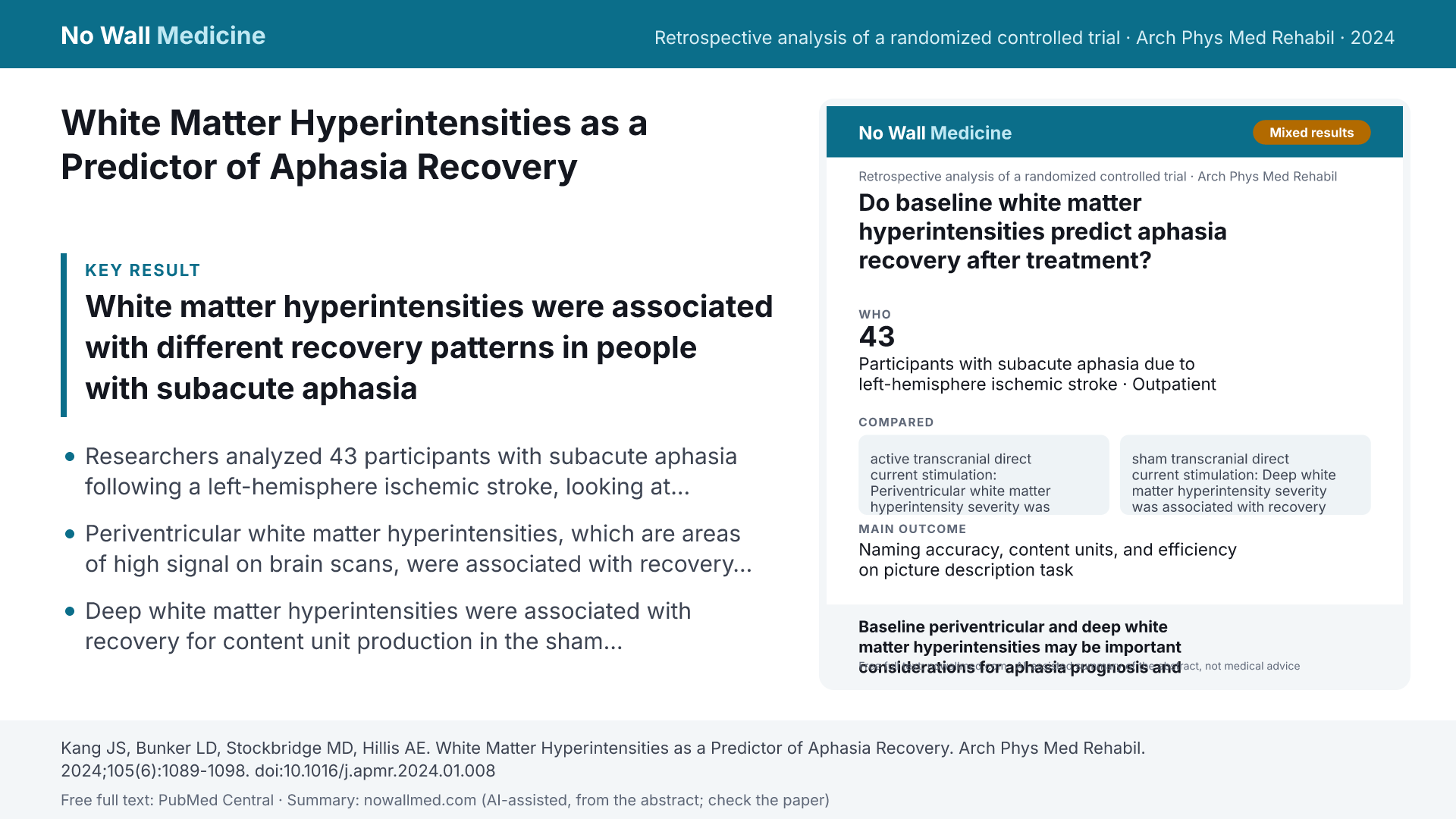
White matter hyperintensities were associated with different recovery patterns in people with subacute aphasia
White Matter Hyperintensities as a Predictor of Aphasia Recovery
Retrospective analysis of a randomized controlled trialMixed results
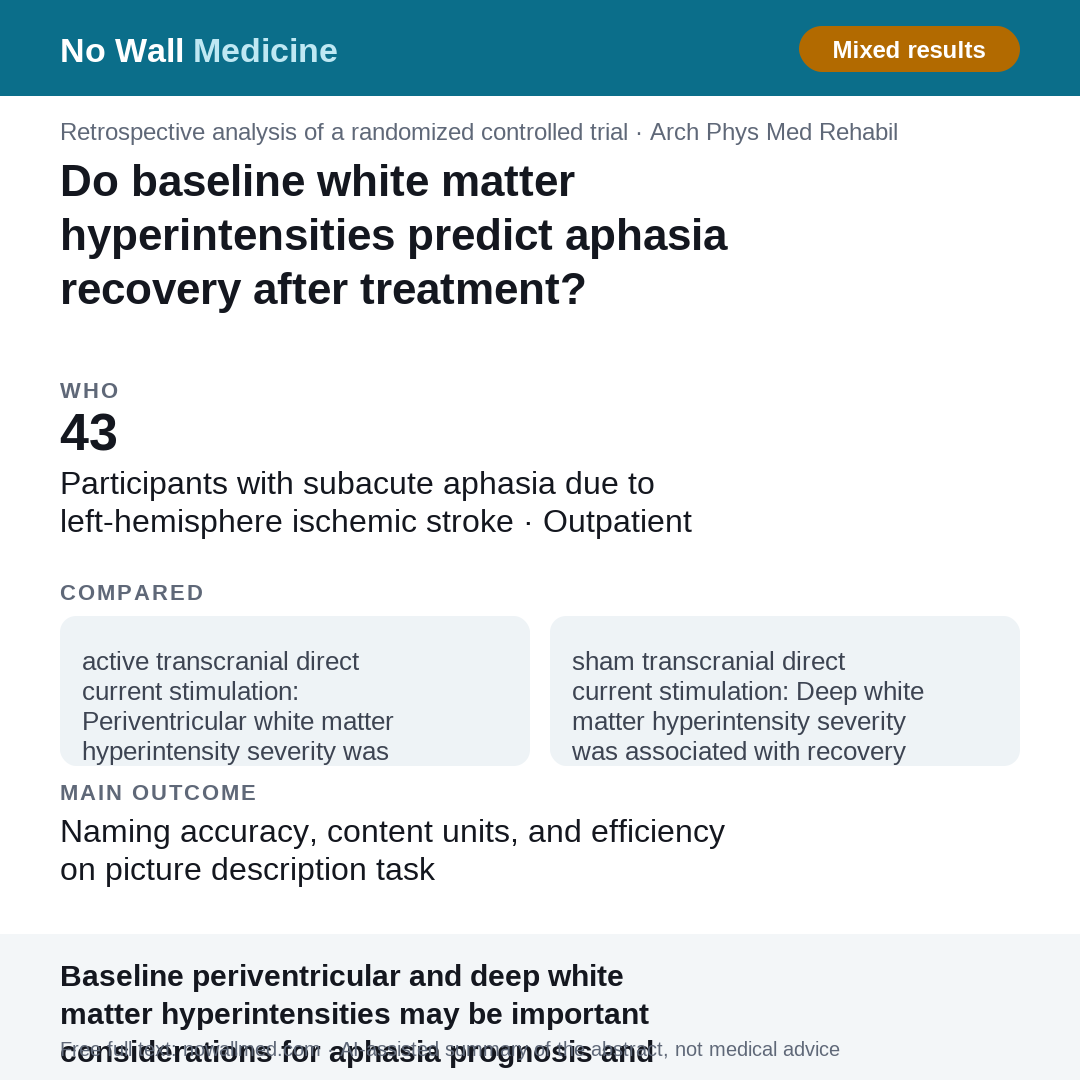
Do baseline white matter hyperintensities predict aphasia recovery after treatment?
Who
43
Participants with subacute aphasia due to left-hemisphere ischemic stroke · Outpatient clinical setting or participant home
Compared
active transcranial direct current stimulation: Periventricular white matter hyperintensity severity was independently associated with recovery in picture naming
sham transcranial direct current stimulation: Deep white matter hyperintensity severity was associated with recovery for content units production
Main outcome
Naming accuracy, content units, and efficiency on picture description task
Bottom line: Baseline periventricular and deep white matter hyperintensities may be important considerations for aphasia prognosis and treatment planning.
Arch Phys Med Rehabil · 2024-01-26Download image
Clinical question: Do baseline white matter hyperintensities predict aphasia recovery after treatment?
Why it matters: It was unknown if the severity of white matter hyperintensities, or areas of brain tissue damage, could predict how well patients recover language skills after a stroke.
Key points
- Researchers analyzed 43 participants with subacute aphasia following a left-hemisphere ischemic stroke, looking at how brain imaging related to language recovery.
- Periventricular white matter hyperintensities, which are areas of high signal on brain scans, were associated with recovery in picture naming for the active transcranial direct current stimulation group.
- Deep white matter hyperintensities were associated with recovery for content unit production in the sham transcranial direct current stimulation group.
Limitation the authors note: The study was a retrospective analysis of a cohort from a randomized controlled trial.
Headline and key points written with AI from the paper’s abstract, with every number checked against it. Read the paper before relying on them.
Was this summary helpful?
Subject terms
Cite this article
Kang JS, Bunker LD, Stockbridge MD, Hillis AE. White Matter Hyperintensities as a Predictor of Aphasia Recovery. Arch Phys Med Rehabil. 2024. doi:10.1016/j.apmr.2024.01.008
Spotted a mistake? Suggest a correction
Top studies every Monday
The week’s key trials and guidelines in your specialties, plus any topics you follow. By email, free.
Get the weekly digest