Women's leadership development programmes and gender equality: a systematic review in healthcare, academia and beyond
Systematic review without meta-analysisUnclear result
Do women's leadership development programmes lead to measurable organisational change?
Who
57
Adult professionals in formal organisational roles · 23 countries
Compared
Women's leadership development programmes: self-reported improvements in confidence, knowledge, leadership capability, and behaviour
Organisational outcomes: promotion or retention indicators
Main outcome
Individual and organisational outcomes
Bottom line: Programmes support individual development, but evidence cannot establish whether they lead to organisational transformation.
Limitation: None of the included studies used randomisation and subjective measures predominated.
Funded by: Australian National Health and Medical Research Council
eClinicalMedicine · 2026-09-01Download image
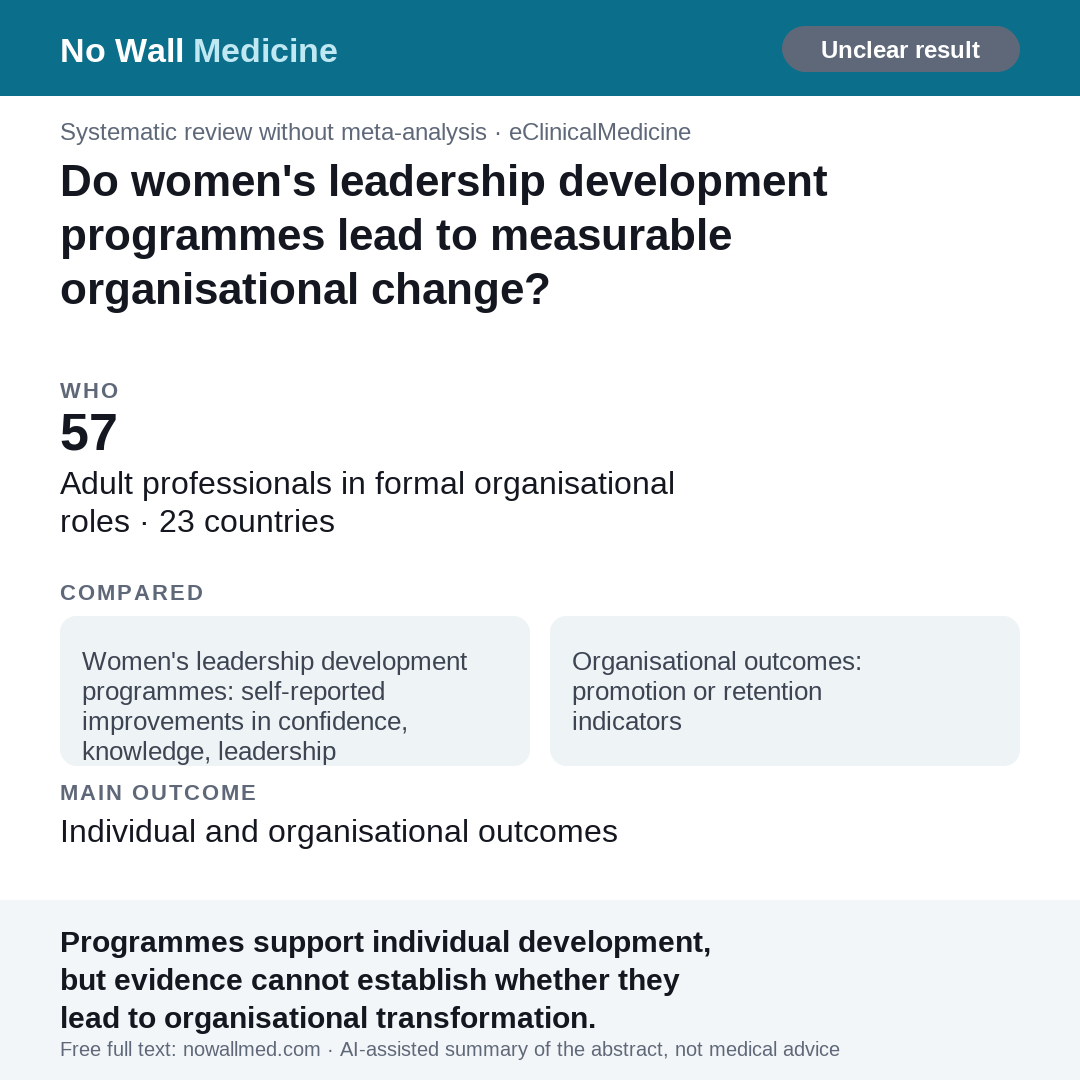
Clinical question: Do women's leadership development programmes lead to measurable organisational change?
Abstract
Background
Women comprise 70% of the global health workforce yet hold only around 25% of leadership positions. Women's leadership development programmes (WLDPs) are widely implemented as organisational equity strategies; this review examined whether their reported outcomes extend beyond individual development to measurable organisational change. Methods
Systematic review without meta-analysis (PROSPERO: CRD42024554419), reported in accordance with PRISMA and SWiM. Nine databases were searched from 25 September 2015 to 5 July 2026. We included peer-reviewed studies evaluating structured WLDPs delivered to adult professionals in formal organisational roles that reported outcomes for women. Student-only populations and mentorship- or coaching-only interventions were excluded. Summary data were extracted from published reports by two independent reviewers using a standardised template incorporating TIDieR intervention-description items; quality was assessed using design-appropriate Joanna Briggs Institute critical appraisal tools. Outcomes were mapped using an extended Kirkpatrick framework spanning individual to organisational outcomes. Findings
From 2314 records, 57 studies evaluating 52 WLDPs across 23 countries were included. Most studies were from the United States (n = 36). Designs were predominantly mixed-methods or qualitative; none used randomisation, and four included comparison groups. All studies reported individual-level outcomes, most commonly self-reported improvements in confidence, knowledge, leadership capability, and behaviour. Thirty-two studies reported any organisational outcome, usually promotion or retention indicators. Subjective measures predominated over objective outcomes. Demographic reporting was limited: only 22 studies reported race or ethnicity, and very few reported sexual orientation, disability, or disaggregated advancement outcomes. Interpretation
WLDPs appear to support individual development, but current evidence cannot establish organisational transformation. Their broader equity potential depends on structural accountability: transparent and equitable recruitment pathways, institutional investment, and disaggregated outcome reporting, a reorientation of responsibility from individuals to organisations. Funding
The Australian National Health and Medical Research Council (NHMRC).
Spotted a mistake? Suggest a correction