Workplace health programs were associated with lower hypertension rates in Chinese employees
Workplace-based primary prevention intervention reduces incidence of hypertension: a post hoc analysis of cluster randomized controlled study
Post hoc analysis of cluster randomized controlled studyBenefit found
Does a workplace-based primary prevention intervention reduce hypertension incidence among Chinese employees?
Who
24396
Chinese working population · 60 workplaces across 20 urban regions in China
Compared
8.0%intervention group
9.6%control group
Main outcome
incidence of hypertension
Result: relative risk 0.66 (95% CI 0.58 to 0.76)
Bottom line: A workplace-based primary prevention program effectively reduces hypertension incidence and promotes healthy lifestyles among employees.
BMC Med · 2023-06-14Download image
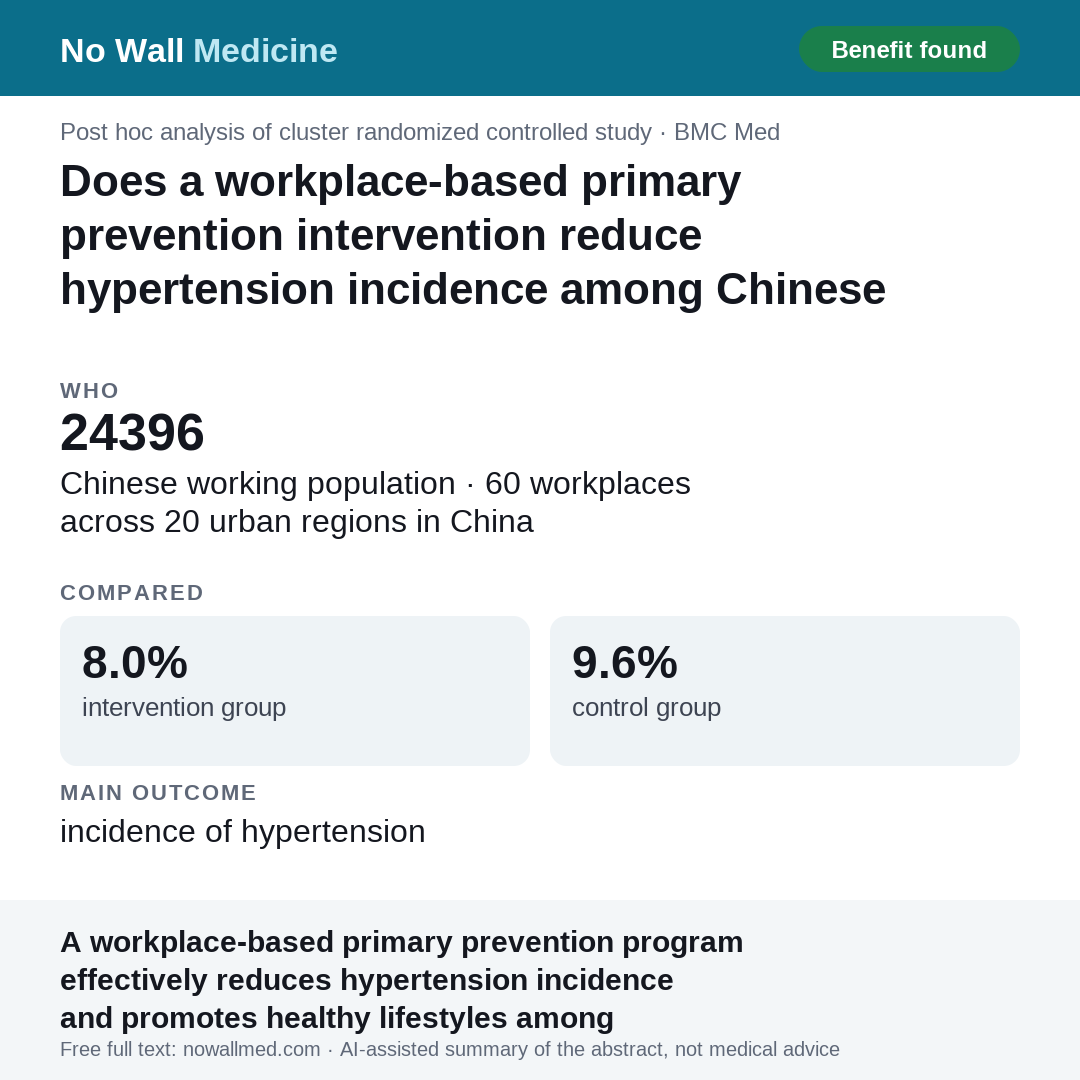
Clinical question: Does a workplace-based primary prevention intervention reduce hypertension incidence among Chinese employees?
Why it matters: The effect of workplace-based multicomponent prevention programs for cardiovascular disease on the incidence of hypertension among the Chinese working population was unknown.
In absolute numbers
intervention group: 8% · control group: 9.6% → a difference of 1.6 percentage points, so about 63 people would need the treatment for 1 more to benefit (number needed to treat) over the trial’s follow-up.
Worked out by us from the two group results above, not reported by the authors. Check the paper for the exact outcome and timing.
Key points
- Researchers analyzed 24,396 employees across 60 workplaces in China who received either a 2-year multicomponent health intervention or standard care.
- The incidence of hypertension was 8.0% in the intervention group compared to 9.6% in the control group after 24 months.
- The program was associated with lower systolic blood pressure by -0.7 mm Hg and diastolic blood pressure by -1.0 mm Hg.
Headline and key points written with AI from the paper’s abstract, with every number checked against it. Read the paper before relying on them.
Was this summary helpful?
Subject terms
Cite this article
Hu Z, Wang X, Hong C, Zheng C, Zhang L, Chen Z. Workplace-based primary prevention intervention reduces incidence of hypertension: a post hoc analysis of cluster randomized controlled study. BMC Med. 2023. doi:10.1186/s12916-023-02915-6
Spotted a mistake? Suggest a correction
Top studies every Monday
The week’s key trials and guidelines in your specialties, plus any topics you follow. By email, free.
Get the weekly digest