World Health Organization updates physical activity and sedentary behavior guidelines for all age groups
World Health Organization 2020 guidelines on physical activity and sedentary behaviour
Orthopedics & Sports MedicineAdult and pediatric
Status not yet checked. We have not confirmed that this is still the issuing body's current recommendation. Check the issuing body before using it in practice.
Why it matters: The previous 2010 recommendations required updating to include specific guidance for pregnant women, postpartum women, and people living with disabilities or chronic conditions.
Key points
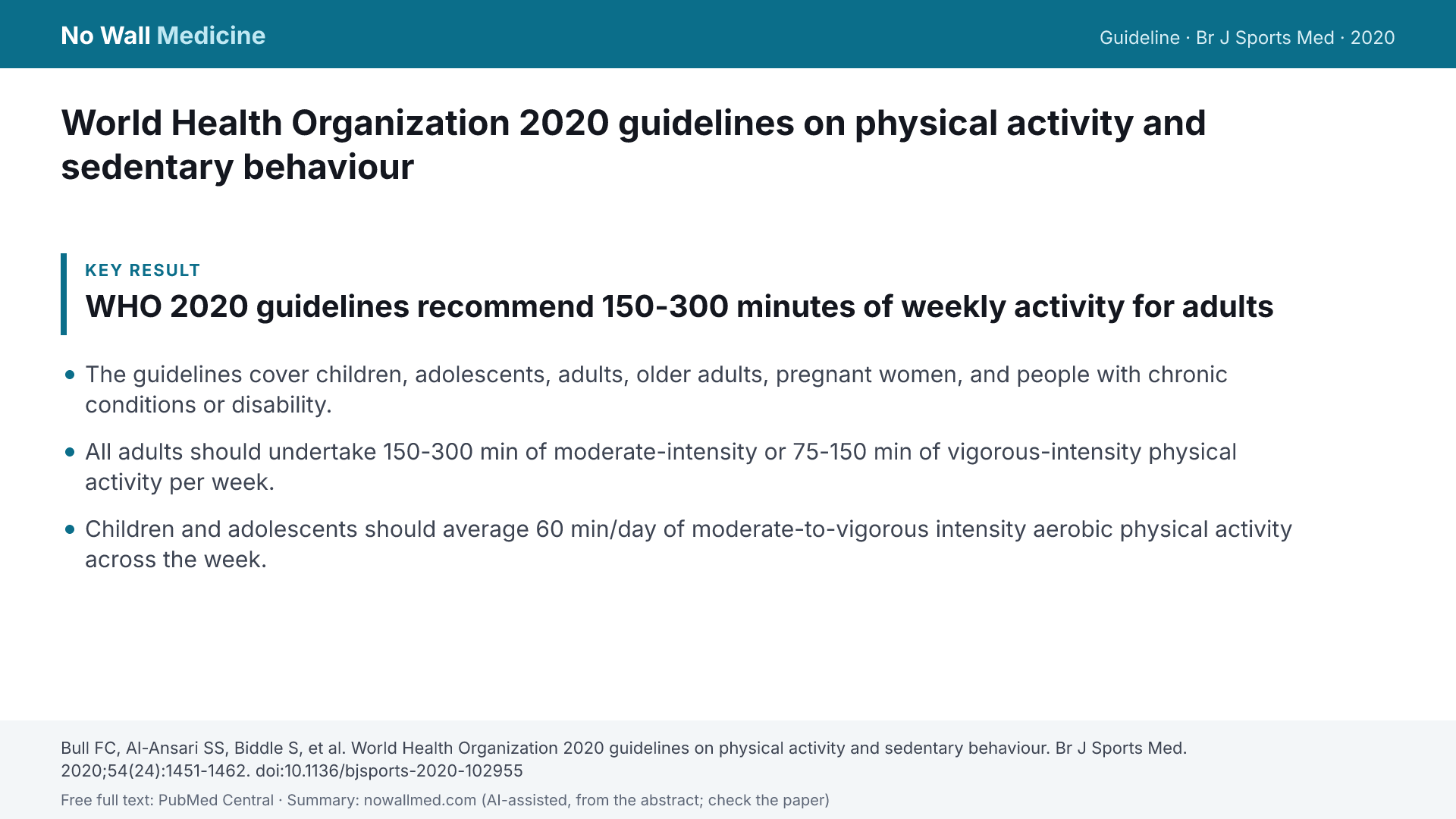
- The guidelines provide recommendations for children, adolescents, adults, older adults, pregnant women, postpartum women, and people with chronic conditions or disabilities.
- Adults are advised to perform 150-300 min of moderate-intensity or 75-150 min of vigorous-intensity aerobic activity per week.
- Children and adolescents should aim for an average of 60 min/day of moderate-to-vigorous intensity aerobic physical activity.
Headline and key points written with AI from the paper’s abstract, with every number checked against it. Read the paper before relying on them.
Was this summary helpful?
Abstract
Objectives
To describe new WHO 2020 guidelines on physical activity and sedentary behaviour. Methods
The guidelines were developed in accordance with WHO protocols. An expert Guideline Development Group reviewed evidence to assess associations between physical activity and sedentary behaviour for an agreed set of health outcomes and population groups. The assessment used and systematically updated recent relevant systematic reviews; new primary reviews addressed additional health outcomes or subpopulations. Results
The new guidelines address children, adolescents, adults, older adults and include new specific recommendations for pregnant and postpartum women and people living with chronic conditions or disability. All adults should undertake 150-300 min of moderate-intensity, or 75-150 min of vigorous-intensity physical activity, or some equivalent combination of moderate-intensity and vigorous-intensity aerobic physical activity, per week. Among children and adolescents, an average of 60 min/day of moderate-to-vigorous intensity aerobic physical activity across the week provides health benefits. The guidelines recommend regular muscle-strengthening activity for all age groups. Additionally, reducing sedentary behaviours is recommended across all age groups and abilities, although evidence was insufficient to quantify a sedentary behaviour threshold. Conclusion
These 2020 WHO guidelines update previous WHO recommendations released in 2010. They reaffirm messages that some physical activity is better than none, that more physical activity is better for optimal health outcomes and provide a new recommendation on reducing sedentary behaviours. These guidelines highlight the importance of regularly undertaking both aerobic and muscle strengthening activities and for the first time, there are specific recommendations for specific populations including for pregnant and postpartum women and people living with chronic conditions or disability. These guidelines should be used to inform national health policies aligned with the WHO Global Action Plan on Physical Activity 2018-2030 and to strengthen surveillance systems that track progress towards national and global targets.
Abstract reproduced under the article’s CC BY licence.
Subject terms
Cite this article
Bull FC, Al-Ansari SS, Biddle S, et al. World Health Organization 2020 guidelines on physical activity and sedentary behaviour. Br J Sports Med. 2020. doi:10.1136/bjsports-2020-102955
Spotted a mistake? Suggest a correction