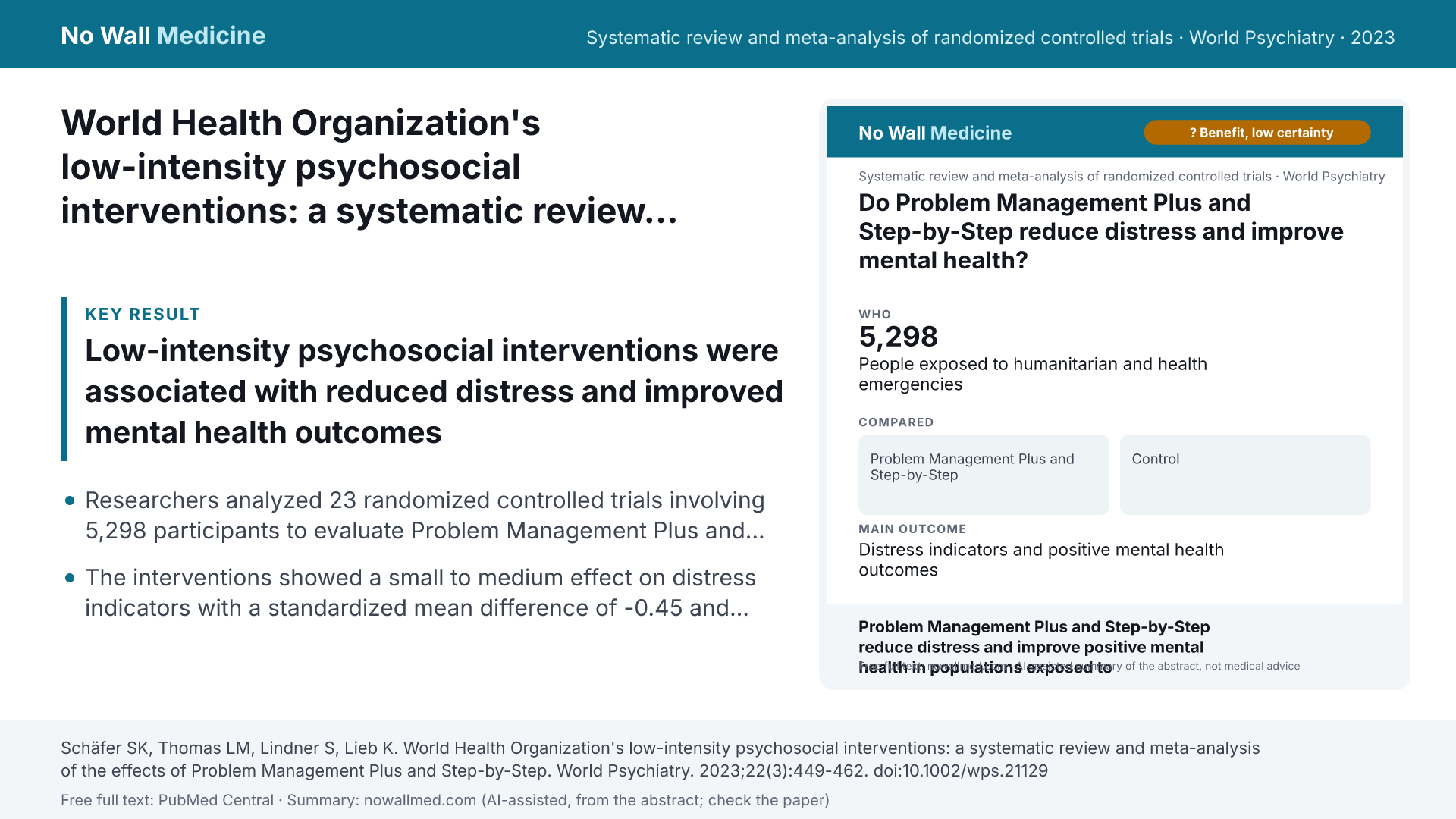
Low-intensity psychosocial interventions were associated with reduced distress and improved mental health outcomes
World Health Organization's low-intensity psychosocial interventions: a systematic review and meta-analysis of the effects of Problem Management Plus and Step-by-Step
Systematic review and meta-analysis of randomized controlled trialsBenefit found
Do Problem Management Plus and Step-by-Step reduce distress and improve mental health?
Who
5,298
People exposed to humanitarian and health emergencies
Compared
Problem Management Plus and Step-by-Step
Control
Main outcome
Distress indicators and positive mental health outcomes
Result: SMD -0.45 (95% CI: -0.56 to -0.34) for distress; SMD 0.31 (95% CI: 0.14-0.47) for positive mental health
Bottom line: Problem Management Plus and Step-by-Step reduce distress and improve positive mental health in populations exposed to adversities.
Limitation: Substantial between-study heterogeneity and very low certainty of evidence across all outcomes.
World Psychiatry · 2023-09-15Download image
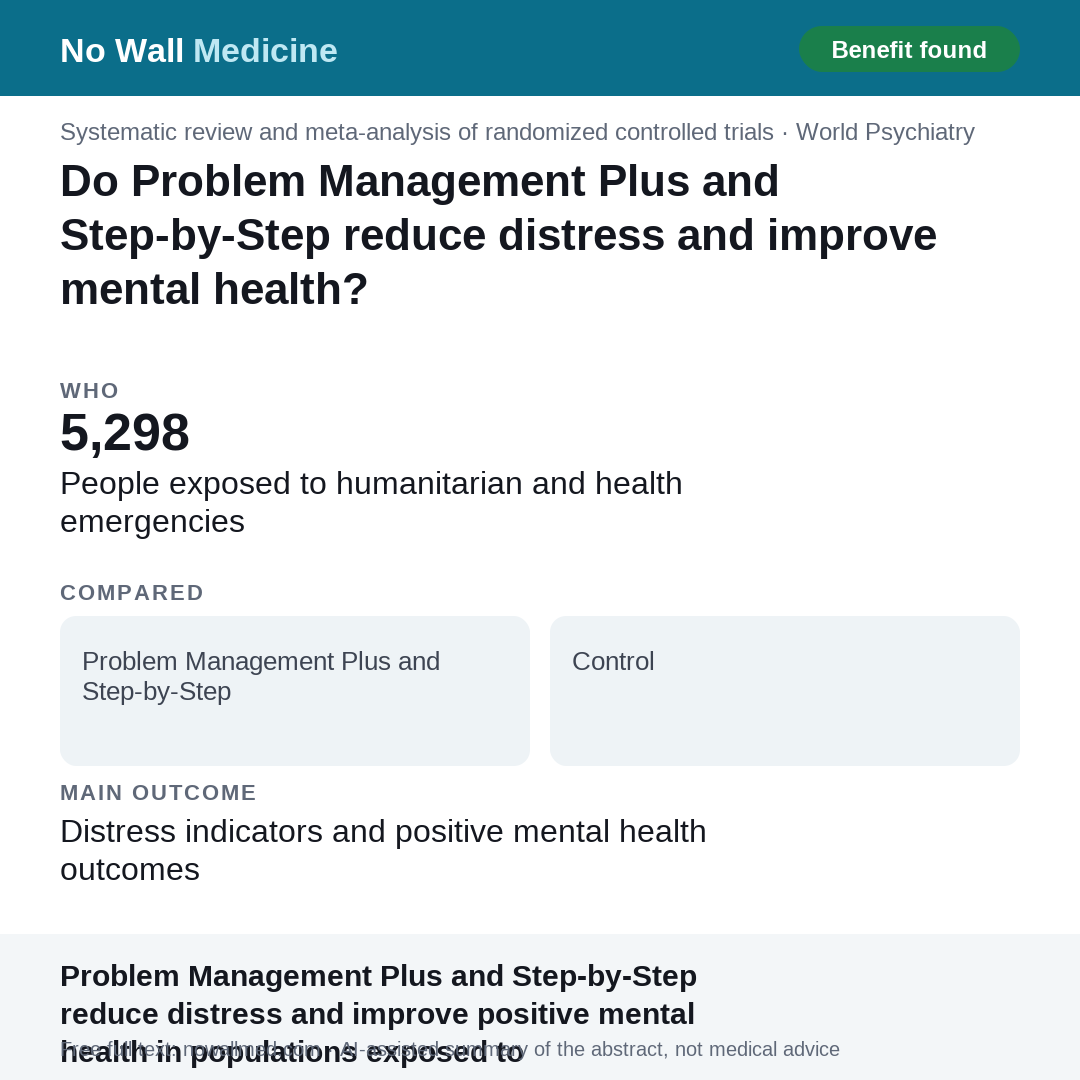
Clinical question: Do Problem Management Plus and Step-by-Step reduce distress and improve mental health?
Why it matters: The effectiveness of the World Health Organization's scalable psychosocial interventions for people experiencing distress in humanitarian or health emergencies was not previously summarized.
Key points
- Researchers analyzed 23 randomized controlled trials involving 5,298 participants to evaluate Problem Management Plus and its digital version, Step-by-Step.
- The interventions showed a small to medium effect on distress indicators with a standardized mean difference of -0.45 and a small effect on positive mental health outcomes with a standardized mean difference of 0.31.
- These effects remained significant at follow-up assessments, although the certainty of evidence was very low across all measured outcomes.
Limitation the authors note: The authors noted substantial between-study heterogeneity and that the certainty of evidence was very low across all outcomes.
Headline and key points written with AI from the paper’s abstract, with every number checked against it. Read the paper before relying on them.
Was this summary helpful?
Cite this article
Schäfer SK, Thomas LM, Lindner S, Lieb K. World Health Organization's low-intensity psychosocial interventions: a systematic review and meta-analysis of the effects of Problem Management Plus and Step-by-Step. World Psychiatry. 2023. doi:10.1002/wps.21129
Spotted a mistake? Suggest a correction