World Health Organization's low-intensity psychosocial interventions: a systematic review and meta-analysis of the effects of Problem Management Plus and Step-by-Step
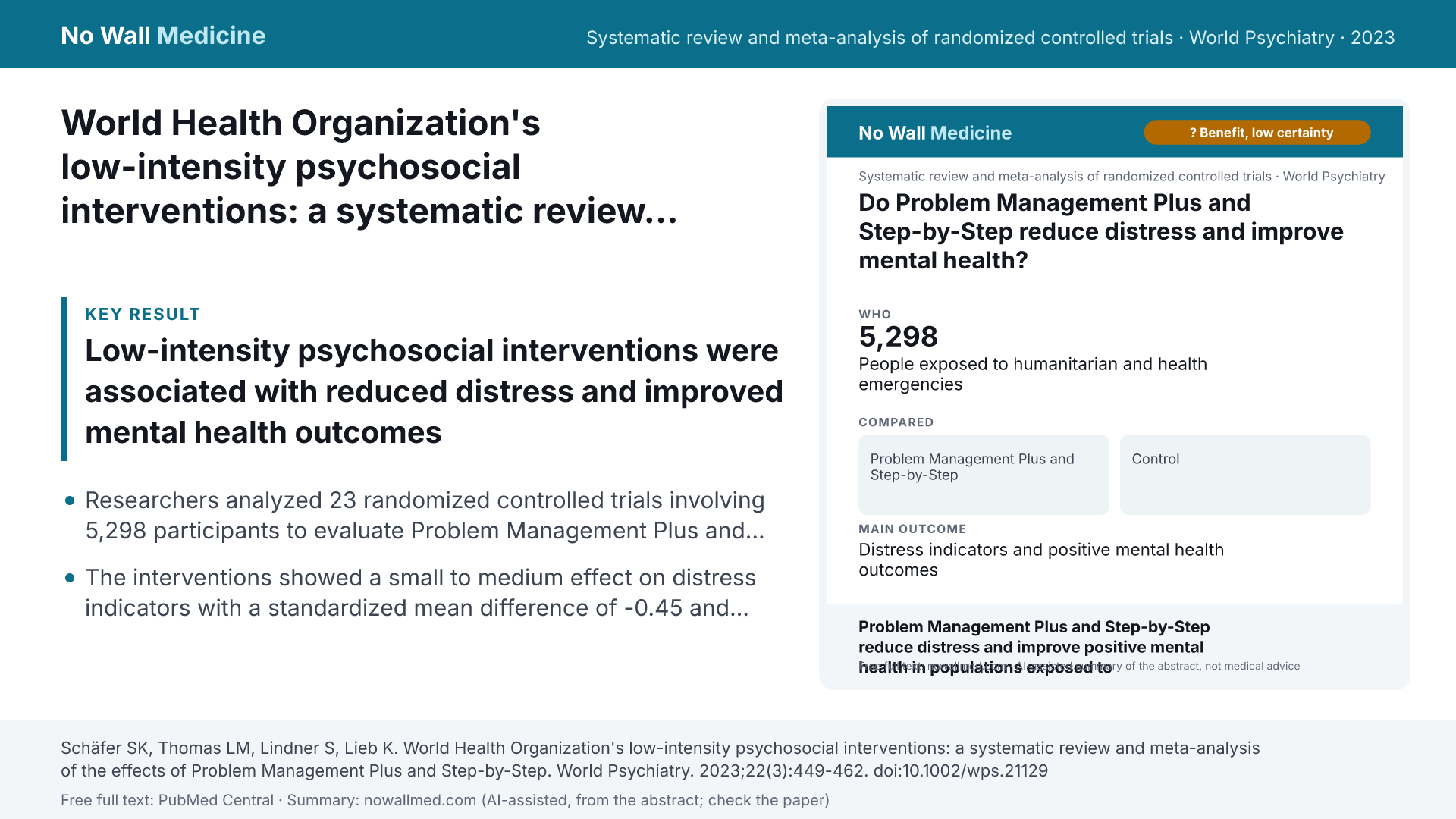
Key result: Low-intensity psychosocial interventions were associated with reduced distress and improved mental health outcomes
Key points
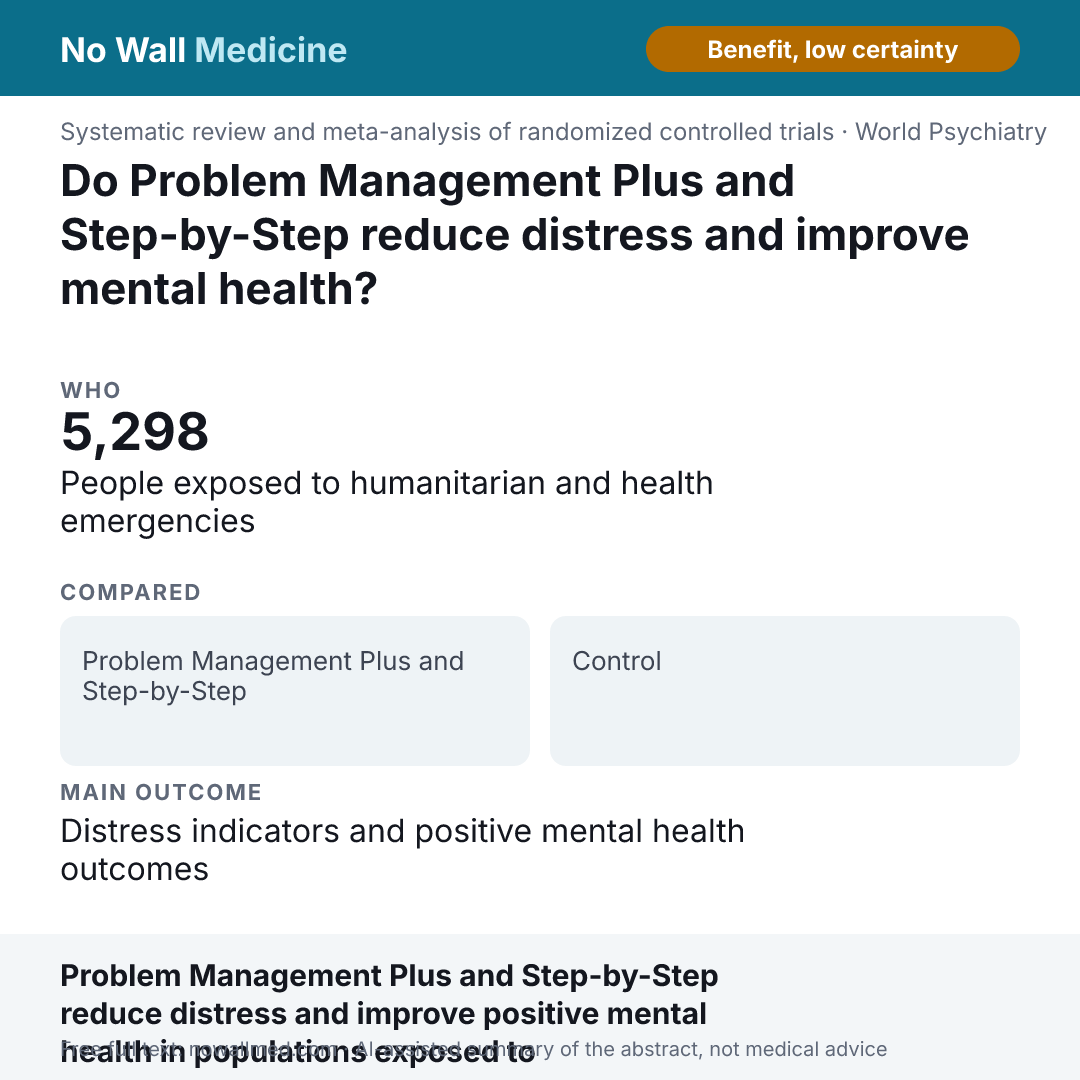
- Researchers analyzed 23 randomized controlled trials involving 5,298 participants to evaluate Problem Management Plus and its digital version, Step-by-Step.
- The interventions showed a small to medium effect on distress indicators with a standardized mean difference of -0.45 and a small effect on positive mental health outcomes with a standardized mean difference of 0.31.
- These effects remained significant at follow-up assessments, although the certainty of evidence was very low across all measured outcomes.
Why it matters: The effectiveness of the World Health Organization's scalable psychosocial interventions for people experiencing distress in humanitarian or health emergencies was not previously summarized.
Limitation the authors note: The authors noted substantial between-study heterogeneity and that the certainty of evidence was very low across all outcomes.
Discussion prompts
- Would these patients look like yours? Who was left out?
- Is the main outcome one that matters to patients?
- Is the difference large enough to change what you do?
Cite: Schäfer SK, Thomas LM, Lindner S, Lieb K. World Health Organization's low-intensity psychosocial interventions: a systematic review and meta-analysis of the effects of Problem Management Plus and Step-by-Step. World Psychiatry. 2023;22(3):449-462. doi:10.1002/wps.21129
Free full text: PubMed Central · Summary and visual abstract: nowallmed.com/a/world-health-organization-s-low-intensity-psychosocial-interventions-1x42dlt/ (AI-assisted from the abstract; check the paper before relying on it).