Visual abstracts
New randomized trials and meta-analyses from leading journals at a glance: who was studied, what was compared, and what was found. Every paper is free to read in full.
All specialtiesCardiology 4877Oncology 4138Gastroenterology & Hepatology 1942Infectious Disease 3837Neurology 1905Psychiatry & Mental Health 2273Pulmonology 2143Critical Care 1365Endocrinology & Diabetes 2580Pediatrics 2980Surgery 2559Orthopedics & Sports Medicine 931Neurosurgery 537Cardiothoracic & Vascular Surgery 674Plastic & Reconstructive Surgery 591Nephrology 1133Rheumatology 823Hematology 1109Dermatology 621Ophthalmology 543Obstetrics & Gynecology 1686Public & Global Health 1058Radiology & Imaging 648Anesthesiology 986Urology 764ENT (Otolaryngology) 503Emergency Medicine 511Allergy & Immunology 313Geriatrics 981Family Medicine & Primary Care 562Medical Genetics & Genomics 676Pathology & Laboratory Medicine 159Physical Medicine & Rehabilitation 757Palliative Care 444Nutrition 1588Digital Health & AI 2201General Medicine 321
A systematic review of machine learning applications in predicting opioid associated adverse events
Systematic reviewMixed results
What are the types and quality of machine learning applications in predicting opioid-related harms?
Who
44
Studies using supervised machine learning for opioid safety research · North America (96%)
Compared
15Postoperative opioid use (34%)
8Opioid overdose (18%)
8Opioid use disorder (18%)
5Persistent opioid use (11%)
Main outcome
Types and quality of machine learning methods in opioid safety
Bottom line: Machine learning models show moderate to strong performance, but lack external validation and transparent reporting of calibration.
Limitation: Infrequent external validation and incomplete reporting of calibration and missing data limit generalizability.
NPJ Digit Med · 2025-01-16Download image

Is Topical Tranexamic Acid Effective in Reducing Hematoma and Seroma in Breast Surgery? A Systematic Review and Meta-analysis
Systematic review and meta-analysisMixed results
Is topical tranexamic acid effective in reducing hematoma and seroma in breast surgery?
Who
823
Patients undergoing breast surgery
Compared
Topical tranexamic acid
Control
Main outcome
hematoma, seroma, infection rates, and drain output/duration
Result: overall hematoma risk ratio 0.32 (95% CI 0.08-1.195)
Bottom line: Topical tranexamic acid significantly reduced hematoma rates in mastectomy but had no significant effect on other outcomes.
Limitation: Larger studies with standardized methodologies are required to fully establish the role.
Plast Reconstr Surg Glob Open · 2025-01-16Download image

Exercise type and settings, quality of life, and mental health in coronary artery disease: a network meta-analysis
Network meta-analysis of 36 randomized controlled trialsBenefit found
How do different exercise types and settings affect coronary artery disease patients?
Who
Patients with coronary artery disease
Compared
High-intensity interval training plus resistance: SMD 1.53 (95% confidence interval 0.83; 2.24)
High-intensity interval training: SMD 0.44 (0.15; 0.73)
Moderate-intensity training: SMD 0.44 (0.20; 0.67)
No exercise
Main outcome
Health-related quality of life, depression, and anxiety
Bottom line: Exercise training, particularly in-person sessions, improves health-related quality of life, depression, and anxiety in coronary artery disease patients.
Limitation: Home-based programmes were not significantly associated with improvements in these outcomes.
Eur Heart J · 2025-01-15Download image

Eradication Therapy to Prevent Gastric Cancer in Helicobacterpylori-Positive Individuals: Systematic Review and Meta-Analysis of Randomized Controlled Trials and Observational Studies
Systematic review and meta-analysisBenefit found
Does eradication therapy prevent gastric cancer in Helicobacter pylori-positive individuals?
Who
Helicobacter pylori-positive adults with or without gastric neoplasia
Compared
Eradication therapy
Placebo or no eradication therapy
Main outcome
Incidence and mortality of gastric cancer
Result: relative risk 0.64 (95% CI 0.48-0.84)
Bottom line: Eradication therapy reduces gastric cancer incidence and mortality in Helicobacter pylori-positive individuals.
Gastroenterology · 2025-01-15Download image

Effect of Sodium-glucose Transporter 2 Inhibitors on Cardiovascular Outcomes in Type 1 Diabetes Mellitus: A Systematic Review and Meta-analysis of Randomized Controlled Trials
Systematic review and meta-analysis of randomized controlled trialsMixed results
Do sodium-glucose transporter 2 inhibitors affect cardiovascular outcomes in type 1 diabetes mellitus?
Who
Insulin-using patients with type 1 diabetes mellitus
Compared
Sodium-glucose transporter 2 inhibitors
Placebo
Main outcome
Glycated hemoglobin, body weight, and diabetic ketoacidosis risk
Result: risk ratio 4.45 (95% CI 2.81-7.05) for diabetic ketoacidosis
Bottom line: Sodium-glucose transporter 2 inhibitors reduce glycated hemoglobin and body weight but significantly increase diabetic ketoacidosis risk.
J Clin Endocrinol Metab · 2025-01-15Download image

Improving large language model applications in biomedicine with retrieval-augmented generation: a systematic review, meta-analysis, and clinical development guidelines
Systematic review and meta-analysisBenefit found
Does retrieval-augmented generation improve large language model performance in biomedicine?
Who
20
Studies comparing baseline large language models with retrieval-augmented generation
Compared
Baseline large language models
Retrieval-augmented generation
Main outcome
Large language model performance
Result: odds ratio 1.35 (95% CI 1.19-1.53)
Bottom line: Retrieval-augmented generation implementation showed a 1.35 odds ratio increase in performance compared to baseline large language models.
J Am Med Inform Assoc · 2025-01-15Download image

Diagnostic performance of CT for extrarenal fat invasion in renal cell carcinoma: a meta-analysis and systematic review
Meta-analysis and systematic reviewMixed results
What is the diagnostic performance of computed tomography for extrarenal fat invasion in renal cell carcinoma?
Who
Patients with renal cell carcinoma
Compared
Perinephric fat invasion: sensitivity 0.69 (95% CI: 0.55-0.79)
Renal sinus fat invasion: sensitivity 0.81 (95% CI: 0.76-0.85)
Main outcome
Diagnostic performance for extrarenal fat invasion
Bottom line: Computed tomography can detect extrarenal fat invasion, but diagnostic performance is inconsistent and limited by low positive sample rates.
Limitation: Low positive sample in the current studies and low positive likelihood ratio.
Insights Imaging · 2025-01-15Download image

Individualized PEEP titration by lung compliance during one-lung ventilation: a meta-analysis
Meta-analysis of trialsBenefit found
Does individualized PEEP reduce complications?
Who
3426
patients undergoing one-lung ventilation
Compared
Individualized PEEP
Fixed PEEP
Main outcome
postoperative pulmonary complications
Result: risk ratio 0.55 (95% CI 0.38 to 0.78)
Bottom line: Individualized PEEP reduces pulmonary complications
Crit Care · 2025-01-15Download image

Screening for Osteoporosis to Prevent Fractures: A Systematic Evidence Review for the US Preventive Services Task Force
Systematic evidence reviewBenefit found
Does osteoporosis screening prevent hip and major osteoporotic fractures?
Who
42009
Older, higher-risk women
Compared
Screening
Usual care
Main outcome
Hip, clinical vertebral, major osteoporotic, and total fractures
Result: pooled relative risk 0.83 (95% CI 0.73-0.93) for hip fractures
Bottom line: Screening in higher-risk women 65 years or older was associated with small absolute risk reduction in hip and major fractures.
Limitation: No evidence evaluated screening with bone mineral density alone or screening in men or younger women.
JAMA · 2025-01-14Download image

Effectiveness of Synchronous Postdischarge Contacts on Health Care Use and Patient Satisfaction : A Systematic Review and Meta-analysis
Systematic review and meta-analysisNo clear difference
Do postdischarge contacts reduce emergency department visits, hospital readmissions, and improve patient satisfaction?
Who
Patients hospitalized receiving postdischarge contacts within 7 days
Compared
Postdischarge contacts
Usual care
Main outcome
30-day emergency department visits and 30-day hospital readmissions
Result: risk difference 0.00 (95% CI -0.02 to 0.03) for emergency department visits; risk difference 0.00 (CI -0.02 to 0.02) for hospital readmissions
Bottom line: Postdischarge contacts within 7 days did not reduce 30-day emergency department visits or hospital readmissions compared to usual care.
Limitation: Adherence and fidelity to postdischarge contact interventions were poorly described.
Funded by: Department of Veterans Affairs
Ann Intern Med · 2025-01-14Download image

Antiseizure Medications in Poststroke Seizures: A Systematic Review and Network Meta-Analysis
Systematic review and network meta-analysisMixed results
Which antiseizure medications are most effective for poststroke seizures?
Who
18,676
Patients with poststroke seizures
Compared
Levetiracetam: 24.8% seizure recurrence
Phenytoin: OR 7.3 (95% CI 3.7-14.5) seizure recurrence
Carbamazepine: OR 1.8 (95% CI 1.5-2.2) drug discontinuation
Valproic acid: OR 4.7 (95% CI 3.6-6.3) mortality
Main outcome
Seizure recurrence, adverse events, drug discontinuation, and mortality
Bottom line: Levetiracetam and lamotrigine may be safe and tolerable antiseizure medications for poststroke seizures.
Limitation: Findings should be interpreted cautiously owing to bias and confounding risks.
Neurology · 2025-01-14Download image

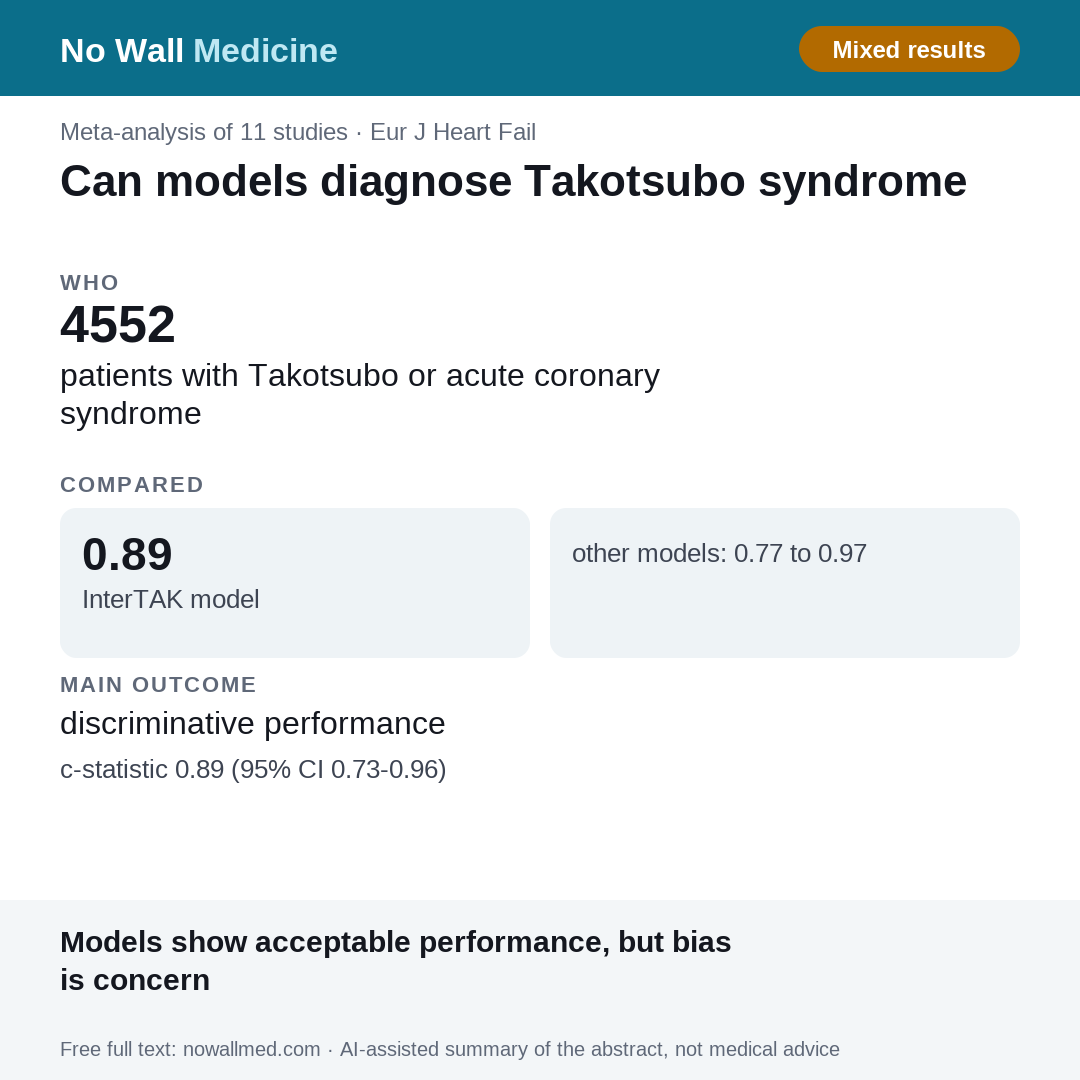
Diagnostic models to differentiate Takotsubo syndrome from acute coronary syndrome: A systematic review and meta-analysis
Meta-analysis of 11 studiesMixed results
Can models diagnose Takotsubo syndrome
Who
4552
patients with Takotsubo or acute coronary syndrome
Compared
0.89InterTAK model (95% CI 0.73-0.96)
other models: 0.77 to 0.97
Main outcome
discriminative performance
Result: c-statistic 0.89 (95% CI 0.73-0.96)
Bottom line: Models show acceptable performance, but bias is concern
Limitation: high risk of bias
Eur J Heart Fail · 2025-01-14Download image
Unlocking the power of empagliflozin: Rescuing inflammation in hyperglycaemia-exposed human cardiomyocytes through comprehensive multi-level analysis
Meta-analysis and in vitro studyBenefit found
Does empagliflozin exert anti-inflammatory effects in diabetic patients and human cardiomyocytes?
Who
Diabetic patients and human cardiomyocyte AC16 cells
Compared
Empagliflozin
High glucose exposure
Main outcome
Inflammatory, metabolic, and aging signatures
Bottom line: Empagliflozin exerts anti-inflammatory effects both systemically and directly in cardiac tissue and cardiomyocytes.
Eur J Heart Fail · 2025-01-14Download image

Clinical criteria for limbic-predominant age-related TDP-43 encephalopathy
GuidelineUnclear result
Clinical criteria for LATE diagnosis
Who
patients with memory loss
Compared
Probable LATE
Possible LATE
Main outcome
memory loss diagnosis
Bottom line: Criteria proposed for LATE diagnosis
Alzheimers Dement · 2025-01-14Download image

Unraveling the bidirectional link between cancer and dementia and the impact of cancer therapies on dementia risk: A systematic review and meta-analysis
Systematic review and meta-analysisMixed results
What is the bidirectional relationship between cancer and dementia and the impact of therapies?
Who
Cancer survivors and patients with dementia
Compared
Cancer survivors: 8% to 14% lower risk of dementia
Patients with dementia: 25% lower cancer risk
Main outcome
Risk of dementia and cancer
Bottom line: Cancer survivors have lower dementia risk, while dementia patients have lower cancer risk, with varying impacts from specific therapies.
Alzheimers Dement · 2025-01-14Download image

Unraveling the transcriptomic landscape of brain vascular cells in dementia: A systematic review
Systematic reviewUnclear result
What are the transcriptomic changes in brain vascular cells across neurodegenerative conditions?
Who
Brain vascular endothelial cells and pericytes from postmortem human tissue
Compared
Alzheimer's disease
Huntington's disease
Arteriovenous malformation
Main outcome
Differentially expressed genes in endothelial cells and pericytes
Bottom line: Consistently dysregulated genes in vascular cells are linked to vascular zonation and genetic risks for dementia.
Alzheimers Dement · 2025-01-14Download image

Benchmarking the efficacy of salvage systemic therapies for recurrent meningioma: A RANO group systematic review and meta-analysis to guide clinical trial design
Systematic review and meta-analysisMixed results
What are the efficacy benchmarks for systemic therapies in recurrent meningioma?
Who
Adults with recurrent meningiomas
Compared
Grade 1 meningiomas: PFS-6 43.6% (95% CI: 22.7-67.0%)
Grades 2-3 meningiomas: PFS-6 38.0% (95% CI: 28.3-48.8%)
Grade 1 targeted therapy: PFS-6 62.0%
Main outcome
Progression-free survival at 6-months and 1-year
Bottom line: Systemic therapies show modest and variable activity, leading to proposed new efficacy benchmarks for future clinical trials.
Neuro Oncol · 2025-01-14Download image

Effects of anti-inflammatory agents on clinical outcomes in people with chronic kidney disease: a systematic review and meta-analysis of randomized control trials
Systematic review and meta-analysis of randomized controlled trialsNo clear difference
Do anti-inflammatory agents improve clinical outcomes in people with chronic kidney disease?
Who
12042
People with chronic kidney disease
Compared
Anti-inflammatory agents
Placebo
Main outcome
Major adverse cardiovascular events
Result: risk ratio 1.01 (95% CI 0.81-1.24)
Bottom line: Anti-inflammatory agents did not reduce cardiovascular risk or kidney disease progression but increased infection risk.
Clin Kidney J · 2025-01-14Download image

Systematic review of machine learning applications using nonoptical motion tracking in surgery
Systematic reviewBenefit found
What are the machine learning applications using non-optical motion tracking in surgery?
Who
84
Studies using non-optical motion tracking systems in surgery · Robotic, laparoscopic, open, and other surgical settings
Compared
38%Artificial Neural Networks
11%Support Vector Machines
Main outcome
Machine learning model effectiveness and surgical motion analysis objectives
Bottom line: Non-optical motion tracking and machine learning can enhance surgical precision, assessment, and training.
NPJ Digit Med · 2025-01-14Download image

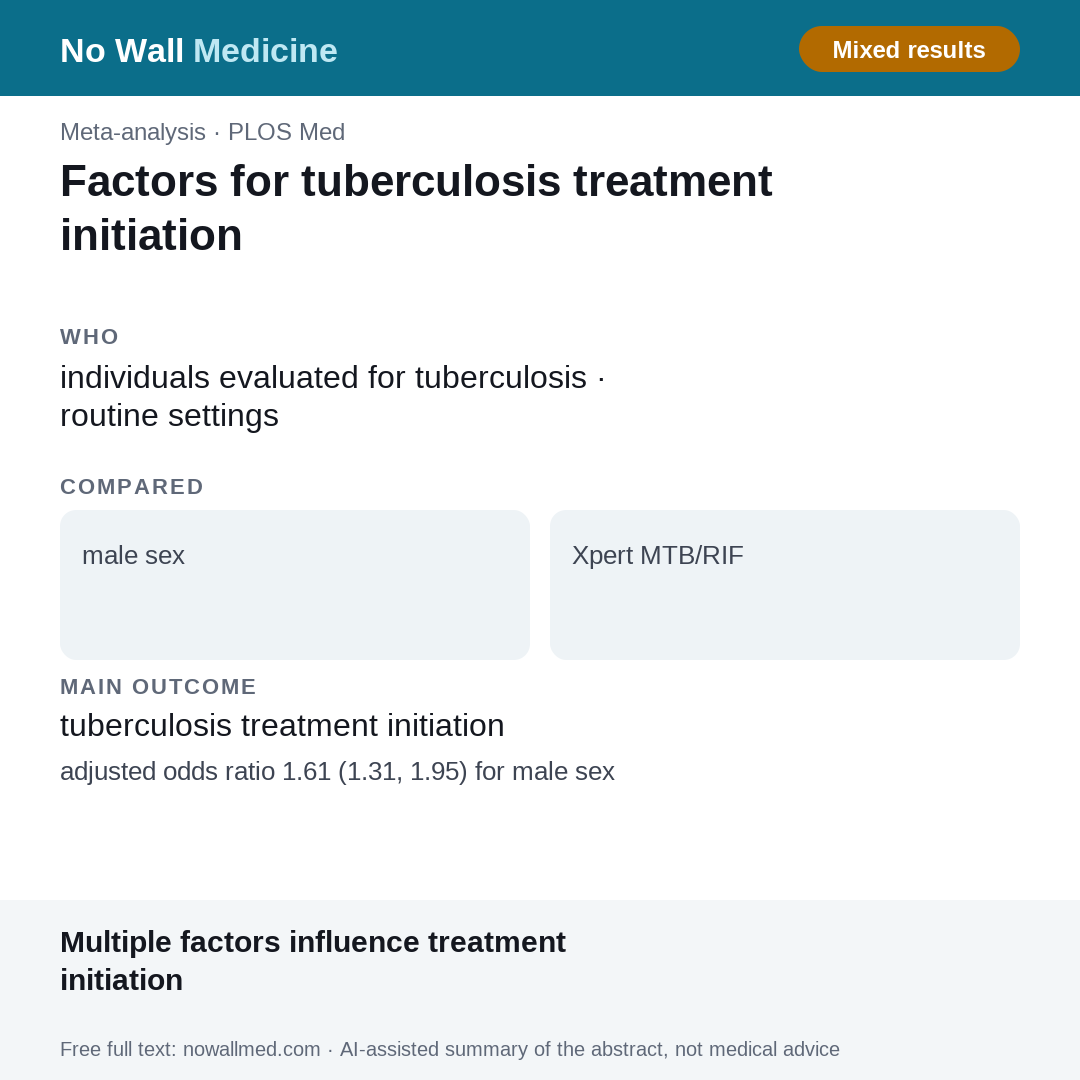
Factors associated with tuberculosis treatment initiation among bacteriologically negative individuals evaluated for tuberculosis: An individual patient data meta-analysis
Meta-analysisMixed results
Factors for tuberculosis treatment initiation
Who
individuals evaluated for tuberculosis · routine settings
Compared
male sex
Xpert MTB/RIF
Main outcome
tuberculosis treatment initiation
Result: adjusted odds ratio 1.61 (1.31, 1.95) for male sex
Bottom line: Multiple factors influence treatment initiation
Limitation: could not assess clinicians' decision making
PLOS Med · 2025-01-13Download image