Visual abstracts
New randomized trials and meta-analyses from leading journals at a glance: who was studied, what was compared, and what was found. Every paper is free to read in full.
All specialtiesCardiology 4763Oncology 4043Gastroenterology & Hepatology 1903Infectious Disease 3756Neurology 1872Psychiatry & Mental Health 2216Pulmonology 2044Critical Care 1319Endocrinology & Diabetes 2544Pediatrics 2889Surgery 2480Orthopedics & Sports Medicine 917Neurosurgery 525Cardiothoracic & Vascular Surgery 656Plastic & Reconstructive Surgery 574Nephrology 1107Rheumatology 810Hematology 1090Dermatology 611Ophthalmology 532Obstetrics & Gynecology 1645Public & Global Health 1037Radiology & Imaging 619Anesthesiology 958Urology 745ENT (Otolaryngology) 494Emergency Medicine 481Allergy & Immunology 309Geriatrics 972Family Medicine & Primary Care 534Medical Genetics & Genomics 659Pathology & Laboratory Medicine 156Physical Medicine & Rehabilitation 734Palliative Care 421Nutrition 1560Digital Health & AI 2137General Medicine 318
Intrauterine manipulator during hysterectomy for endometrial cancer: a systematic review and meta-analysis of oncologic outcomes
Systematic review and meta-analysisNo clear difference
Does intrauterine manipulator use during laparoscopic hysterectomy affect oncologic outcomes in endometrial cancer?
Who
5,019
Endometrial cancer patients undergoing total laparoscopic or robotic hysterectomy
Compared
With intrauterine manipulator
Without intrauterine manipulator
Main outcome
Oncologic outcomes including recurrence, cause-specific, and overall survival
Result: hazard ratio 1.52 (95% confidence interval, 0.99-2.33)
Bottom line: Intrauterine manipulator use was not significantly associated with recurrence or overall survival in endometrial cancer patients.
Limitation: further prospective studies are needed
AJOG · 2023-09-12 · Save PNG

Meta-research: How many diagnostic or prognostic models published in radiological journals are evaluated externally?
Systematic reviewKey finding
What proportion of diagnostic or prognostic models in radiological journals are externally evaluated?
Who
Diagnostic and prognostic models in three radiological journals · Three radiological journals
Compared
Index studies: 15% (15/98) presented an evaluation
Subsequent external evaluations: 6% (6/98) of index studies
Main outcome
Proportion of models evaluated externally
Bottom line: Very few diagnostic or prognostic models in radiological literature are externally evaluated, suggesting wasted research effort and resources.
Eur Radiol · 2023-09-12 · Save PNG

Reporting of Rehabilitation Outcomes in the Traumatic Lower Limb Amputation Literature: A Systematic Review
Systematic reviewMixed results
What rehabilitation outcomes are reported in literature for adults with traumatic lower limb amputation?
Who
692
Adults with traumatic lower limb amputation · Rehabilitation or community settings
Compared
63.4%Life effect
30.1%Physiological/clinical
5.1%Resource use
1.4%Adverse events
Main outcome
Classification of reported rehabilitation and community outcomes
Bottom line: Reporting of rehabilitation outcomes for traumatic lower limb amputation is inconsistent, hindering meta-analyses and identification of effective care.
Arch Phys Med Rehabil · 2023-09-12 · Save PNG

Quantifying outcomes of autologous fat transplantation in different facial deformities: A systemic review and meta-analysis
Systematic review and meta-analysisBenefit found
What are the outcomes of autologous fat transplantation for different facial deformities?
Who
1572
Patients with different facial deformities
Compared
Acquired atrophic deformities: 43% (95% CI 28%-58%) retention
Mixed deformities: 64% (95% CI 57%-71%) retention
Main outcome
Surgeon satisfaction, patient satisfaction, facial symmetry, and complication rates
Result: facial symmetry improved by 13% (95% CI 8.4%-18%)
Bottom line: Autologous fat transplantation is safe and effective for facial symmetry but less effective for acquired atrophic deformities.
J Plast Reconstr Aesthet Surg · 2023-09-12 · Save PNG

Prevention of cardiac surgery-associated acute kidney injury: a systematic review and meta-analysis of non-pharmacological interventions
Systematic review and meta-analysis of 86 trialsMixed results
Do non-pharmacological interventions reduce the incidence of cardiac surgery-associated acute kidney injury?
Who
25,855
Patients undergoing cardiac surgery
Compared
Non-pharmacological interventions
Control
Main outcome
Cardiac surgery-associated acute kidney injury incidence
Result: not explicitly pooled for all interventions
Bottom line: Goal-directed perfusion and remote ischemic preconditioning may reduce cardiac surgery-associated acute kidney injury incidence.
Limitation: No intervention had high-quality evidence to reduce cardiac surgery-associated acute kidney injury.
Crit Care · 2023-09-12 · Save PNG

Targeting the Angiotensin Pathway in the Treatment of Cutaneous Fibrosis: A Systematic Review
Systematic reviewBenefit found
Do angiotensin converting enzyme inhibitors or angiotensin receptor blockers improve cutaneous scarring?
Who
199
Patients with cutaneous scarring
Compared
Angiotensin converting enzyme inhibitors or angiotensin receptor blockers: statistically significant improvement
Placebo or control
Main outcome
Cutaneous scarring improvement
Bottom line: Angiotensin converting enzyme inhibitors and angiotensin receptor blockers show statistically significant improvement in cutaneous scarring.
Limitation: Much of the literature is limited by study design.
JID Innov · 2023-09-12 · Save PNG

Health Providers' Perceptions and Experiences of Using mHealth for Chronic Noncommunicable Diseases: Qualitative Systematic Review and Meta-Synthesis
Qualitative systematic reviewUnclear result
Health providers' views on mHealth for chronic diseases
Who
health providers for chronic noncommunicable diseases
Compared
facilitators
barriers
Main outcome
perceptions and experiences of mHealth use
Bottom line: mHealth has facilitators and barriers for health providers
J Med Internet Res · 2023-09-12 · Save PNG

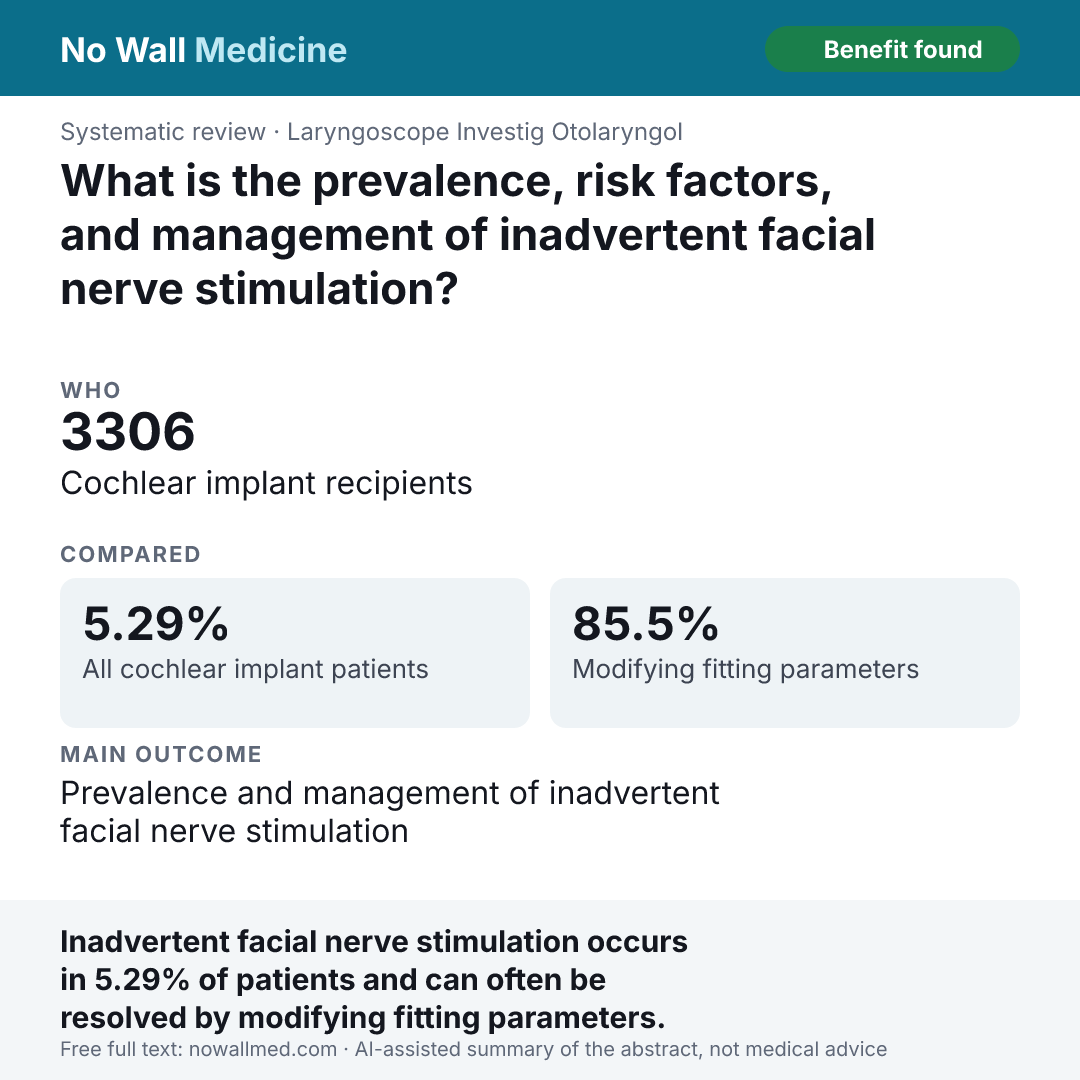
Risk factors and management strategies of inadvertent facial nerve stimulation in cochlear implant recipients: A systematic review
Systematic reviewBenefit found
What is the prevalence, risk factors, and management of inadvertent facial nerve stimulation?
Who
3306
Cochlear implant recipients
Compared
5.29%All cochlear implant patients (175/3306)
85.5%Modifying fitting parameters (142/166)
Main outcome
Prevalence and management of inadvertent facial nerve stimulation
Bottom line: Inadvertent facial nerve stimulation occurs in 5.29% of patients and can often be resolved by modifying fitting parameters.
Limitation: Further studies are required to validate the efficacy of each management strategy.
Laryngoscope Investig Otolaryngol · 2023-09-12 · Save PNG
Efficacy and Tolerability of Gefapixant for Treatment of Refractory or Unexplained Chronic Cough: A Systematic Review and Dose-Response Meta-Analysis
Systematic review and dose-response meta-analysisMixed results
Is gefapixant effective and tolerable for refractory or unexplained chronic cough?
Who
2980
Adults with refractory or unexplained chronic cough
Compared
Gefapixant (45 mg twice daily): small effects on cough frequency, severity, and quality of life
Placebo
Main outcome
Cough frequency, severity, quality of life, and adverse events
Result: mean difference, -6.2 mm [95% CI, -4.1 to -8.4] for cough severity
Bottom line: Gefapixant (45 mg twice daily) provides modest cough improvements but increases treatment-related and taste-related adverse events.
JAMA · 2023-09-11 · Save PNG

Molecular Diagnostic Yield of Exome Sequencing and Chromosomal Microarray in Short Stature: A Systematic Review and Meta-Analysis
Systematic review and meta-analysisKey finding
What is the diagnostic yield of exome sequencing and chromosomal microarray in short stature?
Who
Patients with short stature
Compared
27.1%Exome sequencing (95% CI, 18.1%-37.2%)
13.6%Chromosomal microarray analysis (95% CI, 9.2%-18.7%)
Main outcome
Overall diagnostic yield
Bottom line: Exome sequencing and chromosomal microarray analysis both provide diagnostic efficacy for patients with short stature.
JAMA Pediatr · 2023-09-11 · Save PNG

MEFIB-Index and MAST-Score in the assessment of hepatic decompensation in metabolic dysfunction-associated steatosis liver disease-Individual participant data meta-analyses
Individual participant data meta-analysisKey finding
Do MEFIB-Index and MAST-Score predict hepatic decompensation in MASLD patients?
Who
454
Patients with metabolic dysfunction-associated steatotic liver disease · United States, Japan, and Turkey
Compared
Positive MEFIB-Index
Positive MAST-Score
Main outcome
Incident hepatic decompensation
Result: MEFIB-Index hazard ratio 49.22 (95% CI 6.23-388.64); MAST-Score hazard ratio 3.86 (95% CI 1.46-10.17)
Bottom line: Both MEFIB-Index and MAST-Score predict hepatic decompensation, with MEFIB-Index showing superior predictive performance.
Aliment Pharmacol Ther · 2023-09-11 · Save PNG

Virtual and augmented reality in intensive care medicine: a systematic review
Systematic reviewBenefit found
How are virtual reality and augmented reality currently used in intensive care medicine?
Who
Intensive care unit personnel and critically ill children or adults
Compared
Healthcare providers
Patients
Main outcome
Applications of virtual and augmented reality in intensive care
Bottom line: Virtual and augmented reality offer multiple possibilities to improve care for both healthcare professionals and patients.
Limitation: Many publications are case reports, study plans, or lack a control group.
Ann Intensive Care · 2023-09-11 · Save PNG

Role of Caregivers in Remote Management of Patients With Type 2 Diabetes Mellitus: Systematic Review of Literature
Systematic reviewMixed results
What is the role of caregivers in remote management of type 2 diabetes mellitus?
Who
Adult patients with type 2 diabetes mellitus · North America and South America
Compared
Caregiver involvement
Standard remote monitoring
Main outcome
Diabetes control, medication adherence, quality of life, and healthcare use
Bottom line: Caregivers may improve clinical outcomes, but evidence for quality of life is mixed and hospitalization rates increased in one study.
J Med Internet Res · 2023-09-11 · Save PNG

Comparative effectiveness of interventions for preventing tuberculosis: systematic review and network meta-analysis of interventional studies
Systematic review and network meta-analysisBenefit found
Which interventions are most effective for reducing tuberculosis incidence?
Who
Interventional studies on tuberculosis prevention
Compared
Preventive therapy: OR = 0.44 (95% CrI 0.36-0.52)
BCG vaccination: OR = 0.62 (95% CrI 0.39-0.98)
TB candidate vaccines: OR = 0.67 (95% CrI 0.46-0.98)
Placebo or no intervention
Main outcome
Tuberculosis incidence
Result: OR = 0.44 (95% CrI 0.36-0.52) for preventive therapy
Bottom line: Preventive therapy is the most effective intervention, with isoniazid plus streptomycin ranking highest among preventive treatments.
Funded by: Curtin University and Australian National Health and Medical Research Council
eClinicalMedicine · 2023-09-09 · Save PNG

Impact of Vision Impairment and Ocular Morbidity and Their Treatment on Quality of Life in Children: A Systematic Review
Systematic review and meta-analysisMixed results
How do vision impairment, ocular morbidity, and treatment impact children's quality of life?
Who
32318
Children with vision impairment, ocular morbidity, or strabismus · 14 countries
Compared
Children with vision impairment
Children without vision impairment
Myopic children
Children with normal vision
Main outcome
Quality of life scores
Result: SMD -0.60 (95% CI -1.09 to -0.11) for myopia; SMD -1.19 (95% CI -1.66 to -0.73) for strabismus; SMD 1.36 (95% CI 0.48-2.23) for strabismus surgery
Bottom line: Myopia and strabismus reduce quality of life in children, but strabismus surgery significantly improves it.
Ophthalmology · 2023-09-09 · Save PNG

Genome-wide meta-analysis implicates variation affecting mast cell biology in urticaria
Meta-analysis of genome-wide studiesUnclear result
Genetic basis of urticaria
Who
14306
European cohorts with urticaria · Europe
Compared
Urticaria cases
Controls
Main outcome
Urticaria susceptibility
Result: Genome-wide significant associations at 6 loci
Bottom line: Genetic variation affects urticaria risk
JACI · 2023-09-09 · Save PNG

Systemic treatments for atopic dermatitis (eczema): Systematic review and network meta-analysis of randomized trials
Systematic review and network meta-analysisMixed results
What are the comparative benefits and harms of systemic treatments for atopic dermatitis?
Who
28,686
Patients with moderate-to-severe atopic dermatitis
Compared
High-dose upadacitinib: among the most effective for 5 of 6 patient-important outcomes
Dupilumab, lebrikizumab, and tralokinumab: intermediate effectiveness and among the safest
Main outcome
Atopic dermatitis severity, itch, sleep, quality of life, flares, and harms
Bottom line: High-dose Janus kinase inhibitors are highly effective but more harmful, while monoclonal antibodies offer intermediate effectiveness with favorable safety.
Limitation: Efficacy and safety of several treatments like azathioprine and oral corticosteroids are less certain.
JACI · 2023-09-09 · Save PNG

Topical treatments for atopic dermatitis (eczema): Systematic review and network meta-analysis of randomized trials
Systematic review and network meta-analysisBenefit found
What are the comparative benefits and harms of prescription topical treatments for atopic dermatitis?
Who
43,123
Patients with atopic dermatitis
Compared
Pimecrolimus: improved 6 of 7 outcomes
High-dose tacrolimus (0.1%): improved 5 outcomes
Low-dose tacrolimus (0.03%): improved 5 outcomes
Topical antibiotics: among the least effective
Main outcome
Atopic dermatitis severity, itch, sleep, quality of life, flares, and harms
Bottom line: Pimecrolimus, tacrolimus, and moderate-potency topical corticosteroids are among the most effective for improving atopic dermatitis outcomes.
JACI · 2023-09-09 · Save PNG

The mid-term effect of intravascular ultrasound on endovascular interventions for lower extremity peripheral arterial disease: A systematic review and meta-analysis
Systematic review and meta-analysisKey finding
Does intravascular ultrasound improve outcomes during endovascular therapy for peripheral arterial disease?
Who
708808
Patients with lower extremity peripheral arterial disease
Compared
Intravascular ultrasound-guided endovascular therapy
Angiography-alone-guided endovascular therapy
Main outcome
Restenosis/occlusion rate
Result: relative risk 0.74 (95% confidence interval 0.54-1.00)
Bottom line: Intravascular ultrasound may lower major amputation risk, though restenosis reduction showed only a non-significant trend.
Limitation: Included studies were largely of moderate quality.
J Vasc Surg · 2023-09-09 · Save PNG

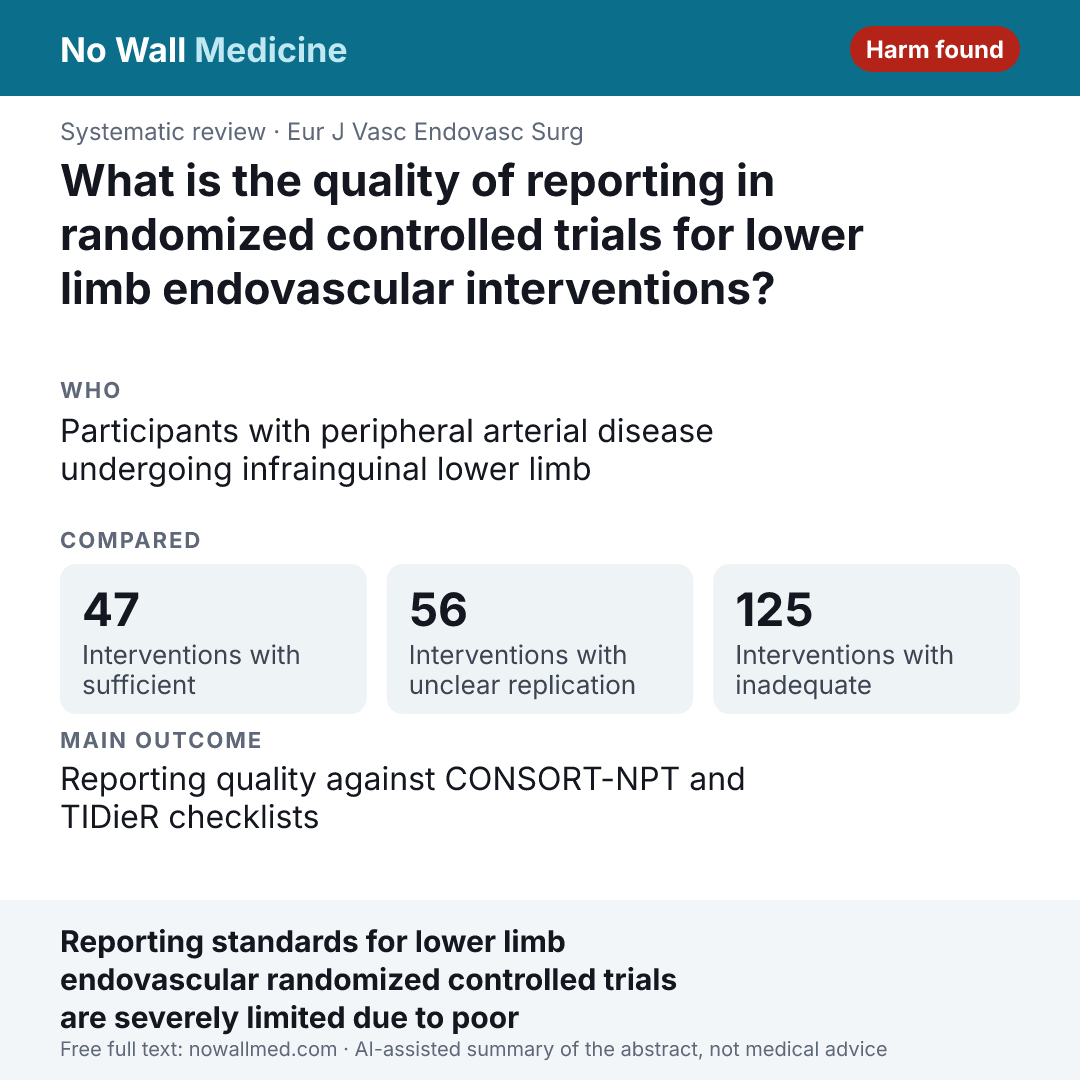
Exploring the Reporting Standards of Randomised Controlled Trials Involving Endovascular Interventions for Peripheral Arterial Disease: A Systematic Review
Systematic reviewHarm found
What is the quality of reporting in randomized controlled trials for lower limb endovascular interventions?
Who
Participants with peripheral arterial disease undergoing infrainguinal lower limb endovascular intervention · Medline, Embase, and Cochrane Library databases
Compared
47Interventions with sufficient replication details (21%)
56Interventions with unclear replication details (24%)
125Interventions with inadequate replication details (55%)
Main outcome
Reporting quality against CONSORT-NPT and TIDieR checklists
Bottom line: Reporting standards for lower limb endovascular randomized controlled trials are severely limited due to poor intervention descriptions and standardization.
Eur J Vasc Endovasc Surg · 2023-09-09 · Save PNG