Visual abstracts
New randomized trials and meta-analyses from leading journals at a glance: who was studied, what was compared, and what was found. Every paper is free to read in full.
All specialtiesCardiology 370Oncology 289Gastroenterology & Hepatology 149Infectious Disease 288Neurology 168Psychiatry & Mental Health 238Pulmonology 169Critical Care 113Endocrinology & Diabetes 214Pediatrics 163Surgery 110Orthopedics & Sports Medicine 67Neurosurgery 23Cardiothoracic & Vascular Surgery 38Plastic & Reconstructive Surgery 73Nephrology 73Rheumatology 72Hematology 84Dermatology 38Ophthalmology 60Obstetrics & Gynecology 105Public & Global Health 110Radiology & Imaging 30Anesthesiology 62Urology 84ENT (Otolaryngology) 47Emergency Medicine 35Allergy & Immunology 44Geriatrics 105Family Medicine & Primary Care 59Medical Genetics & Genomics 34Pathology & Laboratory Medicine 5Physical Medicine & Rehabilitation 91Palliative Care 56Nutrition 125Digital Health & AI 310General Medicine 43
Levels of immunoglobulin isotypes in serum and respiratory samples of patients with chronic obstructive pulmonary disease: a systematic review and meta-analysis
Systematic review and meta-analysisMixed results
What are the immunoglobulin levels in COPD patients compared to healthy controls?
Who
Patients with chronic obstructive pulmonary disease and healthy controls
Compared
COPD: elevated secretory IgA (SMD 1.68 [95% CI, 0.78, 2.59])
Healthy controls: lower IgG2 (SMD -0.91 [-1.24, -0.58])
Main outcome
Serum, sputum, and bronchoalveolar lavage immunoglobulin levels
Bottom line: Serum IgG2 is lower in COPD and low IgG is associated with increased COPD-related admissions.
Limitation: Non-randomized studies were included
Respir Res · 2026-02-25Download image

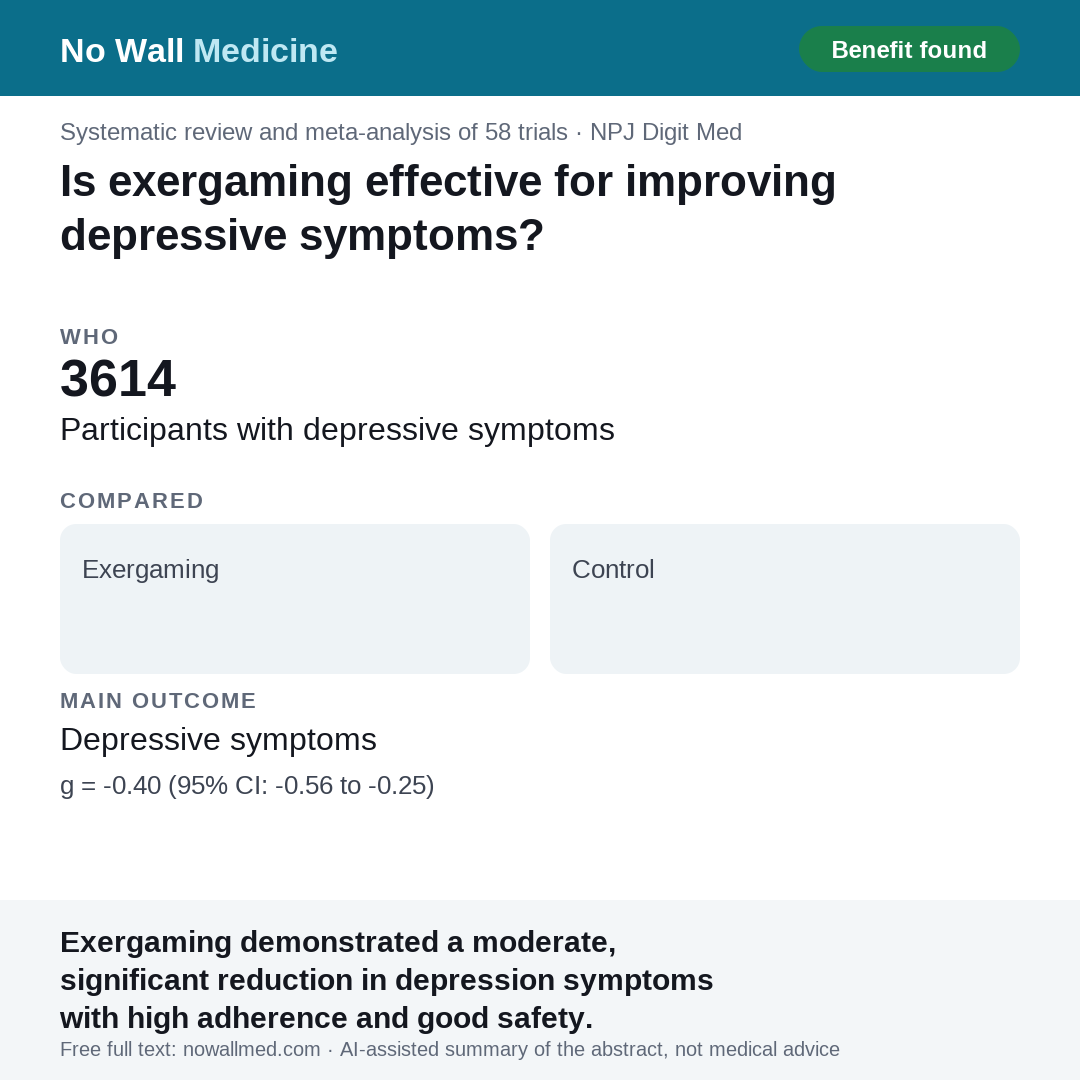
Effectiveness, acceptability, adherence, and safety of exergaming for depressive symptoms: a systematic review and meta-analysis
Systematic review and meta-analysis of 58 trialsBenefit found
Is exergaming effective for improving depressive symptoms?
Who
3614
Participants with depressive symptoms
Compared
Exergaming
Control
Main outcome
Depressive symptoms
Result: g = -0.40 (95% CI: -0.56 to -0.25)
Bottom line: Exergaming demonstrated a moderate, significant reduction in depression symptoms with high adherence and good safety.
Limitation: Future larger-scale randomized controlled trials and studies with extended follow-up periods are needed.
NPJ Digit Med · 2026-02-25Download image
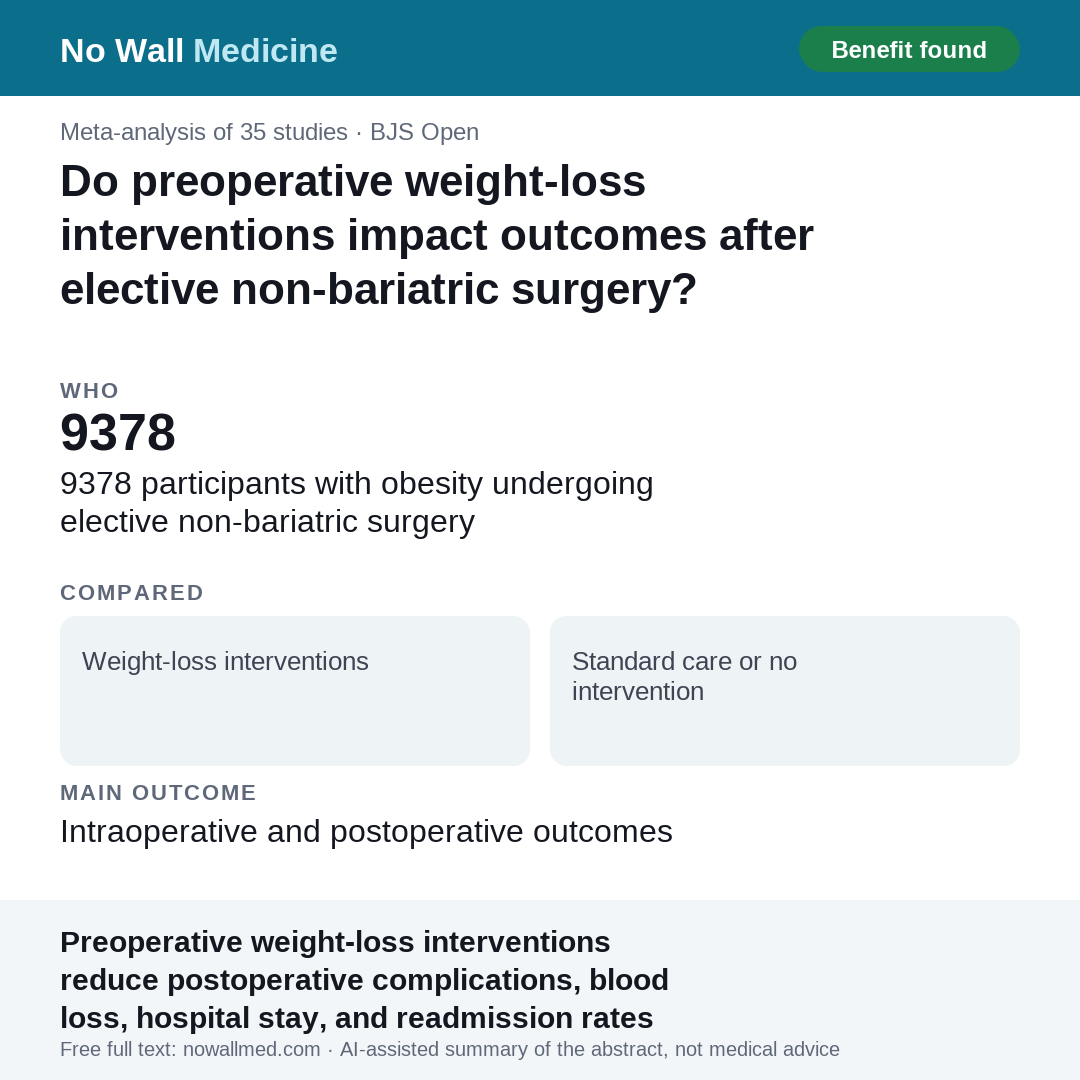
Impact of preoperative weight-loss interventions on outcomes after elective non-bariatric surgery: meta-analysis
Meta-analysis of 35 studiesBenefit found
Do preoperative weight-loss interventions impact outcomes after elective non-bariatric surgery?
Who
9378
9378 participants with obesity undergoing elective non-bariatric surgery
Compared
Weight-loss interventions
Standard care or no intervention
Main outcome
Intraoperative and postoperative outcomes
Result: odds ratio 0.63 (95% confidence interval 0.43 to 0.93)
Bottom line: Preoperative weight-loss interventions reduce postoperative complications, blood loss, hospital stay, and readmission rates in elective non-bariatric surgery.
Limitation: Heterogeneity in study design and surgical populations
BJS Open · 2026-02-25Download image
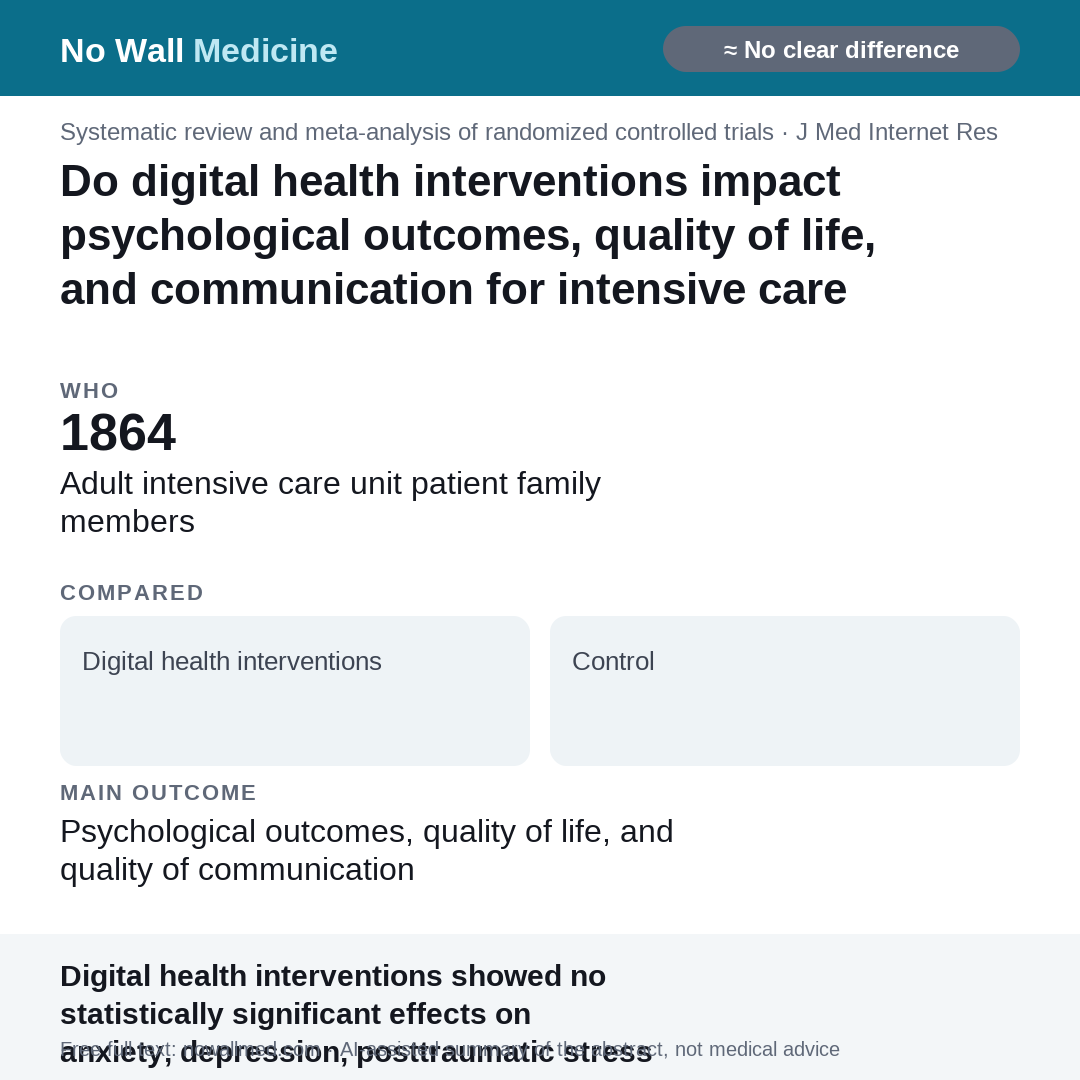
The Effects of Digital Health Interventions for Family Members in Intensive Care Units: Systematic Review and Meta-Analysis of Randomized Controlled Trials
Systematic review and meta-analysis of randomized controlled trialsNo clear difference
Do digital health interventions impact psychological outcomes, quality of life, and communication for intensive care unit family members?
Who
1864
Adult intensive care unit patient family members
Compared
Digital health interventions
Control
Main outcome
Psychological outcomes, quality of life, and quality of communication
Result: no statistically significant pooled effects
Bottom line: Digital health interventions showed no statistically significant effects on anxiety, depression, posttraumatic stress disorder, quality of life, or communication.
Limitation: High heterogeneity and low certainty of the underlying evidence limit the conclusions.
J Med Internet Res · 2026-02-25Download image
Combination of heart failure and atrial fibrillation worsens ethnicity-related disparity: an individual patient-level meta-analysis of randomized trials
Individual patient-level meta-analysis of 12 randomized trialsHarm found
Does comorbid atrial fibrillation worsen ethnicity-related mortality disparities in heart failure patients?
Who
16713
Patients with heart failure and comorbid atrial fibrillation or sinus rhythm
Compared
Non-white patients with HF and AF: 21% (394/1899) all-cause mortality
White patients with HF and AF: 15% (2142/13568) all-cause mortality
Main outcome
all-cause mortality
Result: hazard ratio 1.36 (95% CI 1.20-1.54)
Bottom line: Comorbid atrial fibrillation significantly worsens ethnicity-related mortality disparities in patients with heart failure.
Limitation: Baseline differences between ethnicities were addressed using propensity-score matching.
Eur J Heart Fail · 2026-02-24Download image

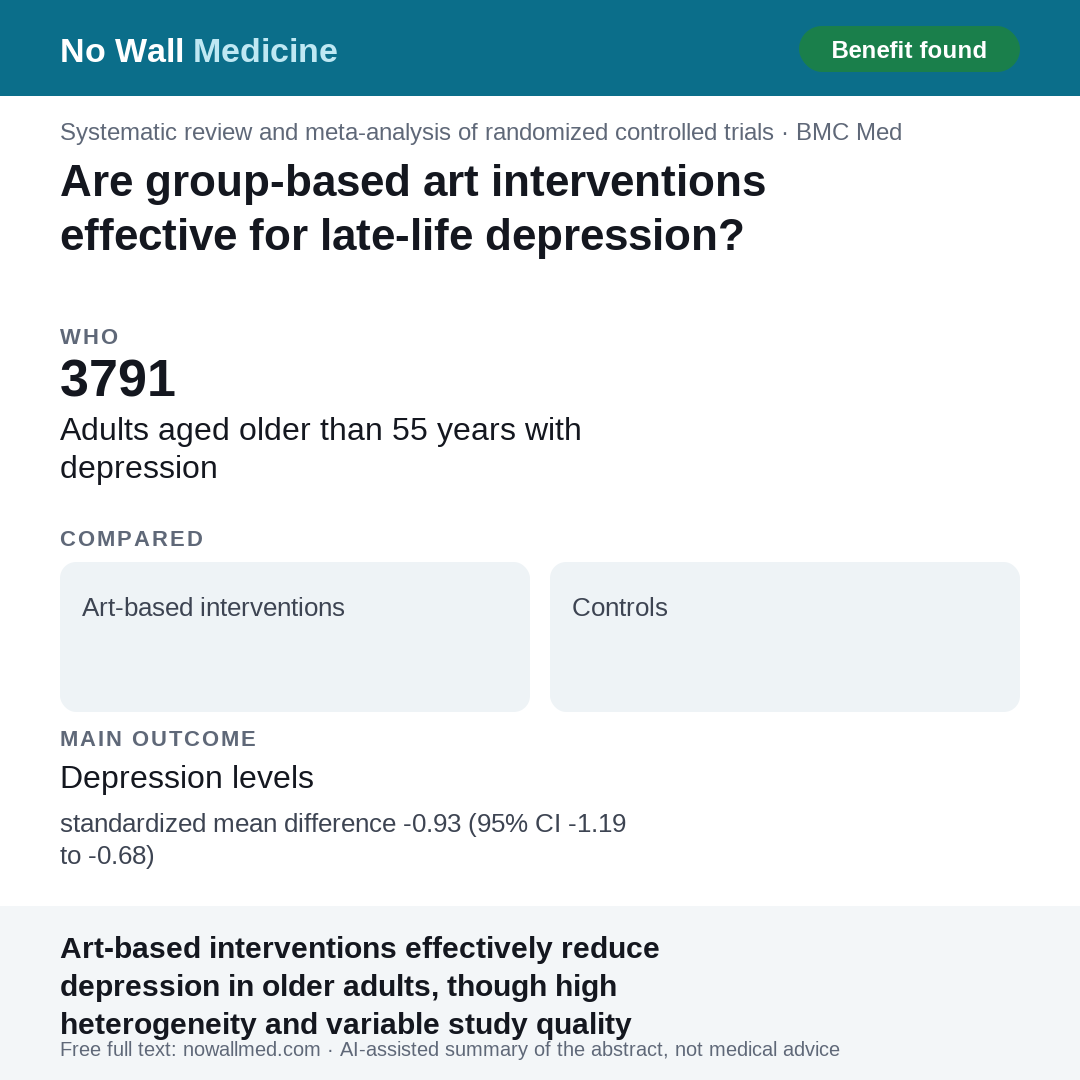
Effectiveness of group-based art interventions for late-life depression: a systematic review and meta-analysis of randomized controlled trials
Systematic review and meta-analysis of randomized controlled trialsBenefit found
Are group-based art interventions effective for late-life depression?
Who
3791
Adults aged older than 55 years with depression
Compared
Art-based interventions
Controls
Main outcome
Depression levels
Result: standardized mean difference -0.93 (95% CI -1.19 to -0.68)
Bottom line: Art-based interventions effectively reduce depression in older adults, though high heterogeneity and variable study quality exist.
Limitation: High degree of heterogeneity and most studies had moderate to high risk of bias.
BMC Med · 2026-02-24Download image
Review of the Performance of Laboratory-Based Molecular Diagnostics for Chlamydia trachomatis and Neisseria gonorrhoeae
Systematic review and narrative reviewBenefit found
What is the performance of laboratory-based molecular diagnostics for chlamydia and gonorrhea?
Who
145
Patients tested for Chlamydia trachomatis and Neisseria gonorrhoeae
Compared
Self-collected vaginal swabs: sensitivity >90% and specificity >98%
Clinician-collected extragenital specimens: sensitivity >90% and specificity >98%
Main outcome
Diagnostic performance of nucleic acid amplification tests
Bottom line: Nucleic acid amplification tests show high sensitivity and specificity for chlamydia and gonorrhea diagnosis.
Limitation: No nucleic acid amplification tests currently have claims for patient-collected extragenital specimens.
Clin Infect Dis · 2026-02-24Download image

Point-of-care Tests for Chlamydia trachomatis and Neisseria gonorrhoeae: Review of the Literature
Systematic literature reviewBenefit found
What is the accuracy and clinical utility of molecular-based point-of-care tests?
Who
Patients with Chlamydia trachomatis and Neisseria gonorrhoeae · Not specified
Compared
Point-of-care tests
Near-point-of-care tests
Main outcome
Performance characteristics and implementation considerations
Bottom line: Point-of-care tests are most beneficial in symptomatic patients within acute care settings to prevent loss to follow-up.
Clin Infect Dis · 2026-02-24Download image

Review of Methods for Detecting Antimicrobial Resistance of Neisseria gonorrhoeae
Systematic reviewMixed results
What are the methods for detecting antimicrobial resistance of Neisseria gonorrhoeae?
Who
Neisseria gonorrhoeae · Medline, Embase, Cochrane, CINAHL, and Scopus
Compared
Culture-based antimicrobial susceptibility testing
Molecular antimicrobial susceptibility testing
Main outcome
Performance of phenotypic and molecular antimicrobial susceptibility testing methods
Bottom line: Culture-based testing remains most reliable, while molecular methods show targeted utility primarily for ciprofloxacin.
Limitation: Molecular predictive accuracy for other antibiotics is limited due to multigenic resistance mechanisms.
Clin Infect Dis · 2026-02-24Download image

Effectiveness of Virtual Reality for Pain Relief in Procedures Related to Obstetrics and Gynaecology: A Systematic Review and Meta-Analysis of Randomised Controlled Trials
Systematic review and meta-analysis of randomized controlled trialsBenefit found
Is immersive virtual reality effective for pain relief in obstetric and gynaecological procedures?
Who
5355
Women undergoing obstetric or gynaecological procedures
Compared
Virtual reality
Standard care
Main outcome
Pain perception and anxiety scores
Result: SMD -0.93 (95% CI -1.25 to -0.60) in labour
Bottom line: Immersive virtual reality effectively reduces pain and anxiety during obstetric and gynaecological procedures, especially during childbirth.
Limitation: High levels of heterogeneity and variability in procedural protocols.
BJOG · 2026-02-24Download image

Diagnosis and management of paediatric magnet ingestion: a systematic review of clinical practice guidelines
Systematic review of clinical practice guidelinesMixed results
What are the current clinical practice guidelines for diagnosing and managing paediatric magnet ingestion?
Who
Children who have ingested magnets
Compared
Asymptomatic single magnets: conservative management is recommended
Prepyloric asymptomatic multiple magnets: endoscopic removal is recommended
Symptomatic multiple magnets: surgery is recommended
Main outcome
Diagnosis and management recommendations for magnet ingestion
Bottom line: Guidelines show consensus on some management strategies but vary in others and rely on low-quality evidence.
Limitation: Existing guidelines are based on low-quality evidence or expert consensus.
Emerg Med J · 2026-02-24Download image

Serotype-specific pneumococcal invasiveness: a global meta-analysis of paired estimates of disease incidence and carriage prevalence
Meta-analysis of 80 publicationsMixed results
What are the serotype-specific case-carrier ratios for pneumococcal disease across different settings?
Who
Children and individuals across various income settings and HIV statuses · 18 countries
Compared
Pre-PCV non-vaccine serotypes in LICs and LMICs: 177 [95% CI 124-251]
Pre-PCV non-vaccine serotypes in UMICs and HICs: 103 [60-176]
Post-PCV non-PCV13 serotypes in UMICs and HICs: 26 [22-30]
Post-PCV non-PCV13 serotypes in LICs and LMICs: 173 [139-216]
Main outcome
Case-carrier ratios (IPD incidence divided by carriage prevalence)
Bottom line: Pneumococcal invasiveness varies significantly by serotype, age, income group, HIV status, and vaccine introduction.
Limitation: Substantial variation in pneumococcal invasiveness remains unexplained.
Funded by: Wellcome Trust
Lancet Microbe · 2026-02-23Download image

Anticholinergic Medication Burden Scales: A Systematic Review
Systematic reviewUnclear result
What are the characteristics and variability of anticholinergic burden scales?
Who
Studies proposing novel or updated anticholinergic burden scales
Compared
Medications included per scale: 27 to 217
74%High-potency drugs scored inconsistently
Main outcome
Scale development strategies, scoring methods, and clinical outcomes
Bottom line: No gold standard anticholinergic burden scale was identified due to significant variability in drug coverage and scoring methods.
J Am Geriatr Soc · 2026-02-23Download image

Mortality in prenatally detected congenital small bowel obstructions: systematic review and meta-analysis
Systematic review and meta-analysisMixed results
What is the risk of intrauterine fetal demise and postnatal death in prenatally detected small bowel obstructions?
Who
774
Fetuses with prenatally detected small bowel obstruction
Compared
All small bowel obstruction: 6.4% [95% CI, 4.6%-8.9%] IUFD
Duodenal obstruction: 6.1% [95% CI 3.6%-10.0%] IUFD
Jejunoileal obstruction: 5.3% [95% CI, 2.6%-10.6%] IUFD
Main outcome
Intrauterine fetal demise and postnatal death
Result: 6.4% [95% CI, 4.6%-8.9%] IUFD
Bottom line: Fetuses with small bowel obstruction face significant risks of intrauterine fetal demise and postnatal death.
AJOG Glob Rep · 2026-02-23Download image

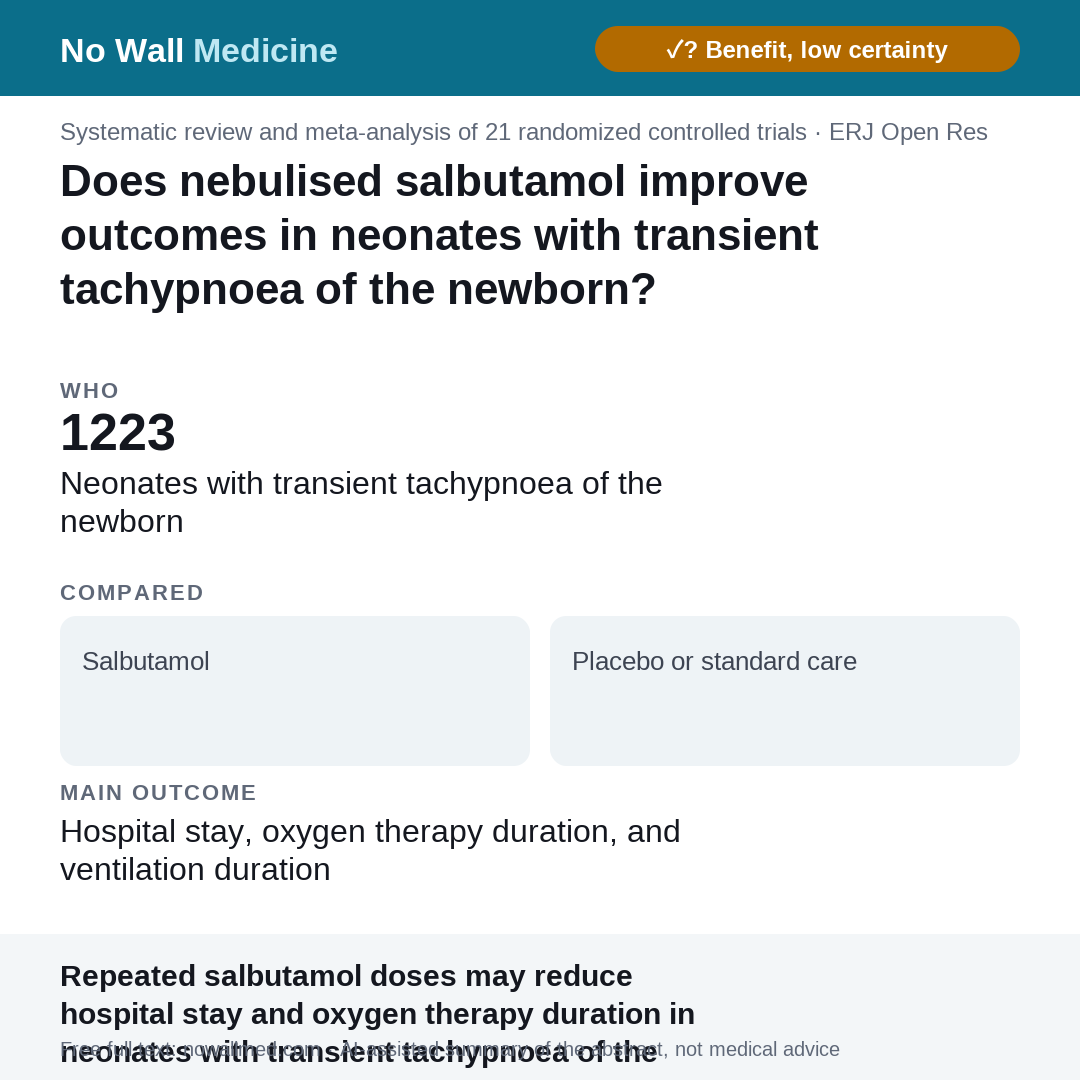
Effects of salbutamol in transient tachypnoea of the newborn: a systematic review and meta-analysis
Systematic review and meta-analysis of 21 randomized controlled trialsBenefit found
Does nebulised salbutamol improve outcomes in neonates with transient tachypnoea of the newborn?
Who
1223
Neonates with transient tachypnoea of the newborn
Compared
Salbutamol
Placebo or standard care
Main outcome
Hospital stay, oxygen therapy duration, and ventilation duration
Result: mean difference -2.3 days (95% CI -3.2 to -1.4 days)
Bottom line: Repeated salbutamol doses may reduce hospital stay and oxygen therapy duration in neonates with transient tachypnoea of the newborn.
Limitation: Low certainty of evidence for most outcomes and need for high-quality trials.
ERJ Open Res · 2026-02-23Download image
AI and Wearables for Early Detection of Cognitive Impairment and Dementia: Systematic Review
Systematic review and narrative synthesisBenefit found
Can wearable devices detect early cognitive impairment and dementia?
Who
200000
Human participants with a mean age 50 years or older
Compared
Disrupted sleep, circadian rhythm, and activity patterns: linked to worse cognitive outcomes
Machine learning and deep learning approaches: area under the curve values between approximately 0.70 and 0.95
Main outcome
early detection and prevention of cognitive impairment and dementia
Bottom line: Wearable-derived behavioral markers show promise for early risk stratification through continuous, passive monitoring.
Limitation: Small sample sizes, short monitoring durations, and limited external validation.
J Med Internet Res · 2026-02-23Download image

The Predictive Value of Machine Learning for Postoperative Delirium in Cardiac Surgery: Systematic Review and Meta-Analysis
Systematic review and meta-analysisBenefit found
How effective is machine learning for predicting postoperative delirium in cardiac surgery?
Who
80143
Patients undergoing cardiac surgery
Compared
Machine learning models: c-index 0.805 (95% CI 0.759-0.852)
Logistic regression models: c-index 0.773 (95% CI 0.724-0.823)
Main outcome
Postoperative delirium prediction performance
Result: c-index 0.805 (95% CI 0.759-0.852)
Bottom line: Machine learning shows promising performance for predicting postoperative delirium following cardiac surgery.
Limitation: Limited number of studies and validation approaches necessitate cautious interpretation.
J Med Internet Res · 2026-02-23Download image

Barriers and enablers of implementing spiritual care at the end of life: a mixed-methods systematic review using the theoretical domains framework
Mixed-methods systematic reviewMixed results
What are the barriers and enablers of implementing spiritual care at the end of life?
Who
Patients and healthcare providers in palliative care
Compared
Barriers: 16 sub-themes
Enablers: 16 sub-themes
Main outcome
Barriers and enablers of implementing spiritual care
Bottom line: Implementation requires shifting from spiritual rescue toward longitudinal spiritual integration and multidisciplinary training.
BMC Palliat Care · 2026-02-23Download image

Outcomes of deprescribing for people with life-limiting conditions: A systematic review
Systematic reviewBenefit found
What are the outcomes of deprescribing in people with life-limiting conditions?
Who
People with life-limiting conditions · Nursing homes, long-term care facilities, and hospitals
Compared
Deprescribing
Control
Main outcome
Clinical outcomes including medication burden, mortality, and costs
Bottom line: Deprescribing may reduce medication burden and costs, though mortality impacts and risks require careful monitoring.
Limitation: Further research should explore how outcomes vary by disease condition and medication type.
Palliat Med · 2026-02-22Download image

A Systematic Review and Meta-Analysis of the Recurrence of Autoimmune Encephalitis
Systematic review and meta-analysis of 39 observational studiesMixed results
What is the recurrence rate and risk factors for autoimmune encephalitis?
Who
Patients with autoimmune encephalitis
Compared
0.162Overall autoimmune encephalitis (95% CI, 0.121-0.207)
0.148Anti-NMDAR encephalitis (95% CI, 0.108-0.193)
Main outcome
Recurrence rate of autoimmune encephalitis
Bottom line: The overall recurrence rate was 0.162, with second-line treatment and teratoma removal decreasing recurrence risk.
Ann Clin Transl Neurol · 2026-02-22Download image