Visual abstracts
New randomized trials and meta-analyses from leading journals at a glance: who was studied, what was compared, and what was found. Every paper is free to read in full.
All specialtiesCardiology 4877Oncology 4136Gastroenterology & Hepatology 1942Infectious Disease 3836Neurology 1904Psychiatry & Mental Health 2273Pulmonology 2143Critical Care 1364Endocrinology & Diabetes 2580Pediatrics 2980Surgery 2556Orthopedics & Sports Medicine 931Neurosurgery 537Cardiothoracic & Vascular Surgery 674Plastic & Reconstructive Surgery 591Nephrology 1133Rheumatology 823Hematology 1109Dermatology 621Ophthalmology 543Obstetrics & Gynecology 1686Public & Global Health 1058Radiology & Imaging 648Anesthesiology 986Urology 764ENT (Otolaryngology) 503Emergency Medicine 511Allergy & Immunology 313Geriatrics 979Family Medicine & Primary Care 562Medical Genetics & Genomics 676Pathology & Laboratory Medicine 159Physical Medicine & Rehabilitation 757Palliative Care 444Nutrition 1588Digital Health & AI 2197General Medicine 320
Autoantibodies as predictors of progression to rheumatoid arthritis: a systematic review and meta-analysis
Systematic review and meta-analysisBenefit found
Do autoantibodies predict progression to rheumatoid arthritis?
Who
Autoantibody positive and negative individuals
Compared
Autoantibody positive: 3.1--19.3-fold increase risk
Autoantibody negative
Main outcome
Risk of developing rheumatoid arthritis
Bottom line: Autoantibody presence confers a 3.1 to 19.3-fold increased risk of developing rheumatoid arthritis.
RMD Open · 2026-02-11Download image

Conventional therapy vs HMA or LDAC with or without venetoclax in older adults with AML: systematic review and meta-analysis
Systematic review and meta-analysisMixed results
Conventional therapy versus HMA or LDAC with or without venetoclax in older adults with AML
Who
Older adults with newly diagnosed acute myeloid leukemia
Compared
Conventional therapy
HMA or LDAC based strategies
Main outcome
Mortality, complete remission rates, and recurrence
Result: risk ratio 0.94 (95% CI 0.85-1.04)
Bottom line: Conventional therapy may increase remission rates but evidence for mortality and recurrence benefits remains of low certainty.
Limitation: Evidence for comparisons with venetoclax is of very low certainty.
Blood Adv · 2026-02-11Download image

Perioperative Immune Checkpoint Inhibitors Combined with Radical Cystectomy: A Rapid Systematic Review and Meta-analysis
Rapid systematic review and meta-analysisBenefit found
Are perioperative immune checkpoint inhibitors effective for muscle-invasive bladder cancer patients undergoing radical cystectomy?
Who
Patients with muscle-invasive bladder cancer undergoing radical cystectomy
Compared
Perioperative immune checkpoint inhibitors
Control
Main outcome
Event-free survival and overall survival in lower tract urothelial carcinoma
Result: event-free survival hazard ratio 0.53 (95% CI 0.32-0.87); overall survival hazard ratio 0.70 (95% CI 0.51-0.96)
Bottom line: Perioperative immune checkpoint inhibitors show promising efficacy for event-free and overall survival in lower tract urothelial carcinoma.
Limitation: High heterogeneity in treatment regimens, endpoint definitions, and follow-up durations limits interpretability.
Eur Urol Open Sci · 2026-02-11Download image

Advancing healthcare AI governance through a comprehensive maturity model based on systematic review
Systematic reviewBenefit found
How can healthcare artificial intelligence governance be improved through a maturity model?
Who
35
Thirty-five artificial intelligence implementation frameworks
Compared
Existing frameworks
Healthcare AI Governance Readiness Assessment
Main outcome
Identification of critical governance domains and a maturity model
Bottom line: A new five-level maturity model provides actionable governance pathways based on organizational resources.
NPJ Digit Med · 2026-02-11Download image

Text-Based Depression Estimation Using Machine Learning With Standard Labels: Systematic Review and Meta-Analysis
Systematic review and meta-analysisBenefit found
How well do text-based machine learning models predict depression using standard labels?
Who
15
Machine learning models using text and standard depression labels
Compared
Embedding-based text representations: r=0.741 (95% CI 0.648-0.812)
Traditional features: r=0.514 (95% CI 0.385-0.623)
Deep learning architectures: r=0.731 (95% CI 0.660-0.789)
Shallow models: r=0.486 (95% CI 0.352-0.599)
Main outcome
Predictive performance of text-based depression models
Result: r 0.605 (95% CI 0.498-0.693)
Bottom line: Text-based depression models using standard labels show large predictive performance, especially with deep learning and embedding-based representations.
J Med Internet Res · 2026-02-11Download image

Robot-assisted therapy following stroke: what effects on quality of life, cognitive and psychosocial outcomes? A systematic review
Systematic reviewBenefit found
What are the effects of robot-assisted therapy on post-stroke non-motor outcomes?
Who
90
Post-stroke patients
Compared
Robot-assisted therapy
Conventional training controls
Main outcome
Quality of life, cognition, and psychosocial functioning
Bottom line: Robot-assisted therapy may have a broad impact on quality of life, cognition, and psychosocial outcomes after stroke.
Limitation: Considerable heterogeneity in participant characteristics, intervention duration, and dosage.
J Rehabil Med · 2026-02-11Download image

The role of vasopressin in trauma resuscitation: a protocol of a systematic review and meta-analysis of randomized and observational studies
Meta-analysis of studiesUnclear result
Vasopressin effect in trauma resuscitation
Who
severely injured patients with hemorrhagic shock
Compared
Vasopressin
Control
Main outcome
mortality and complications
Bottom line: Vasopressin may benefit trauma resuscitation
Scand J Trauma Resusc Emerg Med · 2026-02-11Download image

Prognosis and Treatment Response in Aggressive-variant Prostate Cancer and Treatment-related Neuroendocrine Prostate Cancer: A Systematic Review and Meta-analysis
Systematic review and meta-analysisBenefit found
What is the prognosis and treatment response of aggressive-variant prostate cancer?
Who
Patients with aggressive-variant prostate cancer
Compared
Aggressive-variant prostate cancer: 46% objective response rate
Non-aggressive-variant prostate cancer: 19% objective response rate
Main outcome
Progression-free survival, overall survival, and objective response rates
Result: hazard ratio 2.72 (95% CI 1.54-4.81) for progression-free survival
Bottom line: Platinum-based chemotherapy shows higher response rates and survival benefits in aggressive-variant prostate cancer subtypes.
Limitation: Data were insufficient for meta-analytic comparison of survival by platinum-based chemotherapy in treatment-related neuroendocrine prostate cancer.
Eur Urol Oncol · 2026-02-10Download image

A global gap in autonomy assessment among older adults: a COSMIN systematic review
Systematic reviewMixed results
What is the quality of autonomy assessment instruments for older adults?
Who
861338
Adults aged 60 years and older · 42 countries
Compared
Instruments meeting COSMIN category A criteria: 14 instruments
Instruments with structural validity: 29 instruments
Instruments with internal consistency: 33 instruments
Instruments with test-retest reliability: 17 instruments
Main outcome
Quality of autonomy measurement instruments
Bottom line: Only 14 instruments met high-quality criteria, with substantial gaps in cross-cultural validity and responsiveness.
Limitation: Substantial gaps remain in cross-cultural validity and responsiveness of the tested instruments.
Lancet Healthy Longev · 2026-02-10Download image

Peripheral manifestations in spondyloarthritis: a systematic literature review on their assessment and the effect of biological/targeted synthetic DMARDs
Systematic literature reviewMixed results
How are peripheral manifestations assessed and how effective are biological or targeted synthetic disease-modifying antirheumatic drugs?
Who
Patients with axial spondyloarthritis and peripheral spondyloarthritis
Compared
Axial spondyloarthritis: standardized mean differences 0.26 to -1.18
Peripheral spondyloarthritis: standardized mean difference -0.10 to -1.22
Main outcome
Efficacy of biological or targeted synthetic disease-modifying antirheumatic drugs on peripheral manifestations
Bottom line: Biological or targeted synthetic disease-modifying antirheumatic drugs show small-to-moderate effects on peripheral manifestations in spondyloarthritis.
Rheumatology · 2026-02-10Download image

Artificial Intelligence Models to Predict Recurrence Risk Prediction in Early-Stage Non-Small Cell Lung Cancer: A Systematic Review
Systematic reviewBenefit found
How do artificial intelligence models predict recurrence risk in early-stage non-small cell lung cancer?
Who
Patients with early-stage non-small cell lung cancer
Compared
Single-modality data models
Multimodality data integration: area under the curve 0.72-0.94
Main outcome
Predictive performance for postoperative recurrence risk
Bottom line: Integrating multimodal data improves artificial intelligence model performance for predicting recurrence in early-stage non-small cell lung cancer.
Limitation: Models face risk of overfitting and high bias risk during validation due to small test sets.
Eur J Cardiothorac Surg · 2026-02-10Download image

Neuromuscular electrical stimulation for early rehabilitation in critically ill patients: a systematic review of applied protocols
Systematic reviewUnclear result
NMES for critically ill patients
Who
2553
Adult intensive care unit patients
Compared
NMES
Control
Main outcome
Rehabilitation outcomes
Bottom line: NMES protocols lack standardization
Limitation: Heterogeneous NMES protocols
Crit Care · 2026-02-10Download image

Telemonitoring modalities in heart failure: comparative effectiveness across the heart failure population-a meta-analysis
Meta-analysis of 79 randomised trialsBenefit found
Which remote monitoring modality is most effective for heart failure patients?
Who
31669
Patients with heart failure
Compared
Remote monitoring
Standard care
Main outcome
Total heart failure hospitalisations, first hospitalisations, and all-cause mortality
Result: incidence rate ratio 0.81 (95% CI 0.72-0.91) for total hospitalisations
Bottom line: Remote monitoring reduces total heart failure hospitalisations, first hospitalisations, and all-cause mortality in heart failure patients.
Limitation: Current evidence does not allow targeted remote monitoring implementation for specific patients.
NPJ Digit Med · 2026-02-10Download image

Effect of preoperative prehabilitation on the 6-minute walk distance and postoperative outcomes in adult patients: meta-analysis
Meta-analysis of 21 randomized clinical trialsBenefit found
Does preoperative prehabilitation improve 6-minute walk distance and postoperative outcomes?
Who
1649
Adult patients scheduled to undergo elective surgery
Compared
Prehabilitation
Control
Main outcome
Change in 6-minute walk distance
Result: mean difference 29 m (95% c.i. 14 to 42 m)
Bottom line: Prehabilitation with physical exercise improves preoperative cardiorespiratory fitness but does not affect hospital stay or mortality.
BJS Open · 2026-02-10Download image

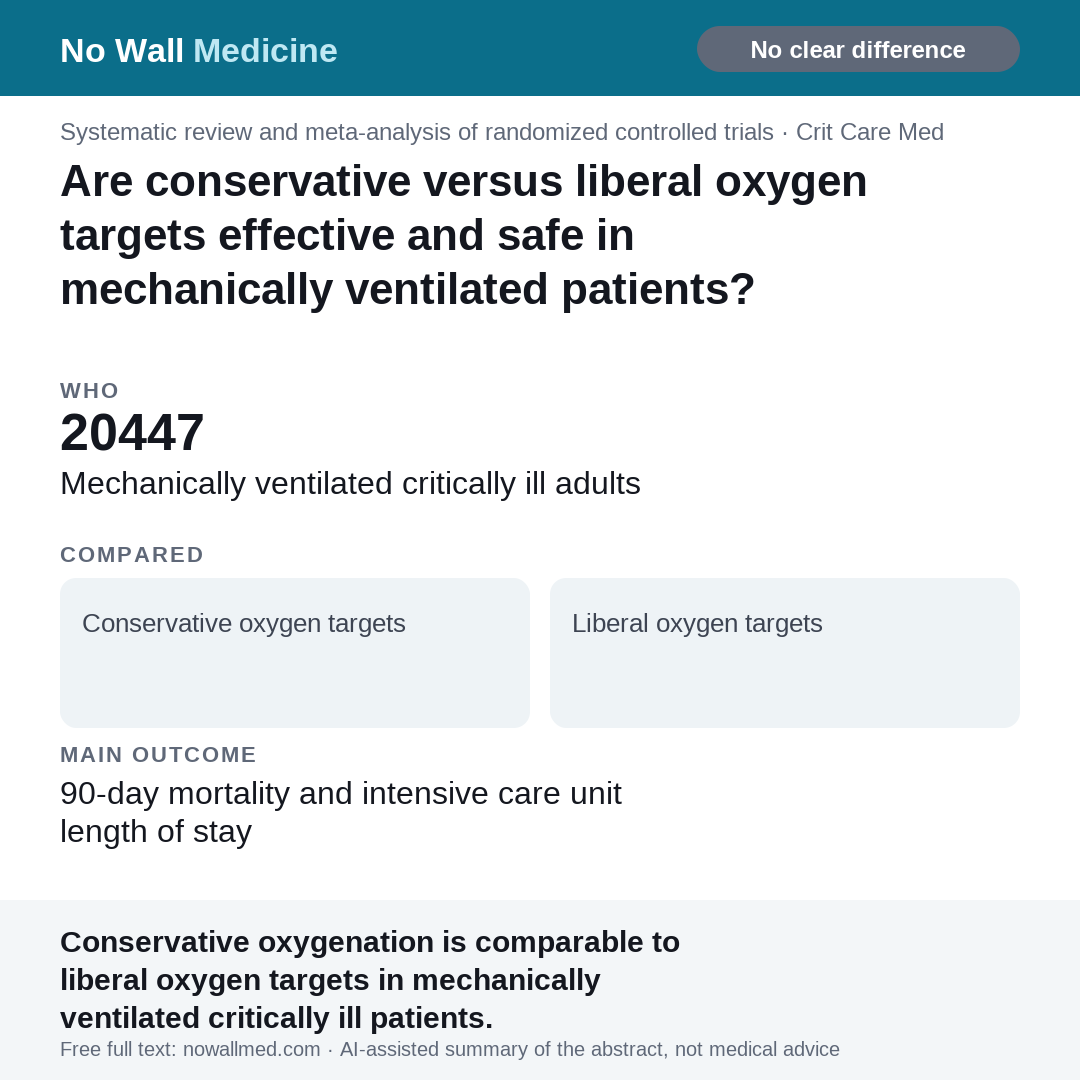
Conservative Oxygen Targets in Mechanically Ventilated Patients (OXY-BREATHES): A Systematic Review and Meta-Analysis of Randomized Controlled Trials
Systematic review and meta-analysis of randomized controlled trialsNo clear difference
Are conservative versus liberal oxygen targets effective and safe in mechanically ventilated patients?
Who
20447
Mechanically ventilated critically ill adults
Compared
Conservative oxygen targets
Liberal oxygen targets
Main outcome
90-day mortality and intensive care unit length of stay
Result: risk ratio 1.01 (95% CI 0.94-1.09)
Bottom line: Conservative oxygenation is comparable to liberal oxygen targets in mechanically ventilated critically ill patients.
Limitation: Imprecision and open-label trial designs in some studies.
Crit Care Med · 2026-02-09Download image
Risk Factors for the Development of Food Allergy in Infants and Children: A Systematic Review and Meta-Analysis
Systematic review and meta-analysisMixed results
What is the incidence and risk factors for food allergy development in infants and children?
Who
2
Children younger than 6 years · 40 countries
Compared
4.7%Overall incidence
Atopic dermatitis within first year: OR, 3.88; RD, 12.0%; 95% CI, 8.8%-15.7%
Allergic rhinitis: OR, 3.39; RD, 10.1%; 95% CI, 6.7%-14.4%
Infant antibiotic use first month: OR, 4.11; RD, 12.8%; 95% CI, 0.4%-40%
Main outcome
Food allergy to age 6 years
Bottom line: Food allergy incidence is likely 4.7%, with risk factors including early allergic conditions, delayed allergen introduction, genetics, and antibiotic exposure.
JAMA Pediatr · 2026-02-09Download image

Global ethnic disparities in cerebral small vessel disease imaging markers and vascular risk factors: a systematic review and meta-analysis
Systematic review and meta-analysisMixed results
Are there ethnic disparities in cerebral small vessel disease markers and vascular risk factors?
Who
Community-dwelling adults
Compared
Asians: higher cerebral microbleeds and lacunes
Whites: greater metabolic risks
Blacks: higher hypertension
Hispanics: elevated diabetes
Main outcome
cerebral small vessel disease imaging markers and vascular risk factors
Bottom line: Cerebral small vessel disease phenotypes and risk factor associations differ significantly across global ethnic groups.
Alzheimers Dement · 2026-02-09Download image

Co-occurrence of psychotic disorders and borderline personality disorder: a systematic review and meta-analysis
Systematic review and meta-analysisMixed results
What is the prevalence of co-occurrence between psychotic disorders and borderline personality disorder?
Who
People with psychotic disorders and people with borderline personality disorder
Compared
22.7%Borderline personality disorder in psychotic disorders (95% CI: 14.2–34.3%)
14.3%Psychotic disorder in borderline personality disorder (95% CI: 5.5–32.1%)
40.0%Borderline personality disorder in first-episode psychosis (95% CI: 21.9–61.3%)
Main outcome
Prevalence of co-occurrence
Bottom line: Co-occurrence of these disorders is significant, particularly in first-episode psychosis, requiring integrative and personalized care pathways.
Limitation: Most studies were cross-sectional, with small samples and high heterogeneity.
Psychol Med · 2026-02-09Download image

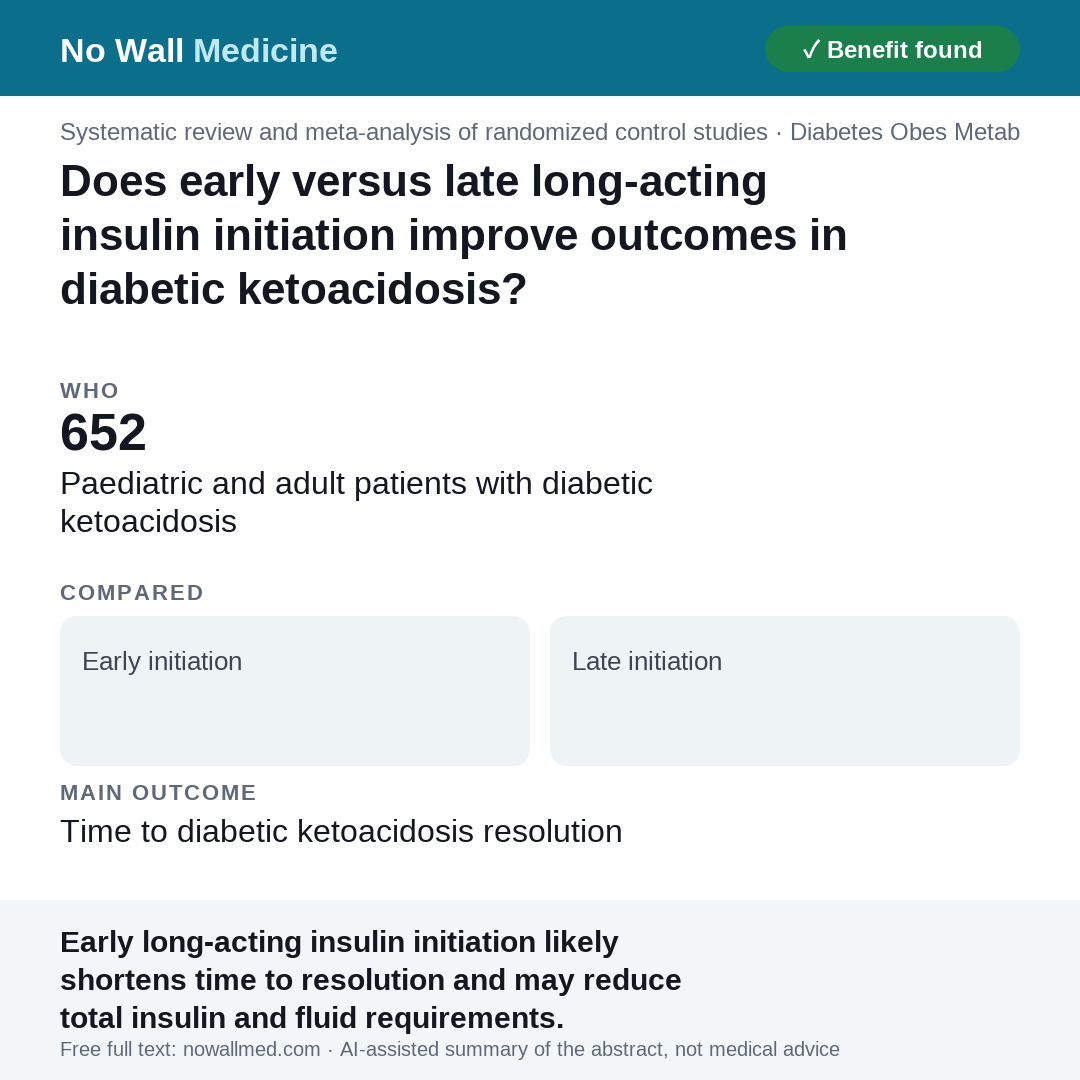
Early versus late initiation of long-acting insulin in paediatric and adult diabetic ketoacidosis: A systematic review and meta-analysis of randomised control trials
Systematic review and meta-analysis of randomized control trialsBenefit found
Does early versus late long-acting insulin initiation improve outcomes in diabetic ketoacidosis?
Who
652
Paediatric and adult patients with diabetic ketoacidosis
Compared
Early initiation
Late initiation
Main outcome
Time to diabetic ketoacidosis resolution
Result: standardized mean difference -0.61 (95% CI -0.83 to -0.38)
Bottom line: Early long-acting insulin initiation likely shortens time to resolution and may reduce total insulin and fluid requirements.
Limitation: Evidence for rebound hyperglycaemia and recurrent diabetic ketoacidosis outcomes remains limited and imprecise.
Diabetes Obes Metab · 2026-02-09Download image
Peri-operative fasting in adults: an international, multidisciplinary consensus statement
International, multidisciplinary consensus statementBenefit found
What are the recommended peri-operative fasting practices for adults?
Who
Adults undergoing anesthesia or sedation · International, five continents
Compared
Solid food and non-clear liquids: continue current practices
Clear liquids: encourage until 2 h before anesthesia
Main outcome
Peri-operative fasting recommendations
Bottom line: Liberalize clear liquid intake until 2 hours before anesthesia to minimize peri-procedural fasting times.
Anaesthesia · 2026-02-09Download image