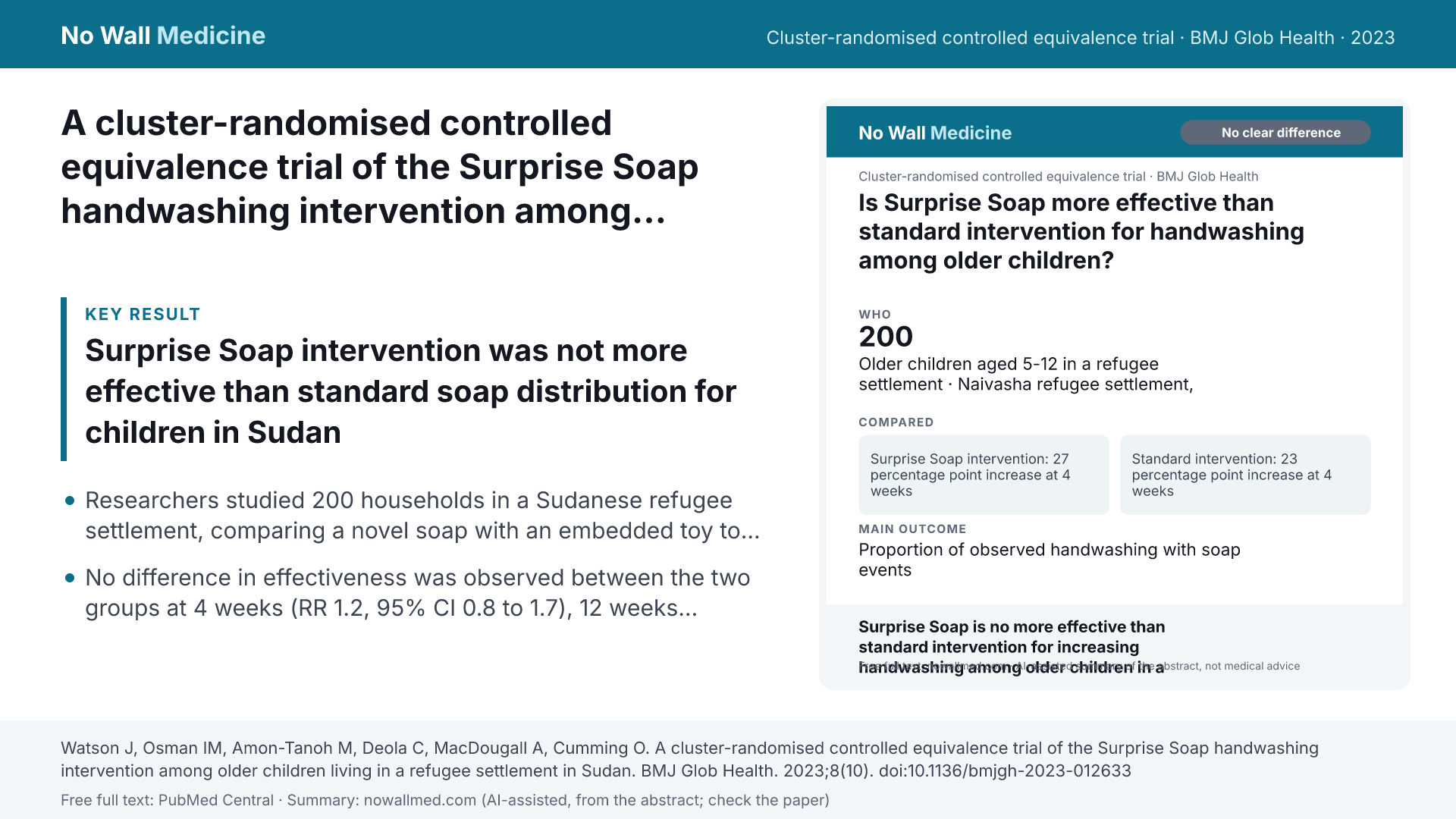
Surprise Soap intervention was not more effective than standard soap distribution for children in Sudan
A cluster-randomised controlled equivalence trial of the Surprise Soap handwashing intervention among older children living in a refugee settlement in Sudan
Cluster-randomised controlled equivalence trialNo clear difference
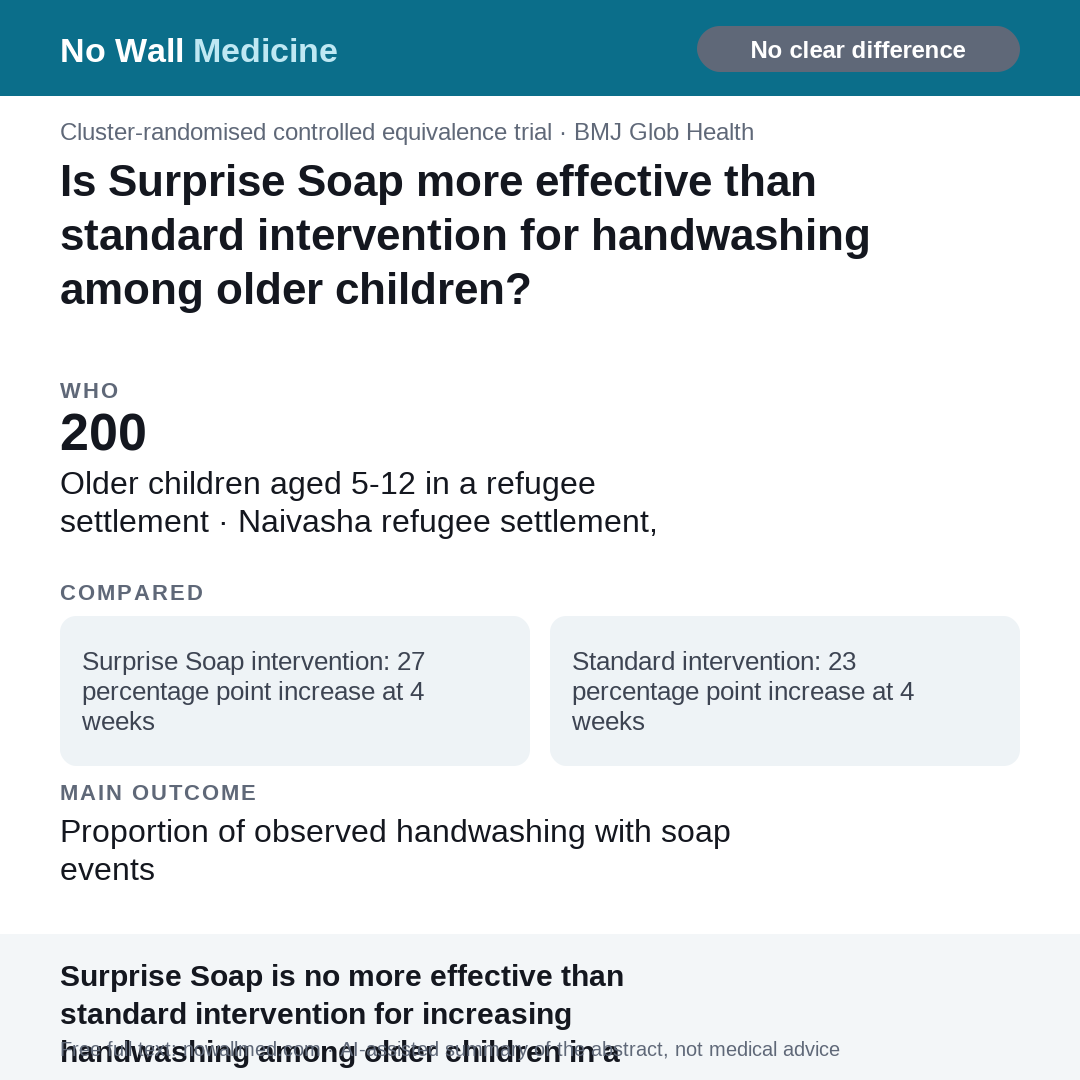
Is Surprise Soap more effective than standard intervention for handwashing among older children?
Who
200
Older children aged 5-12 in a refugee settlement · Naivasha refugee settlement, Sudan
Compared
Surprise Soap intervention: 27 percentage point increase at 4 weeks
Standard intervention: 23 percentage point increase at 4 weeks
Main outcome
Proportion of observed handwashing with soap events
Result: RR 1.1 (95% CI 0.8 to 1.5) at 16 weeks
Bottom line: Surprise Soap is no more effective than standard intervention for increasing handwashing among older children in a refugee settlement.
Limitation: Further trials including a passive control arm are needed to determine independent effects.
BMJ Glob Health · 2023-10-13Download image
Clinical question: Is Surprise Soap more effective than standard intervention for handwashing among older children?
Why it matters: Evidence is limited regarding which approaches effectively increase handwashing with soap among older children living in emergency settings.
Key points
- Researchers studied 200 households in a Sudanese refugee settlement, comparing a novel soap with an embedded toy to a standard intervention of health messaging and plain soap.
- No difference in effectiveness was observed between the two groups at 4 weeks (RR 1.2, 95% CI 0.8 to 1.7), 12 weeks (RR 0.8, 95% CI 0.5 to 1.1), or 16 weeks (RR 1.1, 95% CI 0.8 to 1.5).
- Both groups showed increased handwashing with soap at 4 weeks, with a 27 percentage point increase in the intervention arm and a 23 percentage point increase in the control arm.
Limitation the authors note: The authors state that further trials including a passive control arm are needed to determine the independent effects of each intervention.
Headline and key points written with AI from the paper’s abstract, with every number checked against it. Read the paper before relying on them.
Was this summary helpful?
Abstract
Introduction
Increasing handwashing with soap (HWWS) among older children in emergency settings can have a large public health impact, however, evidence on what works is limited. One promising approach is the 'Surprise Soap' intervention in which a novel soap with an embedded toy is delivered to children in a short, participatory household session that includes a glitter game and HWWS practice. Here, we evaluate this intervention against a standard intervention in a complex emergency setting. Methods
A cluster-randomised controlled equivalence trial was conducted in Naivasha refugee settlement, Sudan. Blinding was not possible. 203 randomly selected households, with at least one child aged 5-12, were randomised to receive the Surprise Soap intervention (n=101) or a standard intervention comprising a short household session with health messaging and plain soap distribution (n=102). The primary outcome was the proportion of prespecified potential HWWS events observed for children aged 5-12, accompanied by HWWS, at baseline, 4, 12 and 16 weeks post intervention delivery. Results
200 households were included in the analyses: 101 intervention and 99 control. No difference in intervention effectiveness was observed at any follow-up (4 weeks: adjusted rate ratio (RR) 1.2, 95% CI 0.8 to 1.7; 12 weeks: RR 0.8, 95% CI 0.5 to 1.1; 16 weeks: RR 1.1, 95% CI 0.8 to 1.5). However, we observed increased HWWS in both arms at 4 weeks (27 and 23 percentage point increase in the intervention and control arm, respectively) that was sustained at 16 weeks. Conclusions
We find that the Surprise Soap intervention is no more effective at increasing older children's HWWS than a standard, household-level, health-based intervention in this complex humanitarian emergency. There appears to be no marginal benefit in terms of HWWS that would justify the additional cost of implementing the Surprise Soap intervention. Further trials that include a passive control arm are needed to determine the independent effects of each intervention and guide future intervention design.
Abstract reproduced under the article’s CC BY NC licence.
Subject terms
Cite this article
Watson J, Osman IM, Amon-Tanoh M, Deola C, MacDougall A, Cumming O. A cluster-randomised controlled equivalence trial of the Surprise Soap handwashing intervention among older children living in a refugee settlement in Sudan. BMJ Glob Health. 2023. doi:10.1136/bmjgh-2023-012633
Spotted a mistake? Suggest a correction