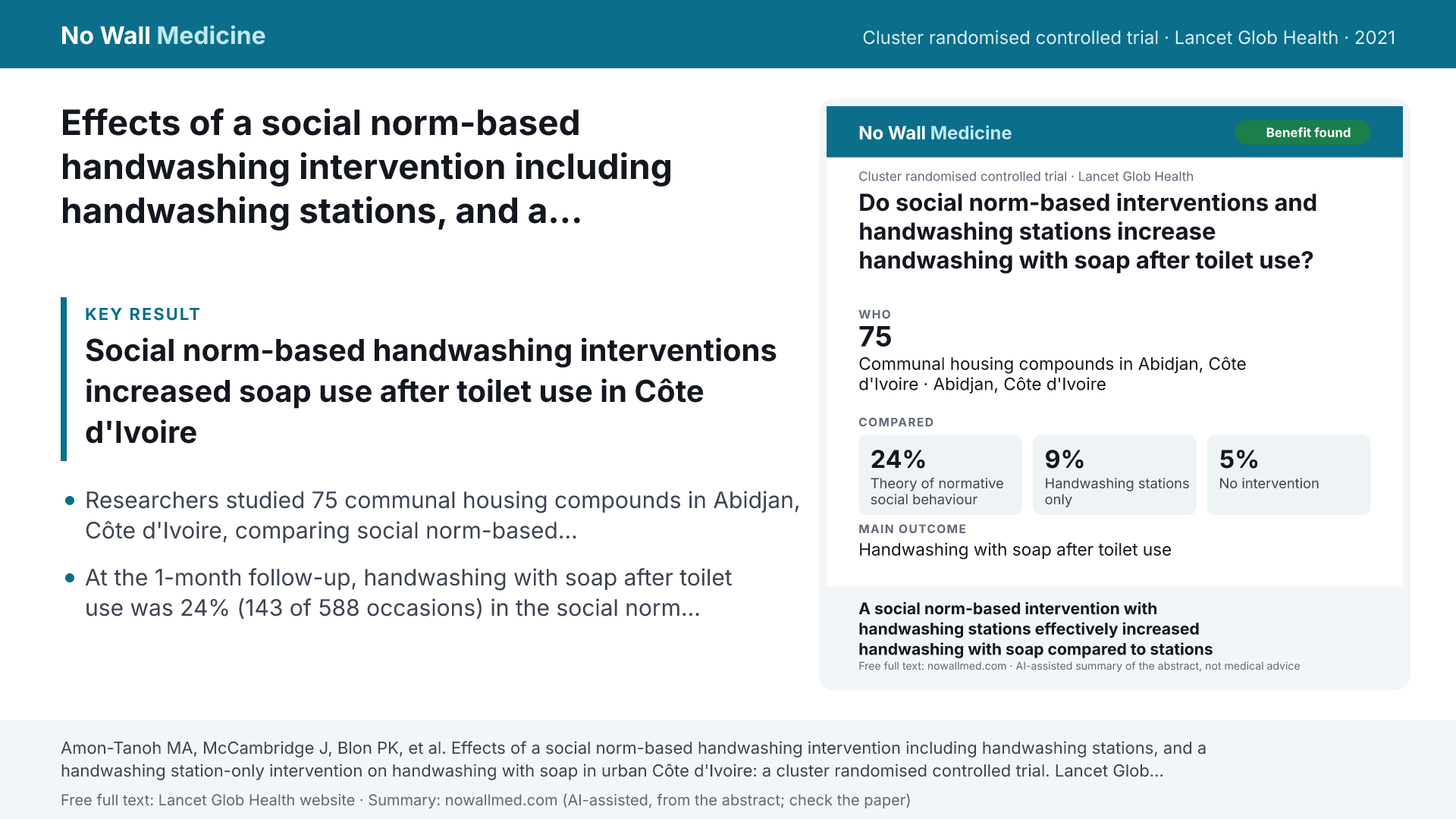
Social norm-based handwashing interventions increased soap use after toilet use in Côte d'Ivoire
Effects of a social norm-based handwashing intervention including handwashing stations, and a handwashing station-only intervention on handwashing with soap in urban Côte d'Ivoire: a cluster randomised controlled trial
Cluster randomised controlled trialBenefit found
Do social norm-based interventions and handwashing stations increase handwashing with soap after toilet use?
Who
75
Communal housing compounds in Abidjan, Côte d'Ivoire · Abidjan, Côte d'Ivoire
Compared
24%Theory of normative social behaviour intervention (143 of 588 occasions)
9%Handwashing stations only (49 of 557 occasions)
5%No intervention (29 of 604 occasions)
Main outcome
Handwashing with soap after toilet use
Result: adjusted risk ratio 4·82, 95% CI 3·06-7·59
Bottom line: A social norm-based intervention with handwashing stations effectively increased handwashing with soap compared to stations alone or no intervention.
Lancet Glob Health · 2021-11-20Download image
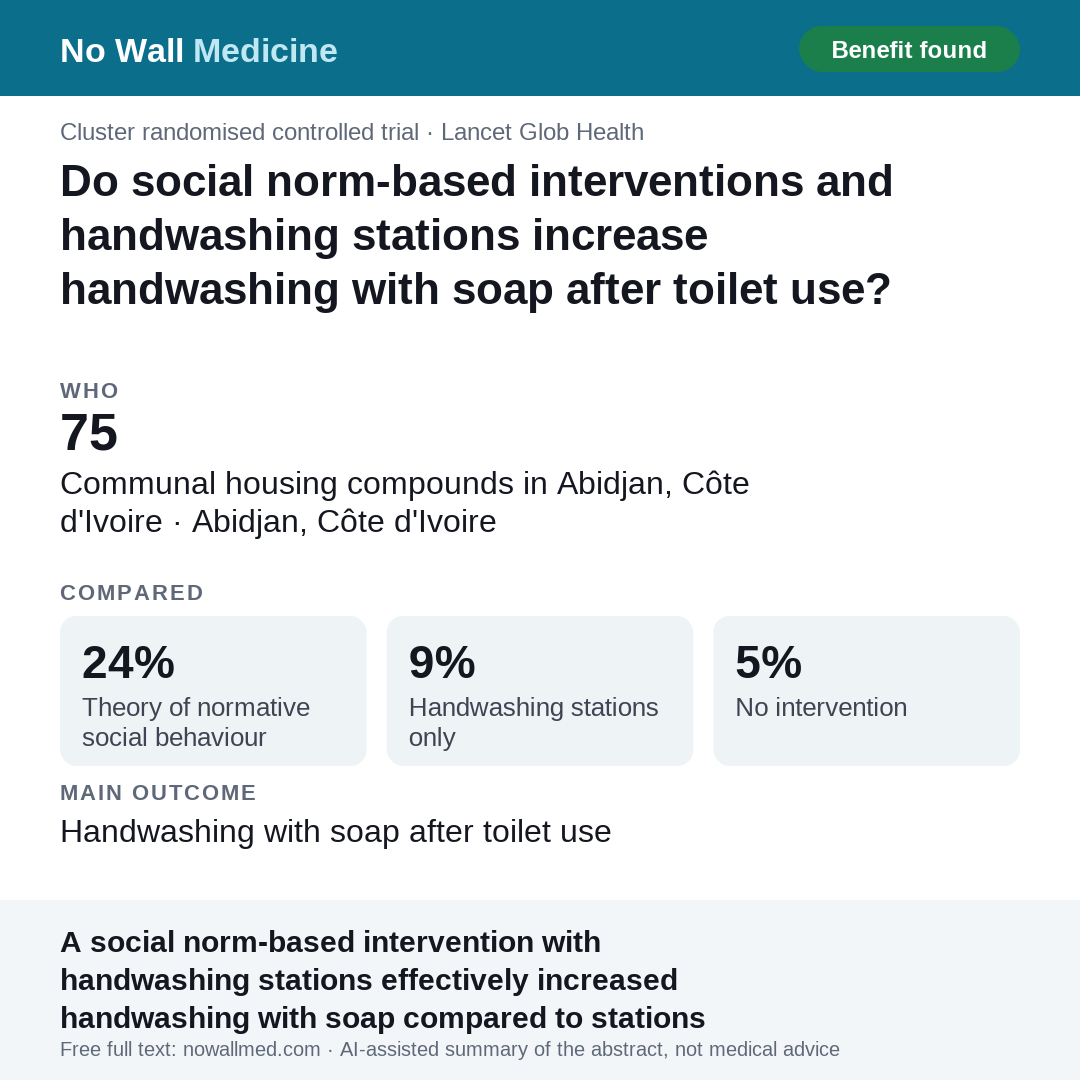
Clinical question: Do social norm-based interventions and handwashing stations increase handwashing with soap after toilet use?
Why it matters: It is unknown whether providing handwashing stations alone or combining them with social norm-based messaging is more effective at increasing handwashing with soap after toilet use.
Key points
- Researchers studied 75 communal housing compounds in Abidjan, Côte d'Ivoire, comparing social norm-based interventions, handwashing stations alone, and no intervention.
- At the 1-month follow-up, handwashing with soap after toilet use was 24% (143 of 588 occasions) in the social norm group compared to 5% (29 of 604 occasions) in the control group.
- The social norm-based intervention was the only approach where the effect was sustained, with 22% (98 of 450 occasions) of handwashing occurring at the follow-up.
Headline and key points written with AI from the paper’s abstract, with every number checked against it. Read the paper before relying on them.
Was this summary helpful?
Abstract
Background
Diarrhoeal diseases are an important cause of mortality in children younger than 5 years in sub-Saharan Africa. We aimed to evaluate the effect of three handwashing interventions on handwashing with soap (HWWS) after toilet use. Methods
In this cluster randomised trial in Abidjan, Côte d'Ivoire, we randomly assigned communal housing compounds (1:1:1) to receive one of three interventions: a theory of normative social behaviour (TNSB) intervention, including provision of handwashing stations; handwashing stations only; and no intervention. The TNSB intervention was designed to shift the outcome expectation associated with HWWS from health to riddance of faeces-related disgust, and to increase the perceived descriptive norm and perceived handwashing publicness. Participants and fieldworkers were masked to the study objectives. The primary outcome was HWWS after toilet use, assessed at 1 month and 5 months follow-ups. Analysis was by intention to treat. This trial is registered at the Pan African Clinical Trial Registry, PACTR201501000892239. Findings
Between April 10 and May 22, 2014, we identified 92 eligible compounds, of which 75 compounds were included. Follow-up data on HWWS were available for 23 compounds for the TNSB group, 25 compounds for the handwashing station-only group, and 25 compounds for the control group. The study ended in April, 2017. Compared with a frequency of 5% (29 of 604 occasions) in the control group, HWWS after toilet use increased to 9% (49 of 557 occasions; adjusted risk ratio 1·89, 95% CI 1·16-3·08) in the handwashing station-only group, and 24% (143 of 588 occasions; 4·82, 3·06-7·59) in the TNSB group, at the 1-month follow-up. The intervention effect was only sustained in the TNSB group (98 [22%] of 450 compounds; 2·68, 1·65-4·34). Interpretation
A social norm-based handwashing intervention combined with disgust-inducing messages, with provision of handwashing stations, was effective at increasing HWWS after toilet use. The provision of handwashing stations alone had little effect. Future studies should investigate whether the same approach, when delivered via mass media, can have a similar effect to the face-to-face delivery used in this study. Funding
None.
Abstract reproduced under the article’s CC BY NC ND licence.
Subject terms
Cite this article
Amon-Tanoh MA, McCambridge J, Blon PK, Kouamé HA, Nguipdop-Djomo P, Biran A. Effects of a social norm-based handwashing intervention including handwashing stations, and a handwashing station-only intervention on handwashing with soap in urban Côte d'Ivoire: a cluster randomised controlled trial. Lancet Glob Health. 2021. doi:10.1016/S2214-109X(21)00387-9
Spotted a mistake? Suggest a correction