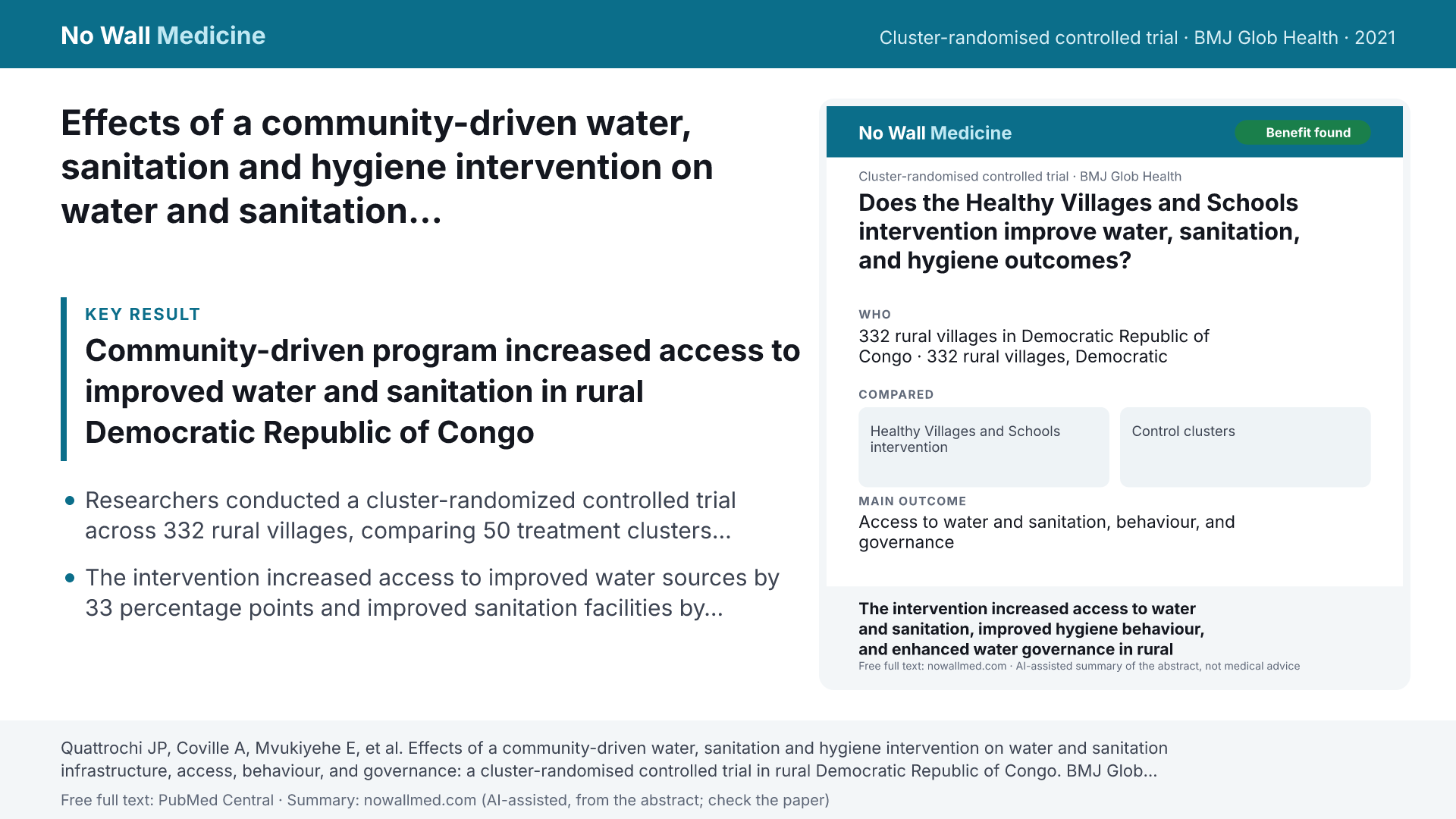
Community-driven program increased access to improved water and sanitation in rural Democratic Republic of Congo
Effects of a community-driven water, sanitation and hygiene intervention on water and sanitation infrastructure, access, behaviour, and governance: a cluster-randomised controlled trial in rural Democratic Republic of Congo
Cluster-randomised controlled trialBenefit found
Does the Healthy Villages and Schools intervention improve water, sanitation, and hygiene outcomes?
Who
332 rural villages in Democratic Republic of Congo · 332 rural villages, Democratic Republic of Congo
Compared
Healthy Villages and Schools intervention
Control clusters
Main outcome
Access to water and sanitation, behaviour, and governance
Result: increased access to improved water sources by 33 percentage points (95% CI 22 to 45)
Bottom line: The intervention increased access to water and sanitation, improved hygiene behaviour, and enhanced water governance in rural villages.
BMJ Glob Health · 2021-05-18 · Save PNG
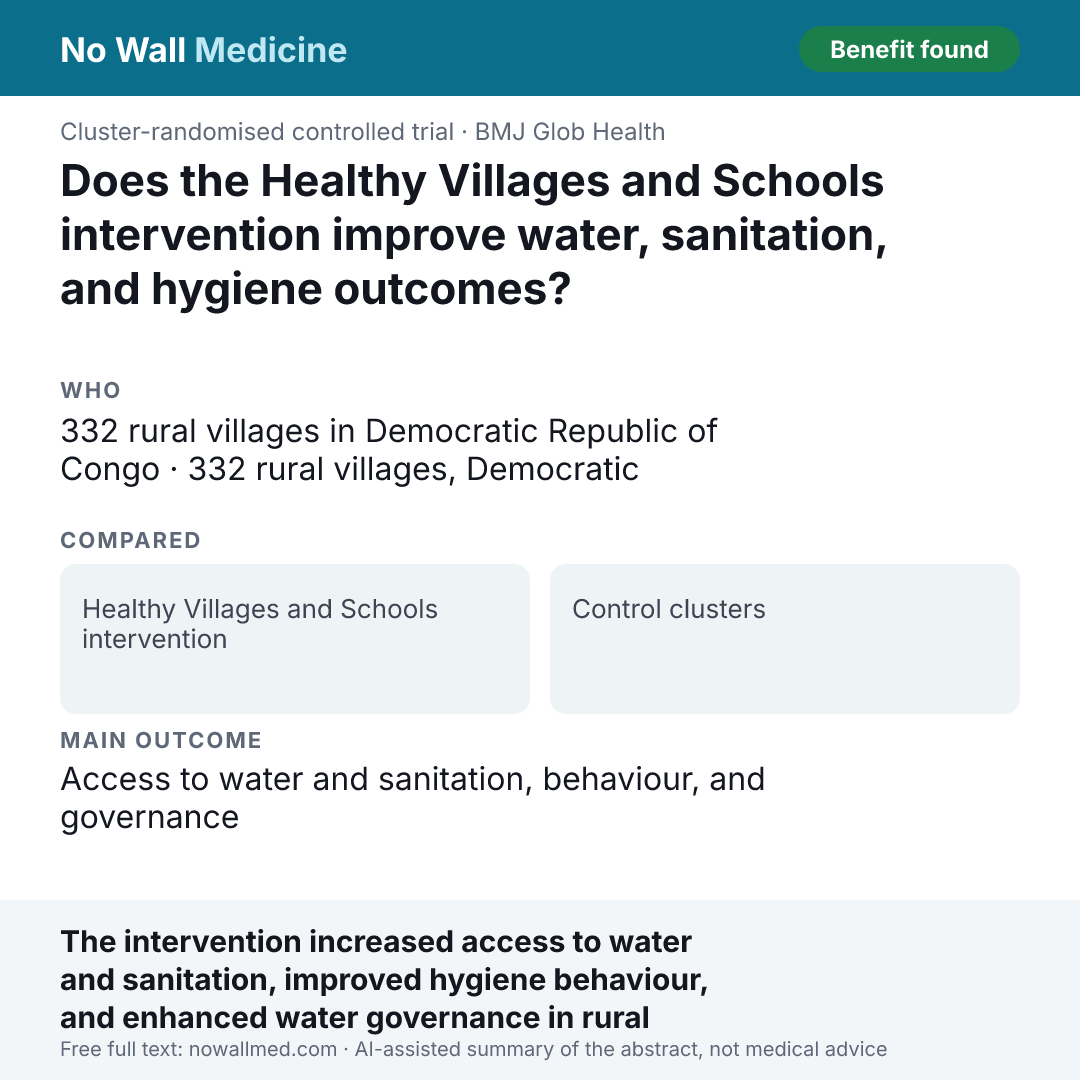
Clinical question: Does the Healthy Villages and Schools intervention improve water, sanitation, and hygiene outcomes?
Key points
- Researchers conducted a cluster-randomized controlled trial across 332 rural villages, comparing 50 treatment clusters to 71 control clusters.
- The intervention increased access to improved water sources by 33 percentage points and improved sanitation facilities by 26 percentage points.
- The program was associated with higher water satisfaction, better handwashing practices, and improved water governance, but showed no significant difference in child health or school attendance.
Limitation the authors note: All outcomes were self-reported.
Headline and key points written with AI from the paper’s abstract, with every number checked against it. Read the paper before relying on them.
Was this summary helpful?
Abstract
Introduction
Inadequate water and sanitation is a central challenge in global health. Since 2008, the Democratic Republic of Congo government has implemented a national programme, Healthy Villages and Schools (Villages et Ecoles Assainis (VEA), with support from UNICEF, financed by UK's Foreign, Commonwealth and Development Office. Methods
A cluster-level randomised controlled trial of VEA was implemented throughout 2019 across 332 rural villages, grouped into 50 treatment and 71 control clusters. Primary outcomes included time spent collecting water; quantity of water collected; prevalence of improved primary source of drinking water; and prevalence of improved primary defecation site. Secondary outcomes included child health, water governance, water satisfaction, handwashing practices, sanitation practices, financial cost of water, school attendance and water storage practices. All outcomes were self-reported. The primary analysis was on an intention-to-treat basis, using linear models. Outcomes were measured October-December 2019, median 5 months post-intervention. Results
The programme increased access to improved water sources by 33 percentage points (pp) (95% CI 22 to 45), to improved sanitation facilities by 26 pp (95% CI 14 to 37), and improved water governance by 1.3 SDs (95% CI 1.1 to 1.5), water satisfaction by 0.6 SD (95% CI 0.4 to 0.9), handwashing practices by 0.5 SD (95% CI 0.3 to 0.7) and sanitation practices by 0.3 SD (95% CI 0.1 to 0.4). There was no significant difference in financial cost of water, school attendance, child health or water storage practices. Conclusion
VEA produced large increases in access to and satisfaction with water and sanitation services, in self-reported hygiene and sanitation behaviour, and in measures of water governance. Trial registration number
AEARCTR-0004648; American Economic Association RCT registry.
Abstract reproduced under the article’s CC BY NC licence.
Subject terms
Headline, design, result, key points, caveat and citation as plain text.
Cite this article
Quattrochi JP, Coville A, Mvukiyehe E, et al. Effects of a community-driven water, sanitation and hygiene intervention on water and sanitation infrastructure, access, behaviour, and governance: a cluster-randomised controlled trial in rural Democratic Republic of Congo. BMJ Glob Health. 2021;6(5). doi:10.1136/bmjgh-2021-005030
Spotted a mistake? Suggest a correction