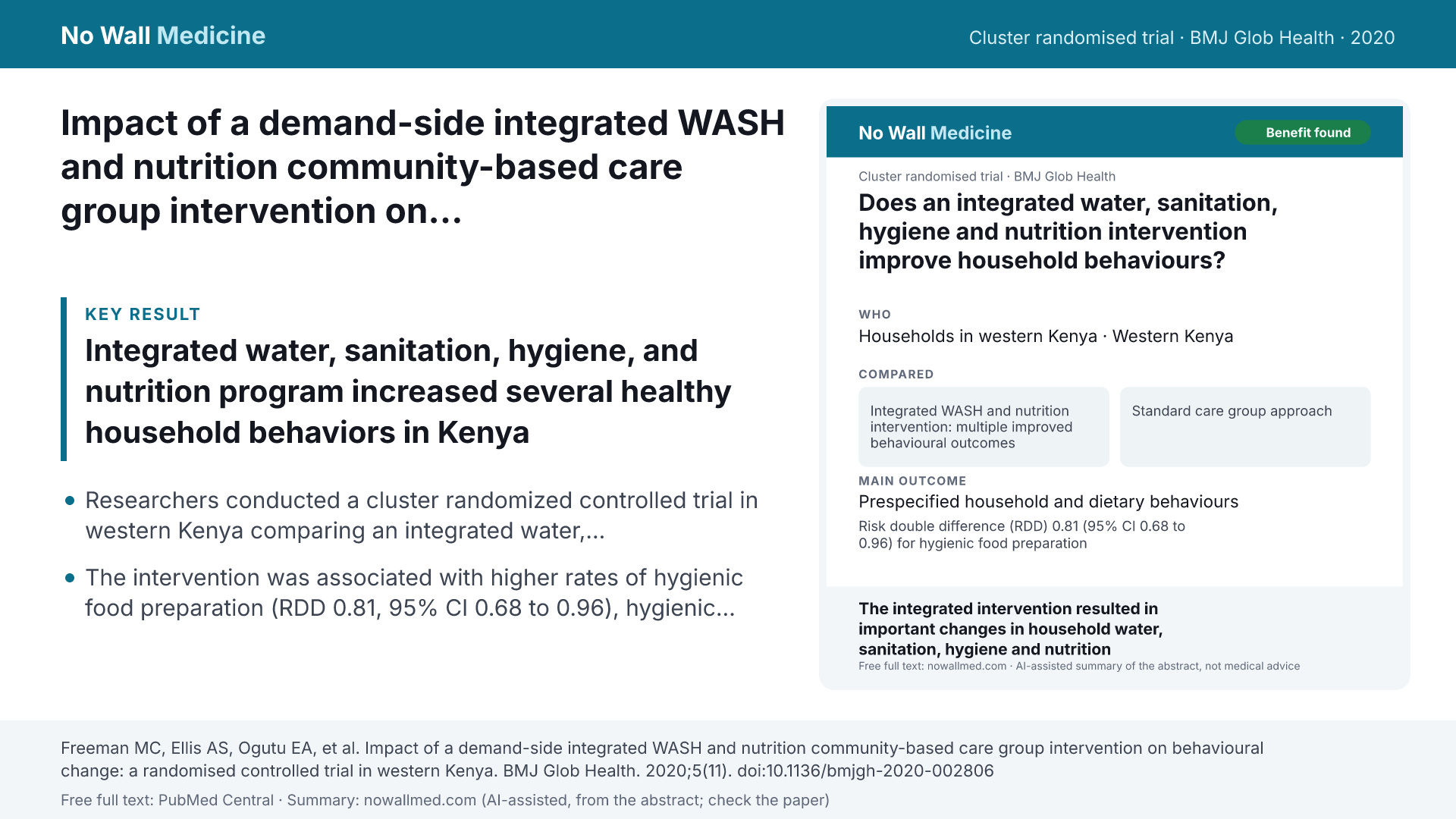
Integrated water, sanitation, hygiene, and nutrition program increased several healthy household behaviors in Kenya
Impact of a demand-side integrated WASH and nutrition community-based care group intervention on behavioural change: a randomised controlled trial in western Kenya
Cluster randomised trialBenefit found
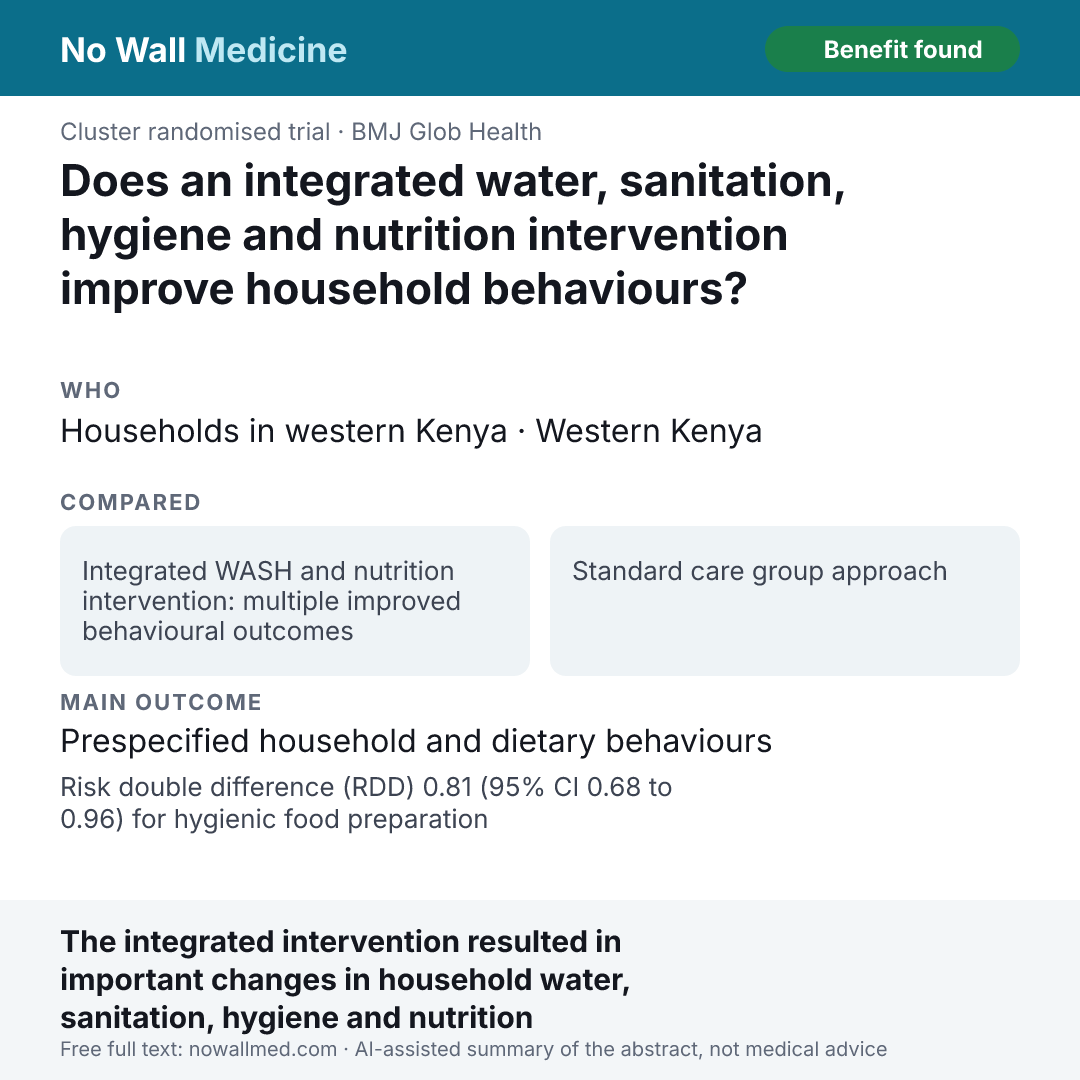
Does an integrated water, sanitation, hygiene and nutrition intervention improve household behaviours?
Who
Households in western Kenya · Western Kenya
Compared
Integrated WASH and nutrition intervention: multiple improved behavioural outcomes
Standard care group approach
Main outcome
Prespecified household and dietary behaviours
Result: Risk double difference (RDD) 0.81 (95% CI 0.68 to 0.96) for hygienic food preparation
Bottom line: The integrated intervention resulted in important changes in household water, sanitation, hygiene and nutrition behaviours.
BMJ Glob Health · 2020-11-25
Why it matters: Siloed nutrition programs may have limitations in addressing the multifaceted causes of undernutrition and diarrheal diseases in low-income settings.
Headline and visual abstract written with AI from the paper’s abstract, with every number checked against it. Read the paper before relying on them.
Was this summary helpful?
Abstract
Introduction
Growth shortfalls and diarrhoeal diseases remain a major cause of morbidity and mortality in low-income settings. Due to the multifaceted causes of undernutrition and the identified limitations of siloed nutrition programmes, improving the delivery of integrated water, sanitation, hygiene (WASH) and nutrition programming could improve child health. Methods
We conducted a cluster randomised trial in western Kenya to assess the impact on household behaviours of a novel, theory-informed and integrated WASH and nutrition intervention delivered through care groups as compared with the standard care group approach. We developed an intervention targeting practices relating to food hygiene, mealtime and feeding, and compound cleanliness, each using various behavioural change techniques to influence the uptake of targeted behaviours. Prespecified behavioural outcomes were verified through direct observation, 24 hours recall, and self-reported picture-based methods. Results
Compared with control households, a greater proportion of intervention households had a hygienic food preparation area (Risk double difference (RDD) 0.81, 95% CI 0.68 to 0.96), had stored food hygienically (RDD 0.76, 95% CI 0.58 to 1.00), had a functional handwashing station (RDD 0.64, 95% CI 0.56 to 0.74), provided a safe space for their child to play (RDD 0.73, 95% CI 0.56 to 0.96), and who fed their children thickened porridge (RDD 0.56, 95% CI 0.51 to 0.63) at endline. The proportion of children 6-24 months in intervention households consuming a sufficient diversity of foods (RDD 0.81, 95% CI 0.64 to 1.04) was higher than in control households; however, there was a non-significant increase in the percentage of pregnant and lactating women receiving an adequate diversity of foods in their diets (RDD 0.86, 95% CI 0.70 to 1.05) among intervention compared with control households at endline. Conclusion
Our integrated WASH and nutrition intervention resulted in important changes in behaviours. This theory-informed intervention could be added to existing care group programmes to considerable advantage.
Abstract reproduced under the article’s CC BY NC licence.
Subject terms
Cite this article
Freeman MC, Ellis AS, Ogutu EA, et al. Impact of a demand-side integrated WASH and nutrition community-based care group intervention on behavioural change: a randomised controlled trial in western Kenya. BMJ Glob Health. 2020;5(11). doi:10.1136/bmjgh-2020-002806
Spotted a mistake? Suggest a correction