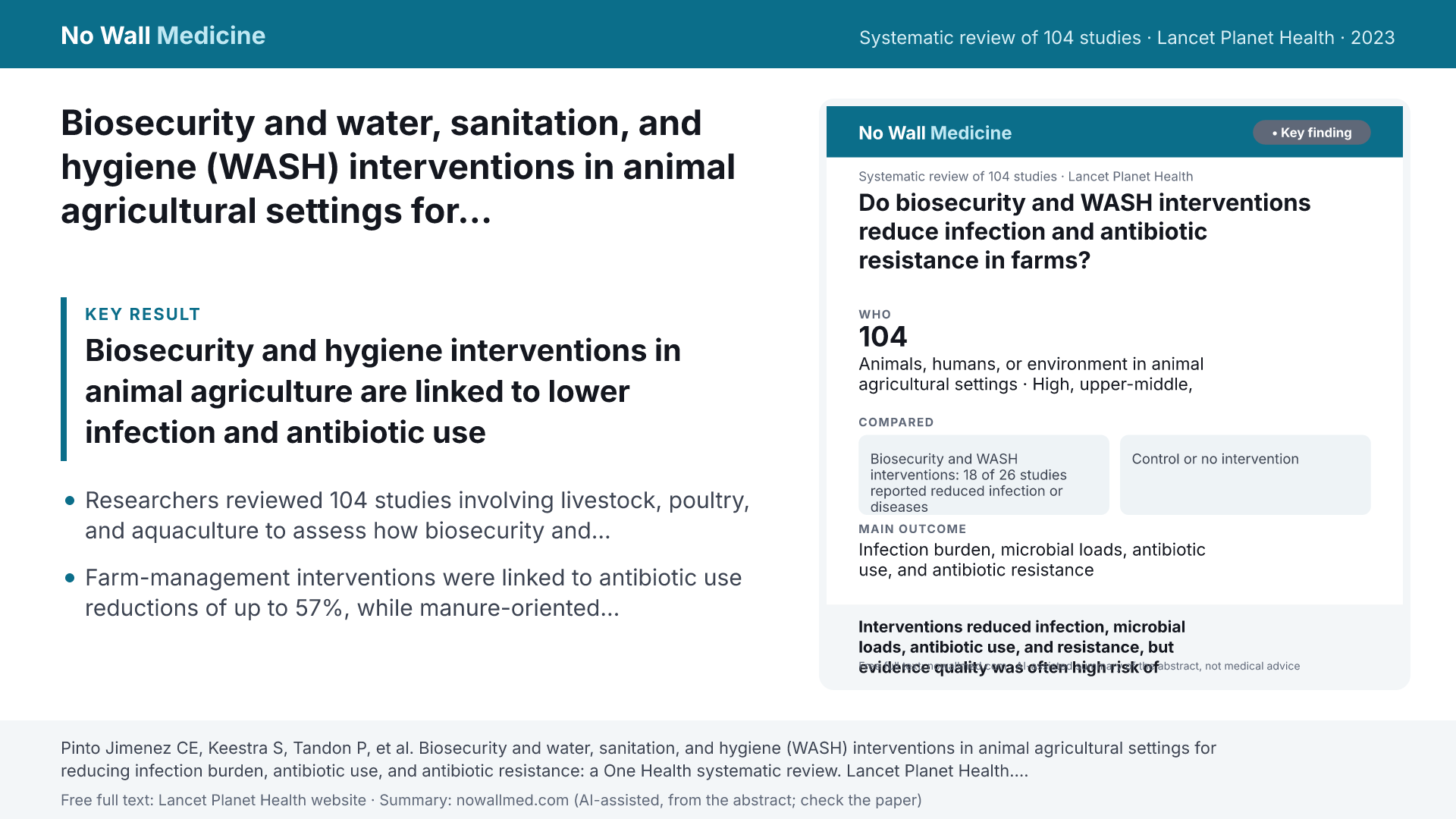
Biosecurity and hygiene interventions in animal agriculture are linked to lower infection and antibiotic use
Biosecurity and water, sanitation, and hygiene (WASH) interventions in animal agricultural settings for reducing infection burden, antibiotic use, and antibiotic resistance: a One Health systematic review
Why it matters: Evidence for how to best manage infection and antibiotic resistance risks in agricultural communities, which make up 45% of households globally, has not been systematically assembled.
Key points
- Researchers reviewed 104 studies involving livestock, poultry, and aquaculture to assess how biosecurity and water, sanitation, and hygiene interventions affect infections and antibiotic resistance.
- Farm-management interventions were linked to antibiotic use reductions of up to 57%, while manure-oriented interventions were linked to reductions in antibiotic resistance genes or bacteria by up to 99%.
- Of the 104 interventions, 18 of 26 studies reported reduced infection or diseases, and 37 of 71 studies reported reduced microbial loads.
Limitation the authors note: Most evidence emerges from studies focusing on the farm itself rather than targeting agricultural communities or the broader social, economic, and policy environment.
Headline and key points written with AI from the paper’s abstract, with every number checked against it. Read the paper before relying on them.
Was this summary helpful?
Abstract
Prevention and control of infections across the One Health spectrum is essential for improving antibiotic use and addressing the emergence and spread of antibiotic resistance. Evidence for how best to manage these risks in agricultural communities-45% of households globally-has not been systematically assembled. This systematic review identifies and summarises evidence from on-farm biosecurity and water, sanitation, and hygiene (WASH) interventions with the potential to directly or indirectly reduce infections and antibiotic resistance in animal agricultural settings. We searched 17 scientific databases (including Web of Science, PubMed, and regional databases) and grey literature from database inception to Dec 31, 2019 for articles that assessed biosecurity or WASH interventions measuring our outcomes of interest; namely, infection burden, microbial loads, antibiotic use, and antibiotic resistance in animals, humans, or the environment. Risk of bias was assessed with the Systematic Review Centre for Laboratory Animal Experimentation tool, Risk of Bias in Non-Randomized Studies of Interventions, and the Appraisal tool for Cross-Sectional Studies, although no studies were excluded as a result. Due to the heterogeneity of interventions found, we conducted a narrative synthesis. The protocol was pre-registered with PROSPERO (CRD42020162345). Of the 20 672 publications screened, 104 were included in this systematic review. 64 studies were conducted in high-income countries, 24 studies in upper-middle-income countries, 13 studies in lower-middle-income countries, two in low-income countries, and one included both upper-middle-income countries and lower-middle-income countries. 48 interventions focused on livestock (mainly pigs), 43 poultry (mainly chickens), one on livestock and poultry, and 12 on aquaculture farms. 68 of 104 interventions took place on intensive farms, 22 in experimental settings, and ten in smallholder or subsistence farms. Positive outcomes were reported for ten of 23 water studies, 17 of 35 hygiene studies, 15 of 24 sanitation studies, all three air-quality studies, and 11 of 17 other biosecurity-related interventions. In total, 18 of 26 studies reported reduced infection or diseases, 37 of 71 studies reported reduced microbial loads, four of five studies reported reduced antibiotic use, and seven of 20 studies reported reduced antibiotic resistance. Overall, risk of bias was high in 28 of 57 studies with positive interventions and 17 of 30 studies with negative or neutral interventions. Farm-management interventions successfully reduced antibiotic use by up to 57%. Manure-oriented interventions reduced antibiotic resistance genes or antibiotic-resistant bacteria in animal waste by up to 99%. This systematic review highlights the challenges of preventing and controlling infections and antimicrobial resistance, even in well resourced agricultural settings. Most of the evidence emerges from studies that focus on the farm itself, rather than targeting agricultural communities or the broader social, economic, and policy environment that could affect their outcomes. WASH and biosecurity interventions could complement each other when addressing antimicrobial resistance in the human, animal, and environmental interface.
Abstract reproduced under the article’s CC BY NC ND licence.
Subject terms
Headline, design, result, key points, caveat and citation as plain text.
Cite this article
Pinto Jimenez CE, Keestra S, Tandon P, et al. Biosecurity and water, sanitation, and hygiene (WASH) interventions in animal agricultural settings for reducing infection burden, antibiotic use, and antibiotic resistance: a One Health systematic review. Lancet Planet Health. 2023;7(5):e418-e434. doi:10.1016/S2542-5196(23)00049-9
Spotted a mistake? Suggest a correction