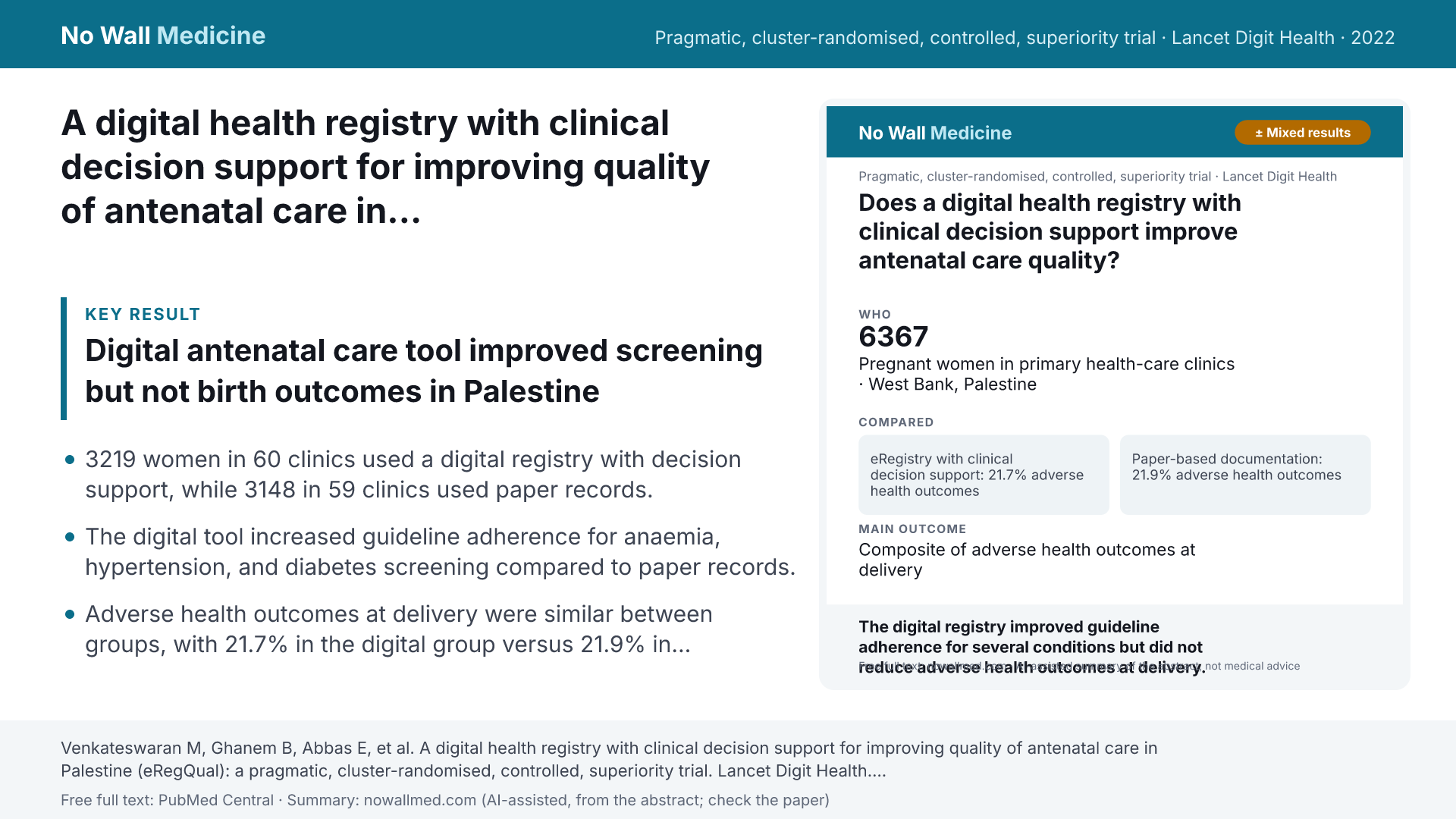
Digital health registry with clinical decision support increased guideline adherence during pregnancy in Palestine
A digital health registry with clinical decision support for improving quality of antenatal care in Palestine (eRegQual): a pragmatic, cluster-randomised, controlled, superiority trial
Pragmatic, cluster-randomised, controlled, superiority trialMixed results
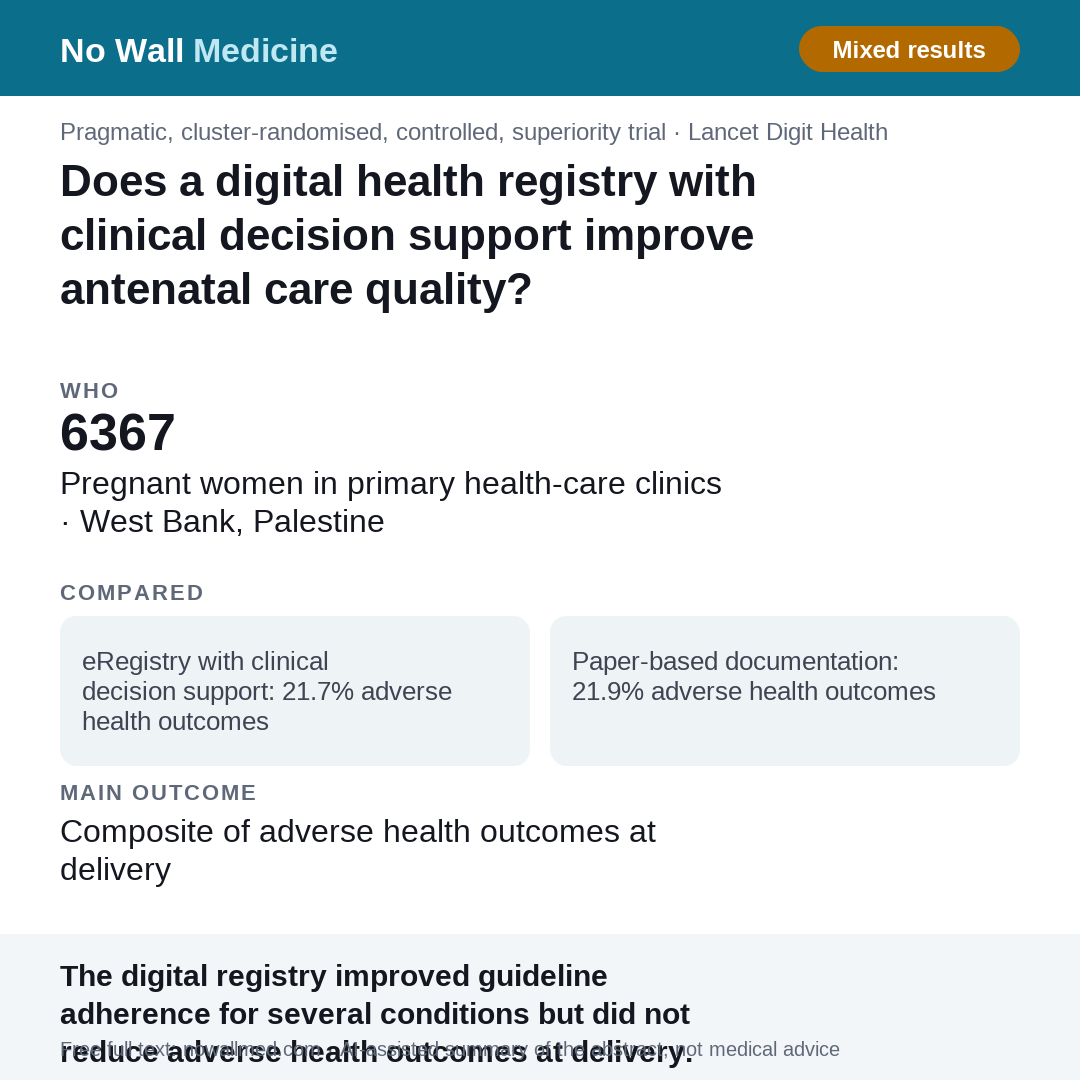
Does a digital health registry with clinical decision support improve antenatal care quality?
Who
6367
Pregnant women in primary health-care clinics · West Bank, Palestine
Compared
eRegistry with clinical decision support: 21.7% adverse health outcomes
Paper-based documentation: 21.9% adverse health outcomes
Main outcome
Composite of adverse health outcomes at delivery
Result: adjusted odds ratio 0.99 (95% CI 0.87-1.12)
Bottom line: The digital registry improved guideline adherence for several conditions but did not reduce adverse health outcomes at delivery.
Funded by: European Research Council and Research Council of Norway
Lancet Digit Health · 2022-01-29Download image
Clinical question: Does a digital health registry with clinical decision support improve antenatal care quality?
Why it matters: It was unknown if implementing a digital maternal and child health registry with clinical decision support would improve the quality of antenatal care compared to paper-based documentation.
Key points
- Researchers randomized 133 primary health-care clinics to either a digital registry with clinical decision support or paper-based records for 6367 pregnant women.
- The digital intervention led to higher guideline adherence for screening and managing anaemia, hypertension, and gestational diabetes compared to paper records.
- The digital tool did not result in fewer adverse health outcomes at delivery, with 21.7% of women in the intervention group and 21.9% in the control group experiencing them.
Headline and key points written with AI from the paper’s abstract, with every number checked against it. Read the paper before relying on them.
Was this summary helpful?
Abstract
Background
Health worker compliance with clinical guidelines is enhanced by digital clinical decision support at the point of care. The Palestinian public health system is implementing a digital maternal and child health eRegistry with clinical decision support. We aimed to compare the quality of antenatal care between clinics using the eRegistry and those using paper-based records. Methods
The eRegQual cluster-randomised controlled trial was done in primary health-care clinics offering routine antenatal care in the West Bank, Palestine. The intervention was the eRegistry with clinical decision support for antenatal care, implemented in District Health Information Systems 2 (DHIS2) Tracker software. 133 clinics forming 120 clusters were included and randomised; clusters were randomly assigned (1:1) to either the control (paper-based documentation) or intervention (eRegistry with clinical decision support) groups. The primary process outcomes were appropriate screening and management of anaemia, hypertension, and diabetes during pregnancy and foetal growth monitoring. The primary health outcome at delivery was a composite of moderate or severe anaemia; severe hypertension; large-for-gestational-age baby; malpresentation and small-for-gestational-age baby undetected before delivery. Data were analysed with mixed-effects logistic regression, accounting for clustering within clinics and pregnancies as appropriate. This trial is registered with the ISRCTN registry (ISRCTN18008445). Findings
Between Jan 15 and Sept 15, 2017, 3219 pregnant women received care in the intervention clinics (n=60 clusters) and 3148 pregnant women received care in the control primary health-care clinics (n=59 clusters). Compared with the control group, the intervention led to higher guideline adherence for screening and management of anaemia (1535 [28·9%] of 5320 vs 2297 [44·3%] of 5182; adjusted odds ratio [OR] 1·88 [95% CI 1·52-2·32]), hypertension (7555 [94·7%] of 7982 vs 7314 [96·6%] of 7569; adjusted OR 1·62 [95% CI 1·29-2·05]), and gestational diabetes (1726 (39·7%) of 4348 vs 2189 (50·7%) of 4321; adjusted OR 1·45 [95% CI 1·14-1·83]) at eligible antenatal contacts. Only 599 (9·4%) of 6367 women attended the full antenatal care schedule, and better care provision did not translate to fewer adverse health outcomes in the intervention clusters (700 cases; 21·7%) compared to the control clusters (688 cases; 21·9%; adjusted OR 0·99; 95% CI 0·87-1·12). Interpretation
Clinical decision support for antenatal care in the eRegistry was superior for most process outcomes but had no effect on the adverse health outcomes. The improvements in process outcomes strengthen the evidence for the WHO guideline for digital client tracking with clinical decision support in lower-middle-income settings. Digital health interventions to address gaps in attendance might help achieve effective coverage of antenatal care. Funding
European Research Council and Research Council of Norway. Translation
For the Arabic translation of the abstract see Supplementary Materials section.
Abstract reproduced under the article’s CC BY licence.
Subject terms
Cite this article
Venkateswaran M, Ghanem B, Abbas E, Khader KA, Ward IA, Awwad T. A digital health registry with clinical decision support for improving quality of antenatal care in Palestine (eRegQual): a pragmatic, cluster-randomised, controlled, superiority trial. Lancet Digit Health. 2022. doi:10.1016/S2589-7500(21)00269-7
Spotted a mistake? Suggest a correction