Digital peer support showed no difference from web-based information for depression and anxiety
A Direct-to-Public Peer Support Program (Big White Wall) Versus Web-Based Information to Aid the Self-management of Depression and Anxiety: Results and Challenges of an Automated Randomized Controlled Trial
Pragmatic, parallel-group, single-blind randomized controlled trialNo clear difference
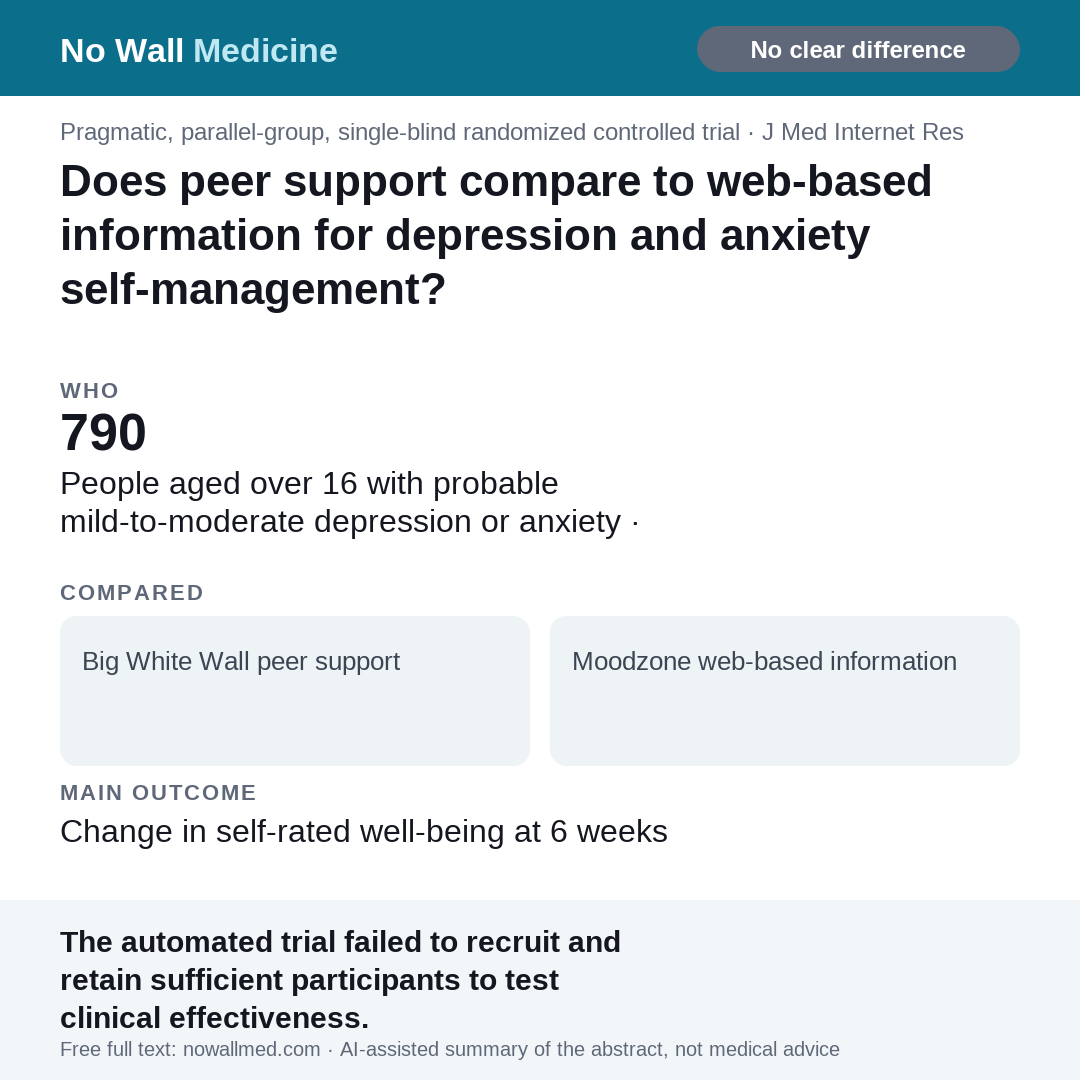
Does peer support compare to web-based information for depression and anxiety self-management?
Who
790
People aged over 16 with probable mild-to-moderate depression or anxiety · Nottinghamshire, United Kingdom
Compared
Big White Wall peer support
Moodzone web-based information
Main outcome
Change in self-rated well-being at 6 weeks
Bottom line: The automated trial failed to recruit and retain sufficient participants to test clinical effectiveness.
J Med Internet Res · 2021-04-23Download image
Clinical question: Does peer support compare to web-based information for depression and anxiety self-management?
Why it matters: It is unknown if a fully automated randomized controlled trial can effectively reach, recruit, and retain enough people to test digital public health interventions.
Key points
- Researchers compared digital peer support via Big White Wall to standard web-based information for 790 participants with probable mild-to-moderate depression or anxiety.
- There were no differences in the primary or secondary outcomes between the peer support group and the information group at 6 weeks.
- Only 16.6% (131/790) of the participants completed the primary outcome assessment for well-being.
Limitation the authors note: The trial failed to recruit and retain sufficient participants to test clinical effectiveness because it did not personally engage participants or explain potential benefits.
Headline and key points written with AI from the paper’s abstract, with every number checked against it. Read the paper before relying on them.
Was this summary helpful?
Subject terms
Cite this article
Morriss R, Kaylor-Hughes C, Rawsthorne M, Coulson N, Simpson S, Guo B. A Direct-to-Public Peer Support Program (Big White Wall) Versus Web-Based Information to Aid the Self-management of Depression and Anxiety: Results and Challenges of an Automated Randomized Controlled Trial. J Med Internet Res. 2021. doi:10.2196/23487
Spotted a mistake? Suggest a correction
Top studies every Monday
The week’s key trials and guidelines in your specialties, plus any topics you follow. By email, free.
Get the weekly digest