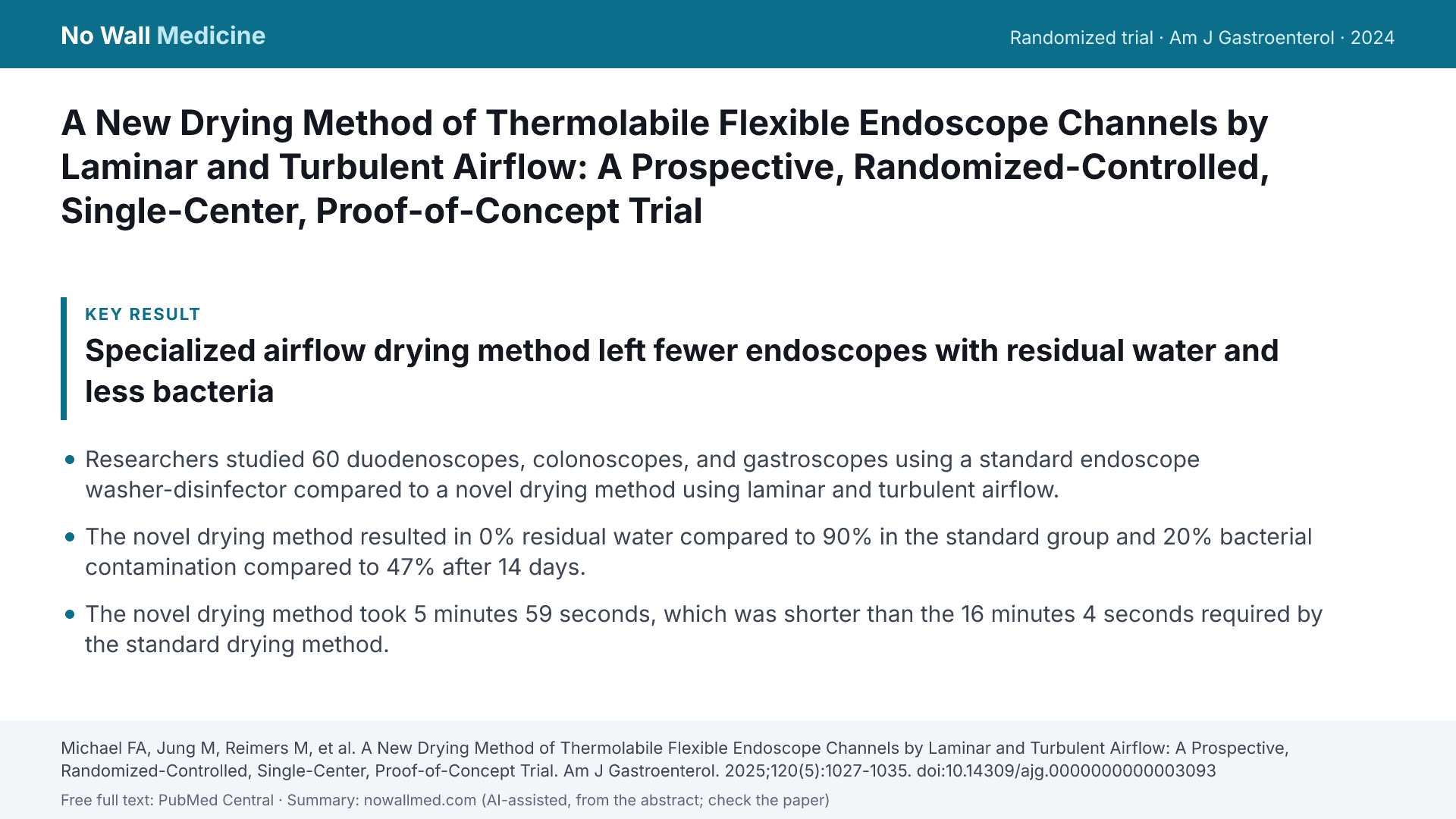
Specialized airflow drying method left fewer endoscopes with residual water and less bacteria
A New Drying Method of Thermolabile Flexible Endoscope Channels by Laminar and Turbulent Airflow: A Prospective, Randomized-Controlled, Single-Center, Proof-of-Concept Trial
Why it matters: Current clinical results for available endoscope drying methods during reprocessing are not satisfactory.
Key points
- Researchers studied 60 duodenoscopes, colonoscopes, and gastroscopes using a standard endoscope washer-disinfector compared to a novel drying method using laminar and turbulent airflow.
- The novel drying method resulted in 0% residual water compared to 90% in the standard group and 20% bacterial contamination compared to 47% after 14 days.
- The novel drying method took 5 minutes 59 seconds, which was shorter than the 16 minutes 4 seconds required by the standard drying method.
Headline and key points written with AI from the paper’s abstract, with every number checked against it. Read the paper before relying on them.
Was this summary helpful?
Subject terms
Headline, design, result, key points, caveat and citation as plain text.
Cite this article
Michael FA, Jung M, Reimers M, et al. A New Drying Method of Thermolabile Flexible Endoscope Channels by Laminar and Turbulent Airflow: A Prospective, Randomized-Controlled, Single-Center, Proof-of-Concept Trial. Am J Gastroenterol. 2025;120(5):1027-1035. doi:10.14309/ajg.0000000000003093
Spotted a mistake? Suggest a correction