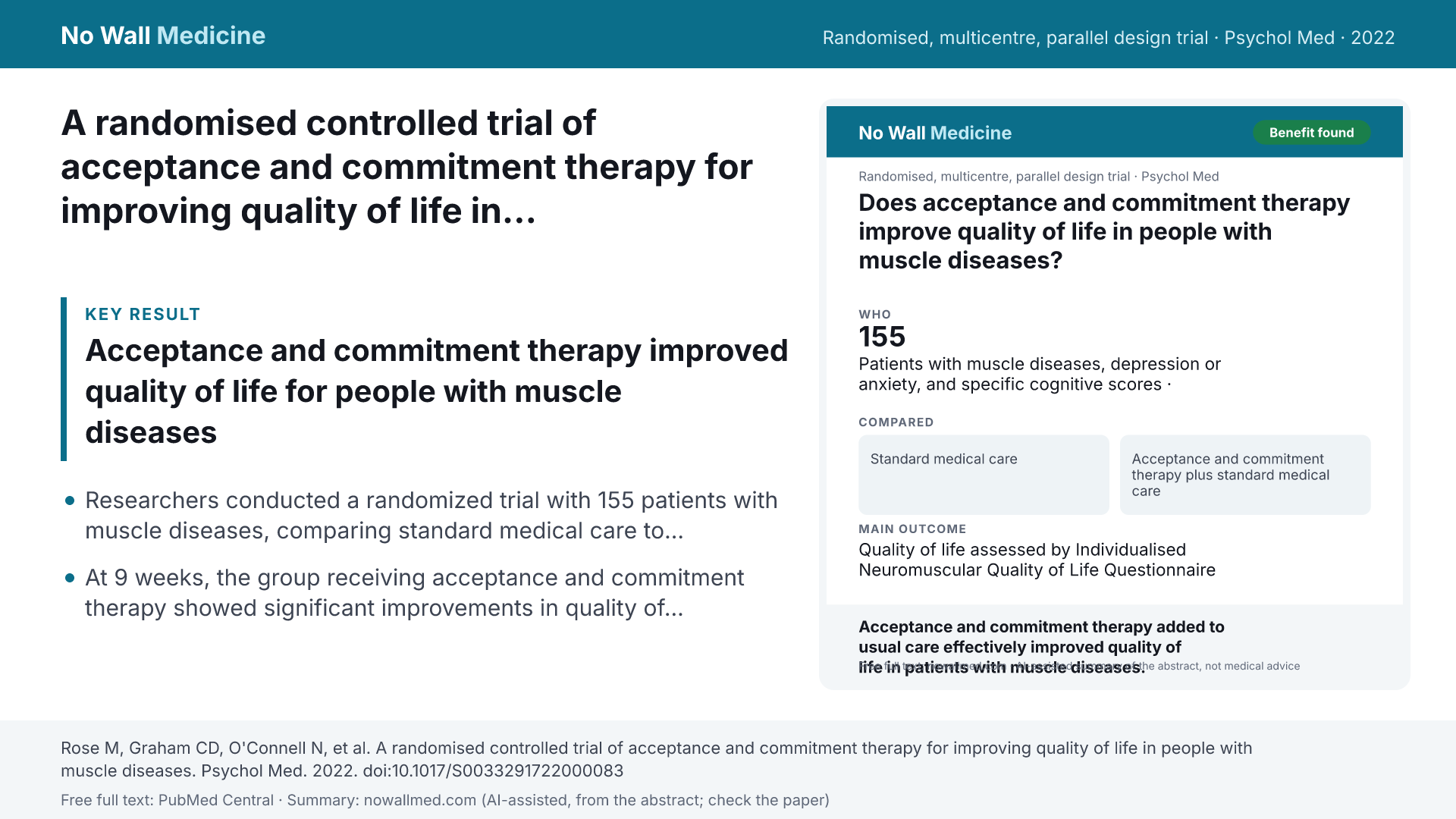
Acceptance and commitment therapy improved quality of life for people with muscle diseases
A randomised controlled trial of acceptance and commitment therapy for improving quality of life in people with muscle diseases
Randomised, multicentre, parallel design trialBenefit found
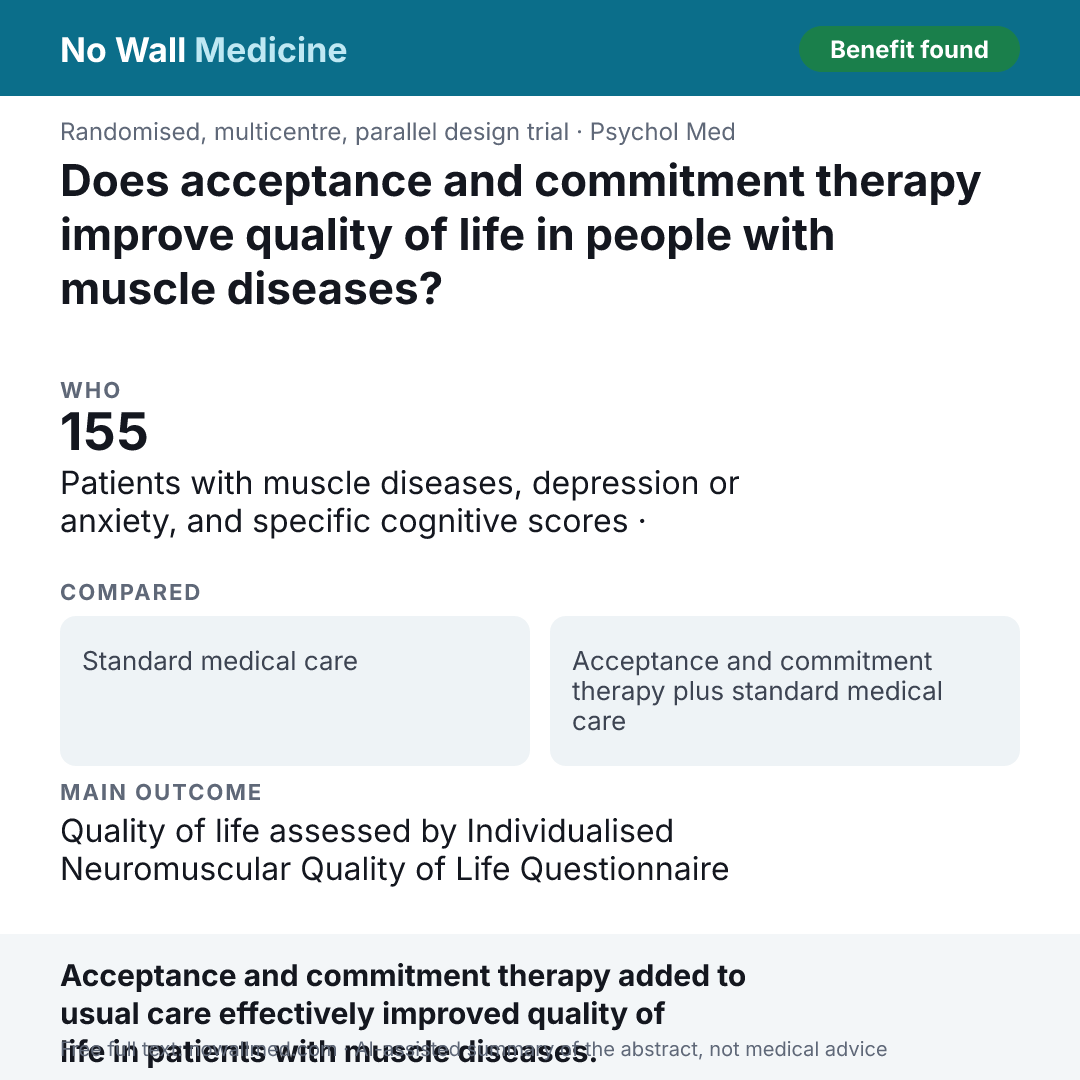
Does acceptance and commitment therapy improve quality of life in people with muscle diseases?
Who
155
Patients with muscle diseases, depression or anxiety, and specific cognitive scores · Multicentre
Compared
Standard medical care
Acceptance and commitment therapy plus standard medical care
Main outcome
Quality of life assessed by Individualised Neuromuscular Quality of Life Questionnaire
Bottom line: Acceptance and commitment therapy added to usual care effectively improved quality of life in patients with muscle diseases.
Psychol Med · 2022-02-23 · Save PNG
Clinical question: Does acceptance and commitment therapy improve quality of life in people with muscle diseases?
Key points
- Researchers conducted a randomized trial with 155 patients with muscle diseases, comparing standard medical care to standard medical care plus acceptance and commitment therapy.
- At 9 weeks, the group receiving acceptance and commitment therapy showed significant improvements in quality of life compared to the standard medical care group.
- Significant differences were also observed at 9 weeks for mood, functional impairment, and aspects of psychological flexibility.
Headline and key points written with AI from the paper’s abstract, with every number checked against it. Read the paper before relying on them.
Was this summary helpful?
Subject terms
Headline, design, result, key points, caveat and citation as plain text.
Cite this article
Rose M, Graham CD, O'Connell N, et al. A randomised controlled trial of acceptance and commitment therapy for improving quality of life in people with muscle diseases. Psychol Med. 2022. doi:10.1017/S0033291722000083
Spotted a mistake? Suggest a correction