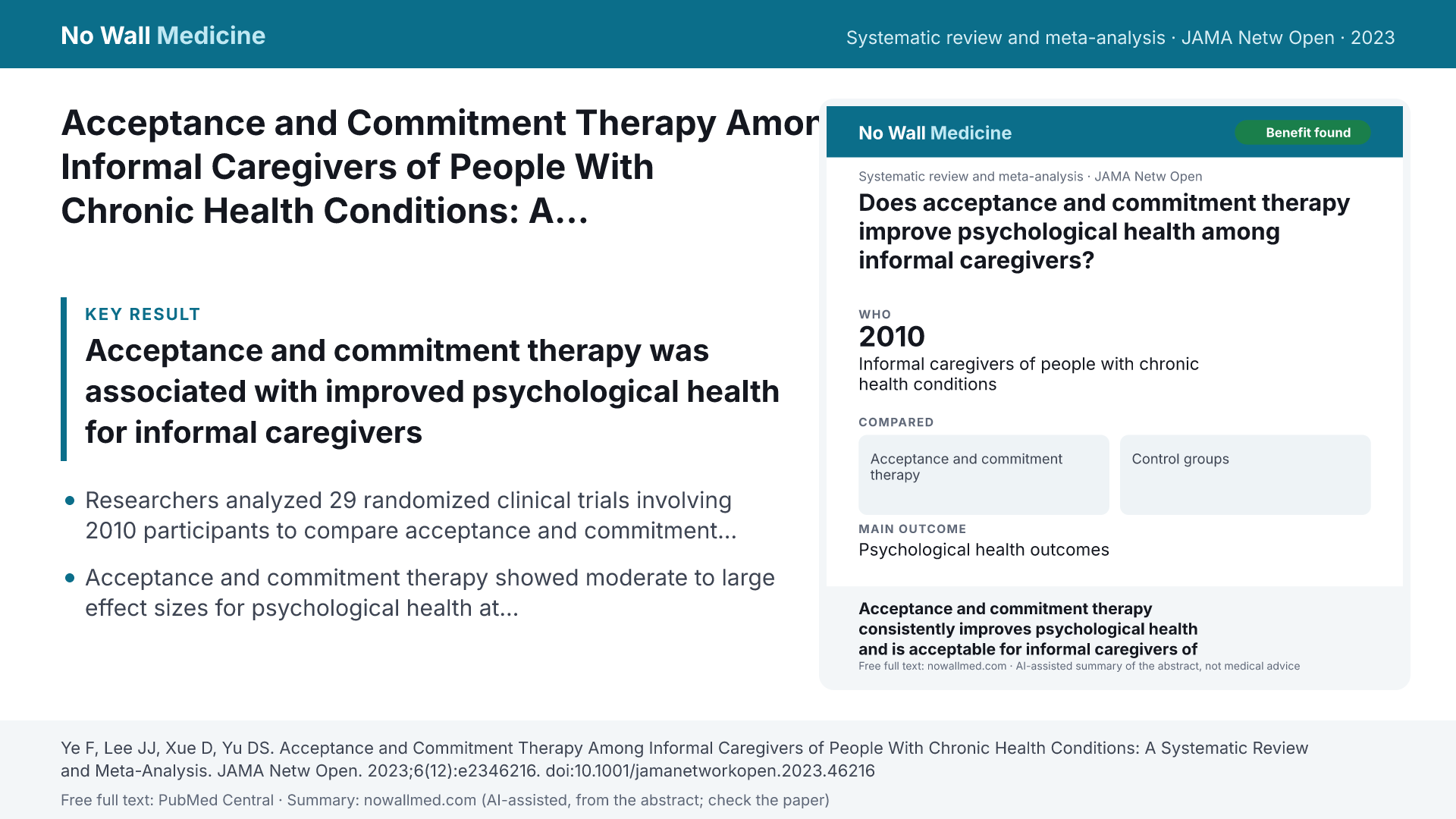
Acceptance and commitment therapy was associated with improved psychological health for informal caregivers
Acceptance and Commitment Therapy Among Informal Caregivers of People With Chronic Health Conditions: A Systematic Review and Meta-Analysis
Systematic review and meta-analysisBenefit found
Does acceptance and commitment therapy improve psychological health among informal caregivers?
Who
2010
Informal caregivers of people with chronic health conditions
Compared
Acceptance and commitment therapy
Control groups
Main outcome
Psychological health outcomes
Result: Hedges g range, -0.55 (95% CI, -0.98 to -0.12) to -1.14 (95% CI, -1.83 to -0.45)
Bottom line: Acceptance and commitment therapy consistently improves psychological health and is acceptable for informal caregivers of people with chronic conditions.
JAMA Netw Open · 2023-12-01 · Save PNG
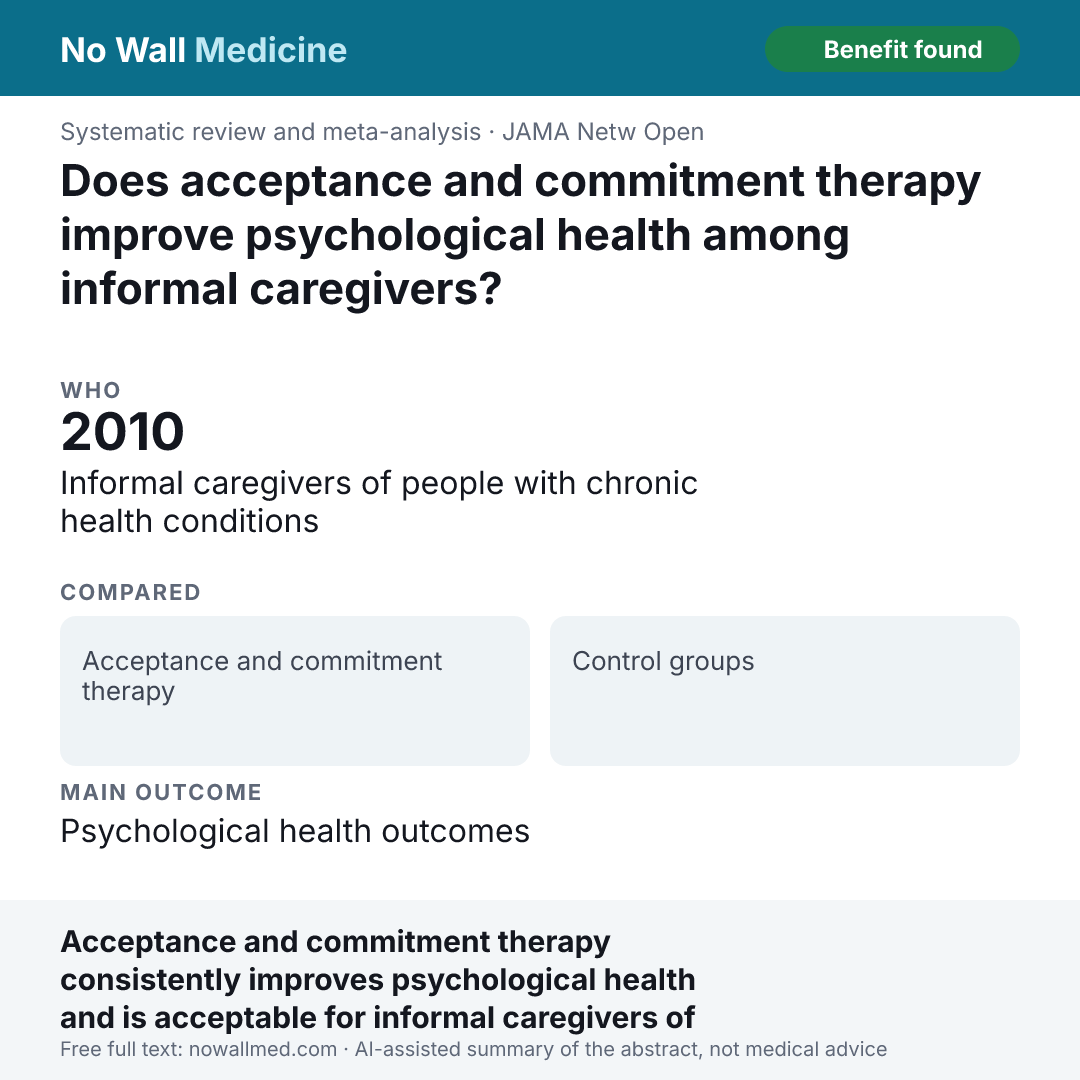
Clinical question: Does acceptance and commitment therapy improve psychological health among informal caregivers?
Why it matters: The great variation in intervention designs among published studies limits the application of acceptance and commitment therapy for informal caregivers.
Key points
- Researchers analyzed 29 randomized clinical trials involving 2010 participants to compare acceptance and commitment therapy, a form of psychotherapy, against control groups.
- Acceptance and commitment therapy showed moderate to large effect sizes for psychological health at postintervention assessments (Hedges g range, -0.55 to -1.14).
- Face-to-face delivery and more intervention sessions were associated with greater improvements for experiential avoidance, depressive symptoms, and anxiety symptoms.
Headline and key points written with AI from the paper’s abstract, with every number checked against it. Read the paper before relying on them.
Was this summary helpful?
Subject terms
Headline, design, result, key points, caveat and citation as plain text.
Cite this article
Ye F, Lee JJ, Xue D, Yu DS. Acceptance and Commitment Therapy Among Informal Caregivers of People With Chronic Health Conditions: A Systematic Review and Meta-Analysis. JAMA Netw Open. 2023;6(12):e2346216. doi:10.1001/jamanetworkopen.2023.46216
Spotted a mistake? Suggest a correction