Distal versus proximal radial artery access showed no difference in artery wall thickening after coronary angiography
A Randomized Comparison of Radial Artery Intimal Hyperplasia Following Distal Versus Proximal Transradial Access for Coronary Angiography: PRESERVE RADIAL
Single-center randomized clinical trialNo clear difference
Does distal versus proximal transradial access affect radial artery intimal-medial thickening?
Who
64
Patients undergoing nonemergent coronary angiography · Single-center
Compared
distal transradial access: 0.07 mm
forearm transradial access: 0.07 mm
Main outcome
mean change in forearm radial artery intimal-medial thickening
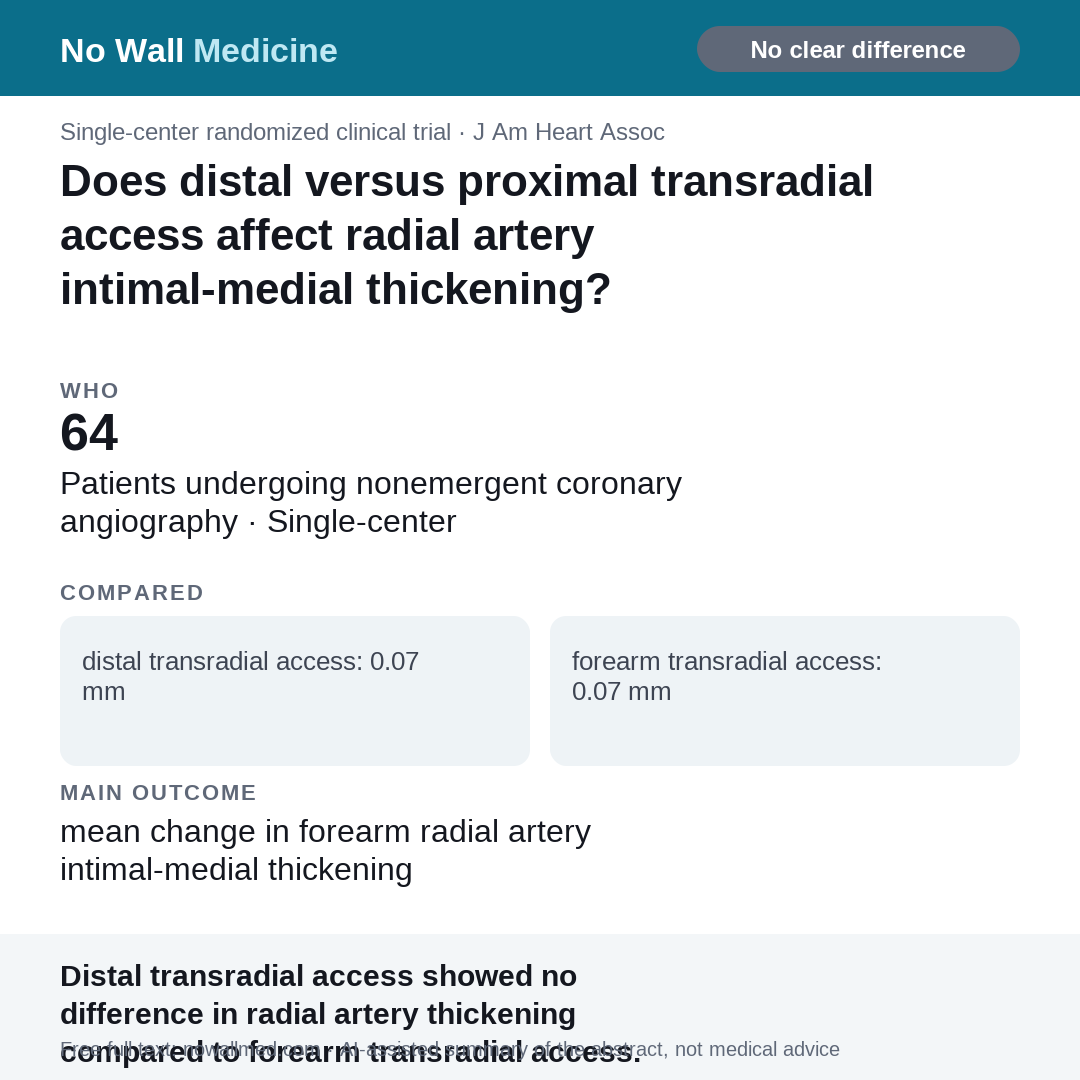
Bottom line: Distal transradial access showed no difference in radial artery thickening compared to forearm transradial access.
J Am Heart Assoc · 2024-02-14Download image
Clinical question: Does distal versus proximal transradial access affect radial artery intimal-medial thickening?
Why it matters: It was unknown if using the distal part of the radial artery for coronary angiography affects how the artery wall heals compared to using the forearm.
Key points
- Researchers randomized 64 patients undergoing nonemergent coronary angiography to either distal transradial access or conventional forearm transradial access.
- There was no difference in the mean change of forearm radial artery intimal-medial thickening, which is the thickening of the inner layers of the artery wall, between the two groups (0.07 versus 0.07 mm; P=0.37).
- No radial artery occlusions, major vascular injuries, or differences in hand pain and function were observed at 90 days.
Limitation the authors note: This was a single-center randomized clinical trial.
Headline and key points written with AI from the paper’s abstract, with every number checked against it. Read the paper before relying on them.
Was this summary helpful?
Subject terms
Cite this article
Tehrani BN, Sherwood MW, Damluji AA, Epps KC, Bakhshi H, Cilia L. A Randomized Comparison of Radial Artery Intimal Hyperplasia Following Distal Versus Proximal Transradial Access for Coronary Angiography: PRESERVE RADIAL. J Am Heart Assoc. 2024. doi:10.1161/JAHA.123.031504
Spotted a mistake? Suggest a correction
Top studies every Monday
The week’s key trials and guidelines in your specialties, plus any topics you follow. By email, free.
Get the weekly digest