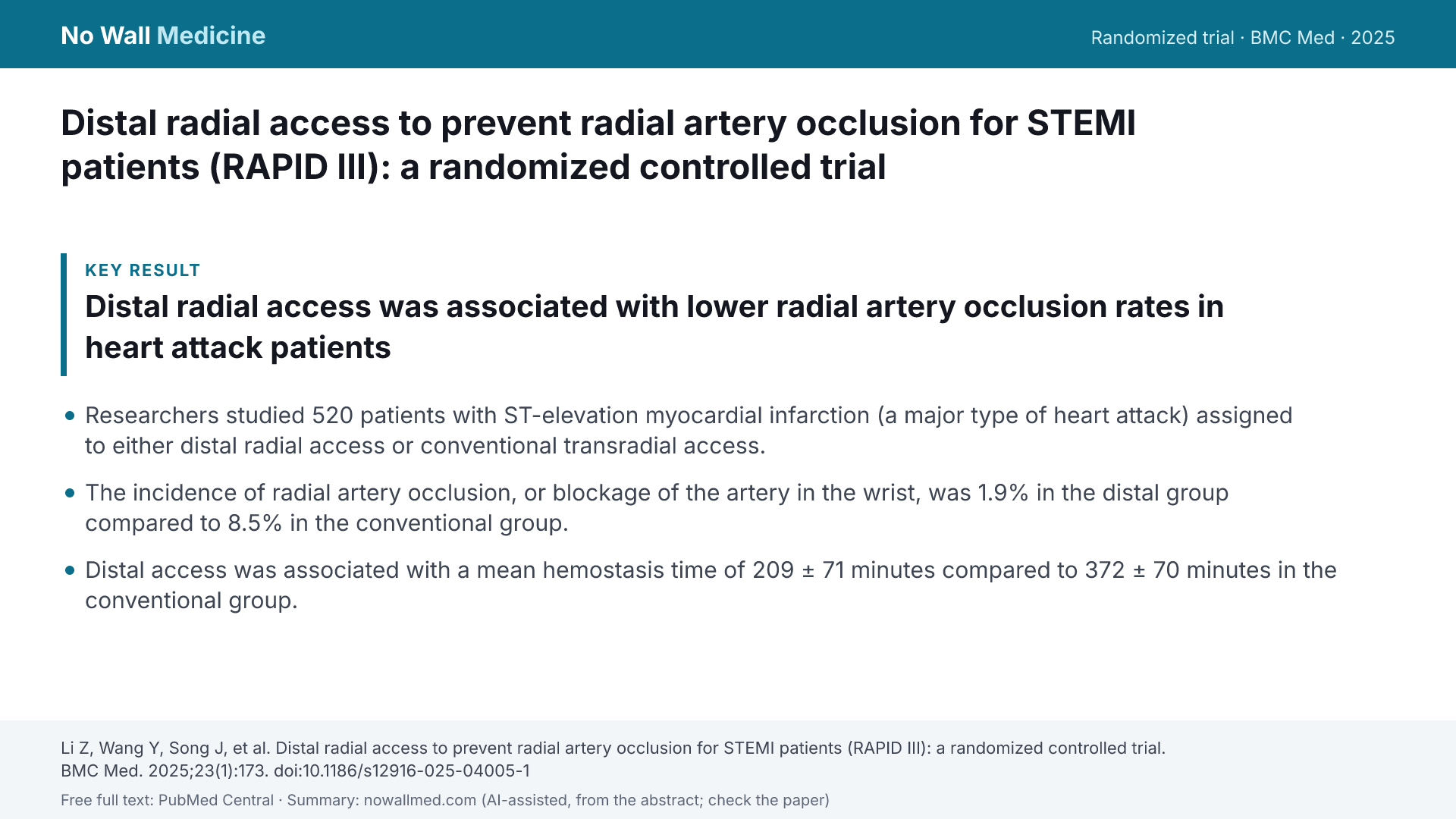
Distal radial access was associated with lower radial artery occlusion rates in heart attack patients
Distal radial access to prevent radial artery occlusion for STEMI patients (RAPID III): a randomized controlled trial
Key points
- Researchers studied 520 patients with ST-elevation myocardial infarction (a major type of heart attack) assigned to either distal radial access or conventional transradial access.
- The incidence of radial artery occlusion, or blockage of the artery in the wrist, was 1.9% in the distal group compared to 8.5% in the conventional group.
- Distal access was associated with a mean hemostasis time of 209 ± 71 minutes compared to 372 ± 70 minutes in the conventional group.
Headline and key points written with AI from the paper’s abstract, with every number checked against it. Read the paper before relying on them.
Was this summary helpful?
Subject terms
Cite this article
Li Z, Wang Y, Song J, et al. Distal radial access to prevent radial artery occlusion for STEMI patients (RAPID III): a randomized controlled trial. BMC Med. 2025;23(1):173. doi:10.1186/s12916-025-04005-1
Spotted a mistake? Suggest a correction