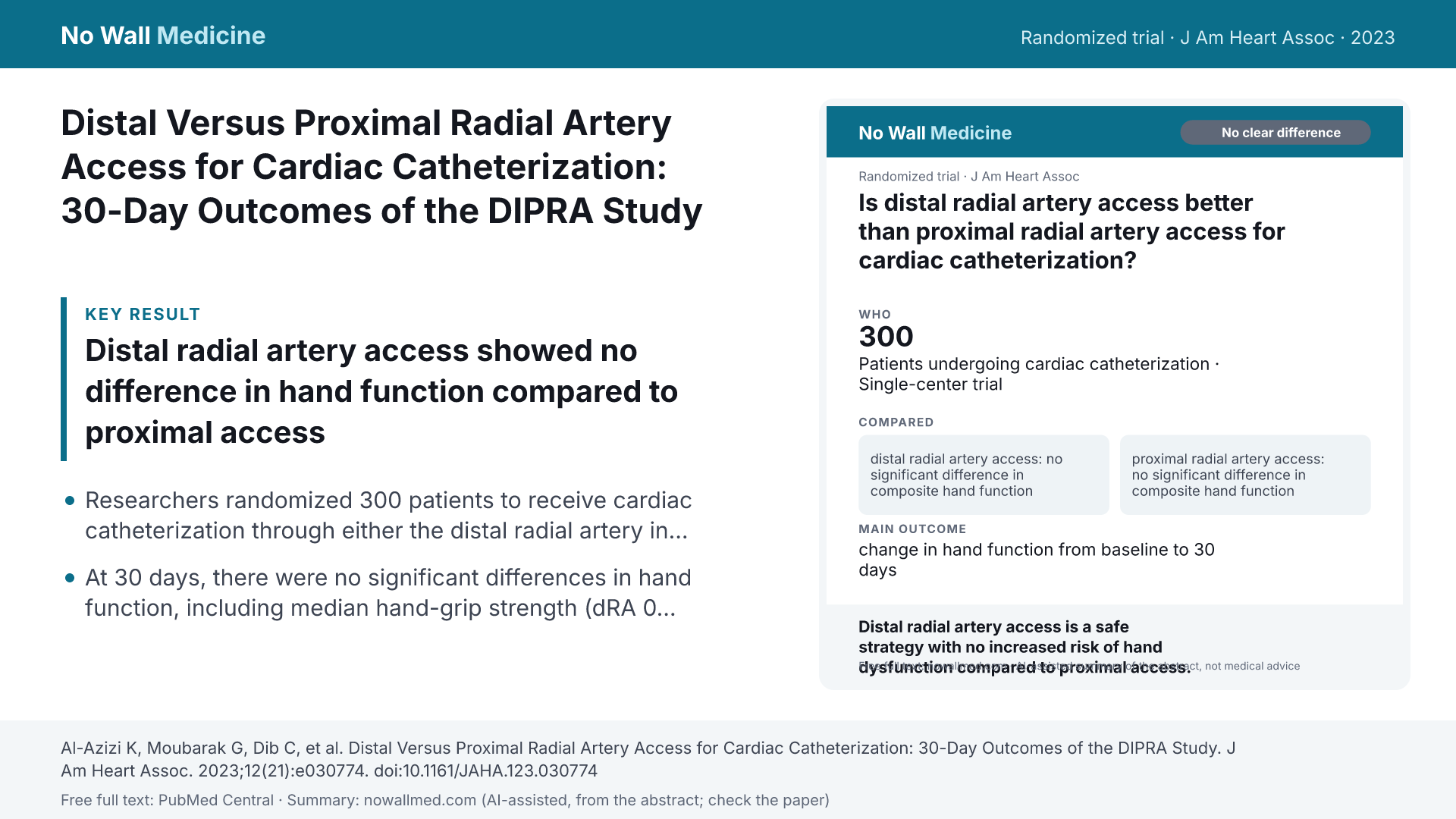
Distal radial artery access showed no difference in hand function compared to proximal access
Distal Versus Proximal Radial Artery Access for Cardiac Catheterization: 30-Day Outcomes of the DIPRA Study
Randomized trialNo clear difference
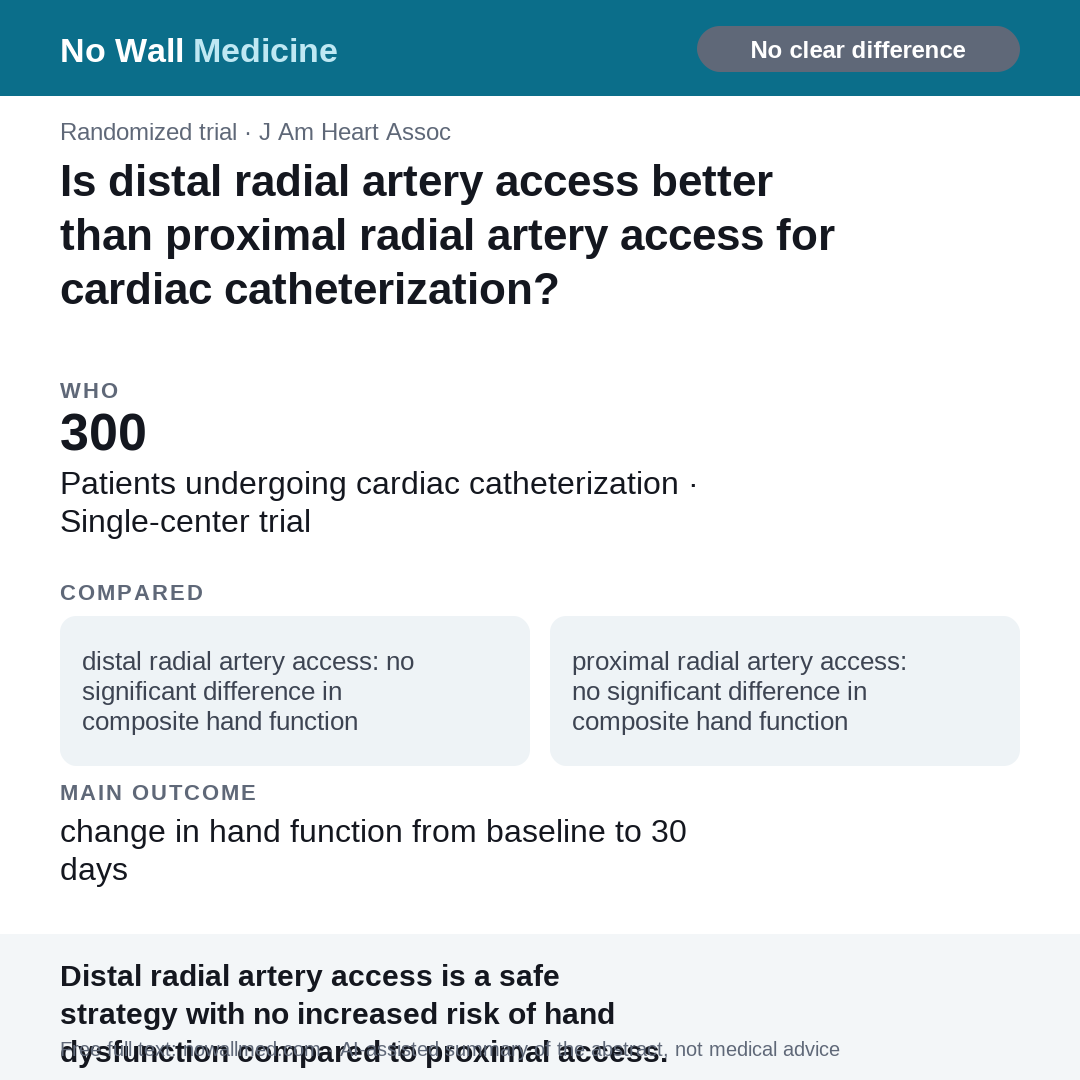
Is distal radial artery access better than proximal radial artery access for cardiac catheterization?
Who
300
Patients undergoing cardiac catheterization · Single-center trial
Compared
distal radial artery access: no significant difference in composite hand function
proximal radial artery access: no significant difference in composite hand function
Main outcome
change in hand function from baseline to 30 days
Bottom line: Distal radial artery access is a safe strategy with no increased risk of hand dysfunction compared to proximal access.
J Am Heart Assoc · 2023-10-27Download image
Clinical question: Is distal radial artery access better than proximal radial artery access for cardiac catheterization?
Why it matters: It is unknown if using the distal radial artery for cardiac catheterization affects hand function or safety compared to the proximal radial artery.
Key points
- Researchers randomized 300 patients to receive cardiac catheterization through either the distal radial artery in the anatomical snuffbox or the proximal radial artery.
- At 30 days, there were no significant differences in hand function, including median hand-grip strength (dRA 0 [-3.2, 3.3] kg versus pRA 0.7 [-2.3, 3.3] kg; P=0.21).
- Access site bleeding rates were similar between groups, with 0% in the distal group and 1.4% in the proximal group (P=0.25).
Limitation the authors note: This was a single-center trial.
Headline and key points written with AI from the paper’s abstract, with every number checked against it. Read the paper before relying on them.
Was this summary helpful?
Subject terms
Cite this article
Al-Azizi K, Moubarak G, Dib C, Sayfo S, Szerlip M, Thomas S. Distal Versus Proximal Radial Artery Access for Cardiac Catheterization: 30-Day Outcomes of the DIPRA Study. J Am Heart Assoc. 2023. doi:10.1161/JAHA.123.030774
Spotted a mistake? Suggest a correction
Top studies every Monday
The week’s key trials and guidelines in your specialties, plus any topics you follow. By email, free.
Get the weekly digest