Topical acrizanib eye drops did not reduce the need for injections in macular degeneration patients
A Randomized, Double-Masked, Multicenter Trial of Topical Acrizanib (LHA510), a Tyrosine Kinase VEGF-Receptor Inhibitor, in Treatment-Experienced Subjects With Neovascular Age-Related Macular Degeneration
Randomized, double-masked, vehicle-controlled proof-of-concept studyNo clear difference
Can topical acrizanib suppress the need for anti-vascular endothelial growth factor therapy?
Who
90
Treatment-experienced patients with neovascular age-related macular degeneration · Multicenter
Compared
topical LHA510: 25 of 33 patients (75.8%)
placebo: 25 of 37 patients (67.6%)
Main outcome
number of patients requiring rescue over 84 days
Bottom line: Topical acrizanib failed to demonstrate clinical efficacy in reducing the need for rescue therapy.
Am J Ophthalmol · 2022-03-02Download image
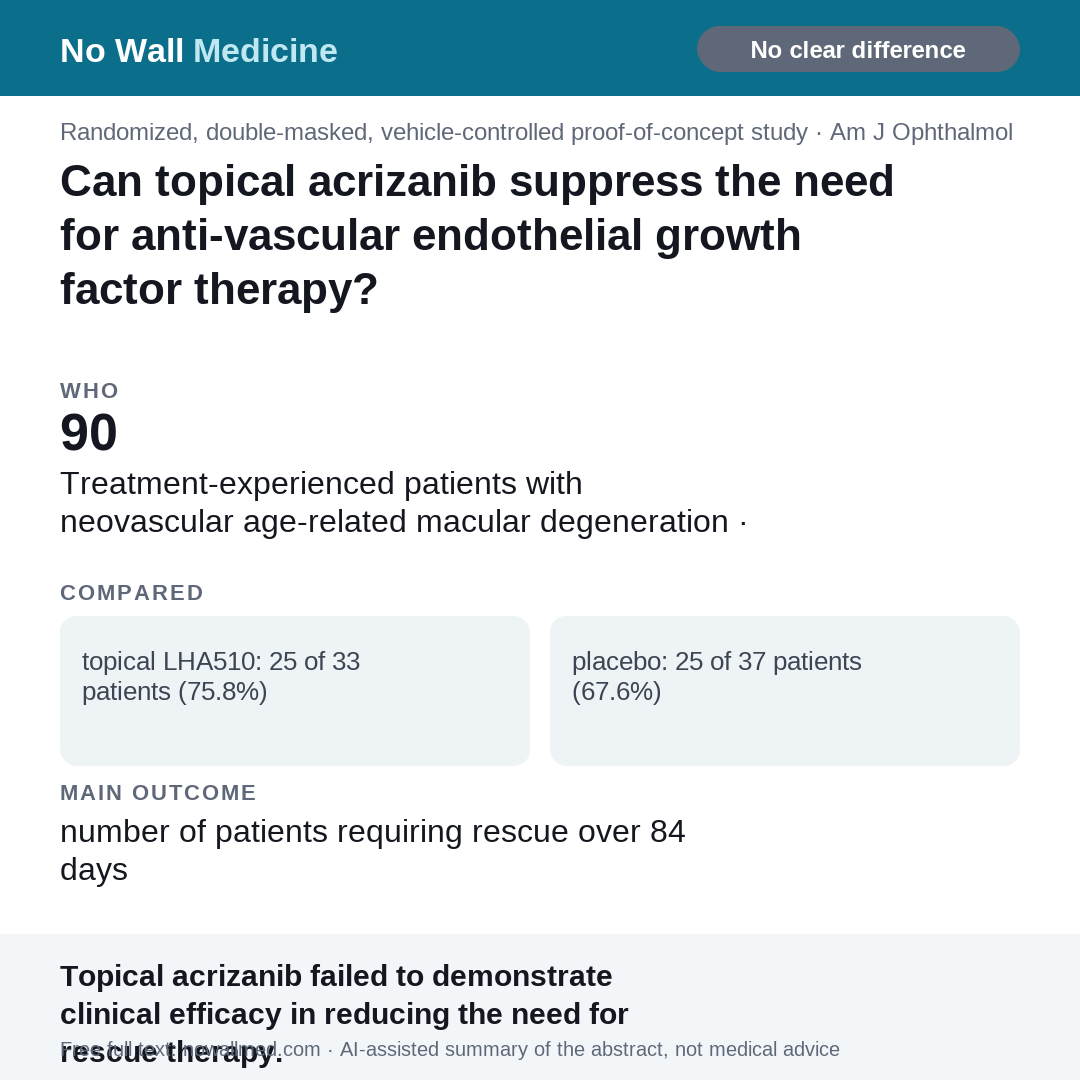
Clinical question: Can topical acrizanib suppress the need for anti-vascular endothelial growth factor therapy?
Why it matters: It was unknown if a topical tyrosine kinase vascular endothelial growth factor receptor inhibitor could suppress the need for regular injections in patients with neovascular age-related macular degeneration.
Key points
- Researchers studied 70 patients with neovascular age-related macular degeneration who were already receiving anti-vascular endothelial growth factor therapy.
- The number of patients requiring rescue injections by day 84 was 75.8% in the acrizanib group compared to 67.6% in the placebo group.
- Twenty-one of 46 patients using acrizanib developed a reversible corneal haze, which is a cloudiness on the clear front part of the eye.
Headline and key points written with AI from the paper’s abstract, with every number checked against it. Read the paper before relying on them.
Was this summary helpful?
Subject terms
Cite this article
Poor SH, Weissgerber G, Adams CM, Bhatt H, Browning DJ, Chastain J. A Randomized, Double-Masked, Multicenter Trial of Topical Acrizanib (LHA510), a Tyrosine Kinase VEGF-Receptor Inhibitor, in Treatment-Experienced Subjects With Neovascular Age-Related Macular Degeneration. Am J Ophthalmol. 2022. doi:10.1016/j.ajo.2022.02.019
Spotted a mistake? Suggest a correction
Top studies every Monday
The week’s key trials and guidelines in your specialties, plus any topics you follow. By email, free.
Get the weekly digest