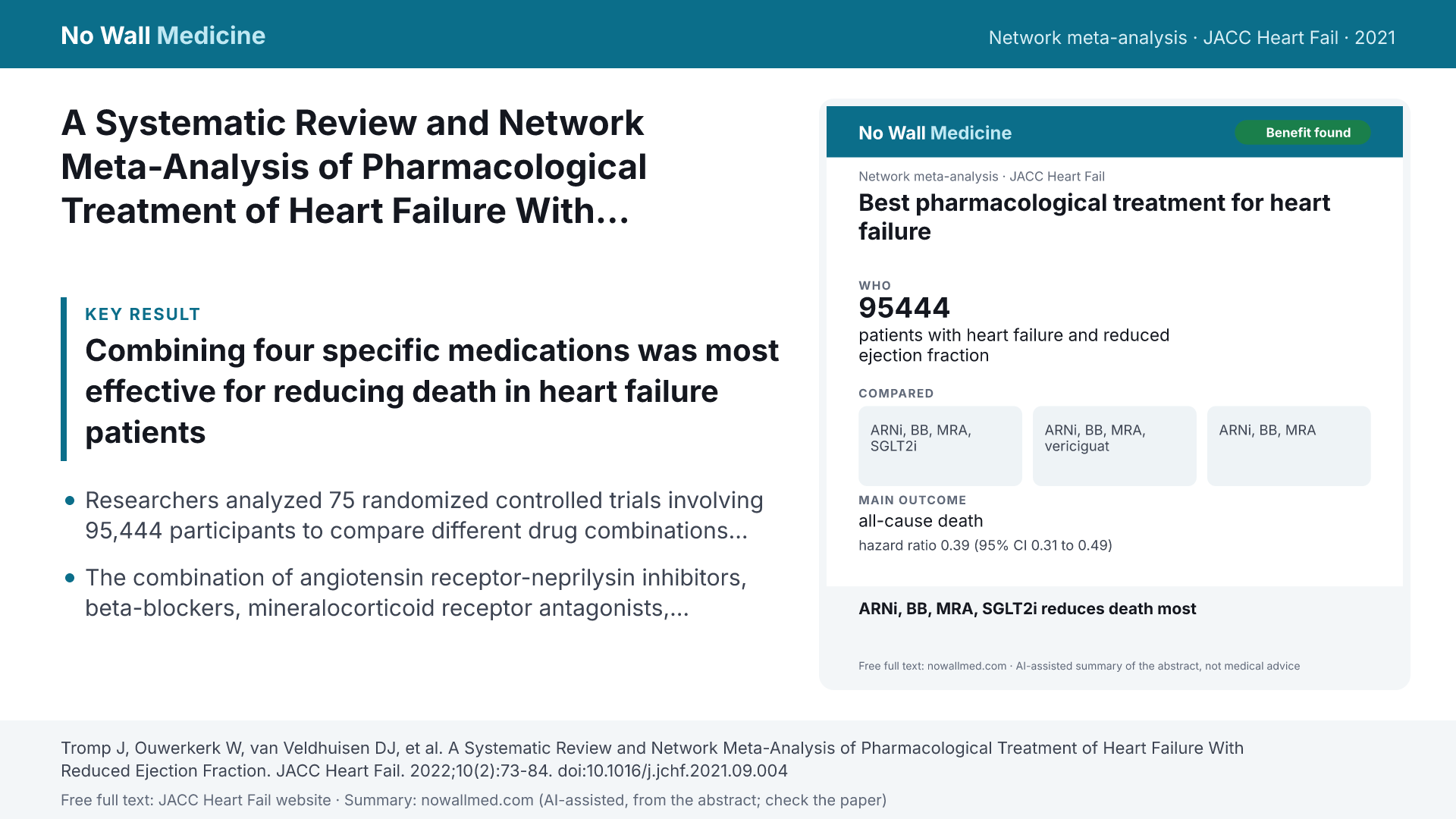
Combining four specific medications was most effective for reducing death in heart failure patients
A Systematic Review and Network Meta-Analysis of Pharmacological Treatment of Heart Failure With Reduced Ejection Fraction
Network meta-analysisBenefit found
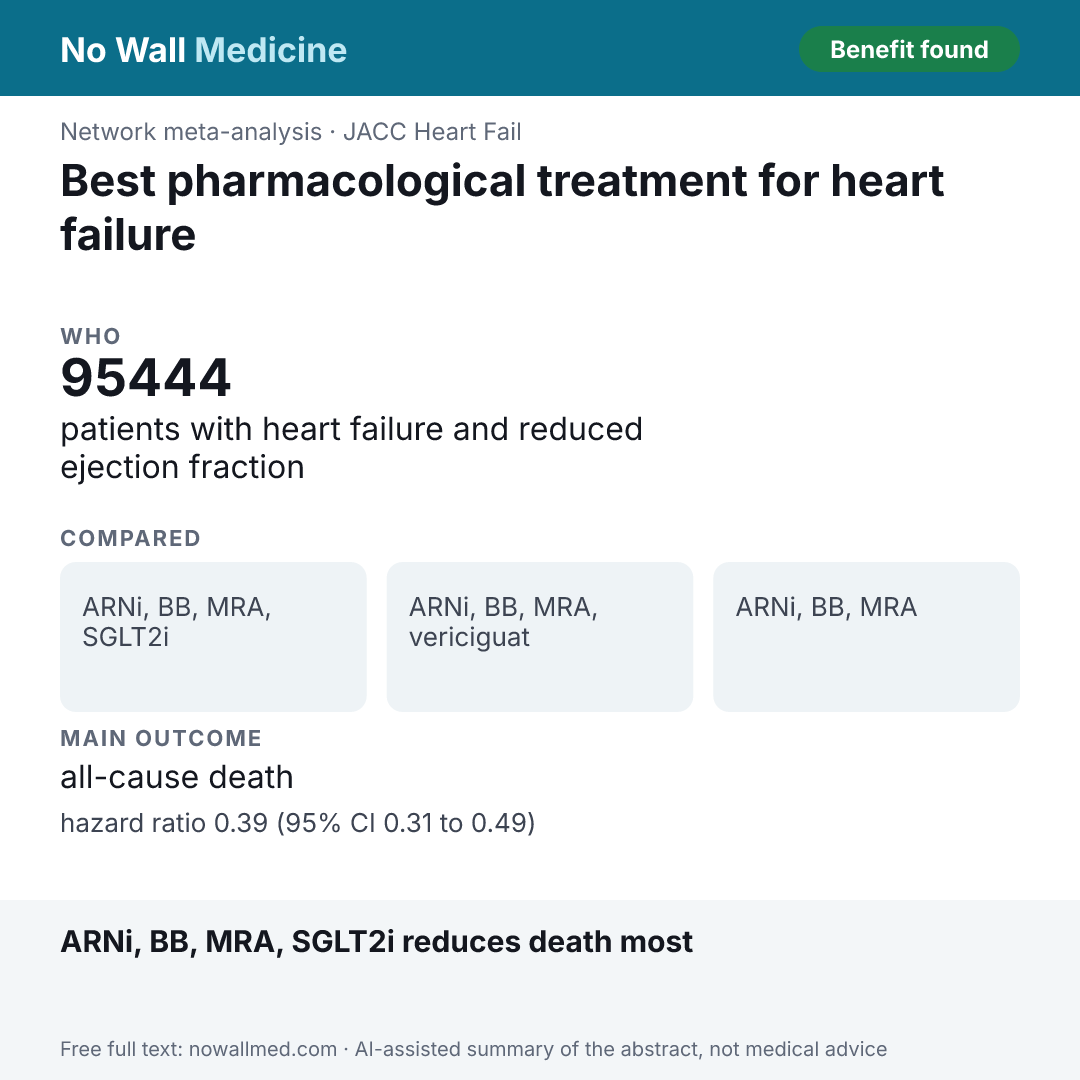
Best pharmacological treatment for heart failure
Who
95444
patients with heart failure and reduced ejection fraction
Compared
ARNi, BB, MRA, SGLT2i
ARNi, BB, MRA, vericiguat
ARNi, BB, MRA
Main outcome
all-cause death
Result: hazard ratio 0.39 (95% CI 0.31 to 0.49)
Bottom line: ARNi, BB, MRA, SGLT2i reduces death most
JACC Heart Fail · 2021-12-08 · Save PNG
Why it matters: The estimated treatment effects of various combinations of contemporary medical therapies for heart failure with reduced ejection fraction are not well characterized.
Key points
- Researchers analyzed 75 randomized controlled trials involving 95,444 participants to compare different drug combinations for heart failure with reduced ejection fraction.
- The combination of angiotensin receptor-neprilysin inhibitors, beta-blockers, mineralocorticoid receptor antagonists, and sodium glucose cotransporter-2 inhibitors had the lowest hazard ratio for all-cause death at 0.39.
- For a 70-year-old patient, the combination of angiotensin receptor-neprilysin inhibitors, beta-blockers, mineralocorticoid receptor antagonists, and sodium glucose cotransporter-2 inhibitors was associated with 5.0 years of additional life-years gained.
Headline and key points written with AI from the paper’s abstract, with every number checked against it. Read the paper before relying on them.
Was this summary helpful?
Subject terms
Headline, design, result, key points, caveat and citation as plain text.
Cite this article
Tromp J, Ouwerkerk W, van Veldhuisen DJ, et al. A Systematic Review and Network Meta-Analysis of Pharmacological Treatment of Heart Failure With Reduced Ejection Fraction. JACC Heart Fail. 2022;10(2):73-84. doi:10.1016/j.jchf.2021.09.004
Spotted a mistake? Suggest a correction