Endovascular treatment first was associated with better amputation-free survival than vein bypass in patients
A vein bypass first versus a best endovascular treatment first revascularisation strategy for patients with chronic limb threatening ischaemia who required an infra-popliteal, with or without an additional more proximal infra-inguinal revascularisation procedure to restore limb perfusion (BASIL-2): an open-label, randomised, multicentre, phase 3 trial
Open-label, pragmatic, multicentre, phase 3, randomised trialBenefit found
Is vein bypass or best endovascular treatment better for chronic limb-threatening ischaemia?
Who
345
Patients with chronic limb-threatening ischaemia requiring infra-popliteal revascularisation · 41 sites in UK, Sweden, and Denmark
Compared
108Vein bypass (63%)
92Best endovascular treatment (53%)
Main outcome
Amputation-free survival
Result: adjusted hazard ratio 1·35 (95% CI 1·02-1·80)
Bottom line: Best endovascular treatment first was associated with better amputation-free survival compared to vein bypass first.
Lancet · 2023-04-25Download image
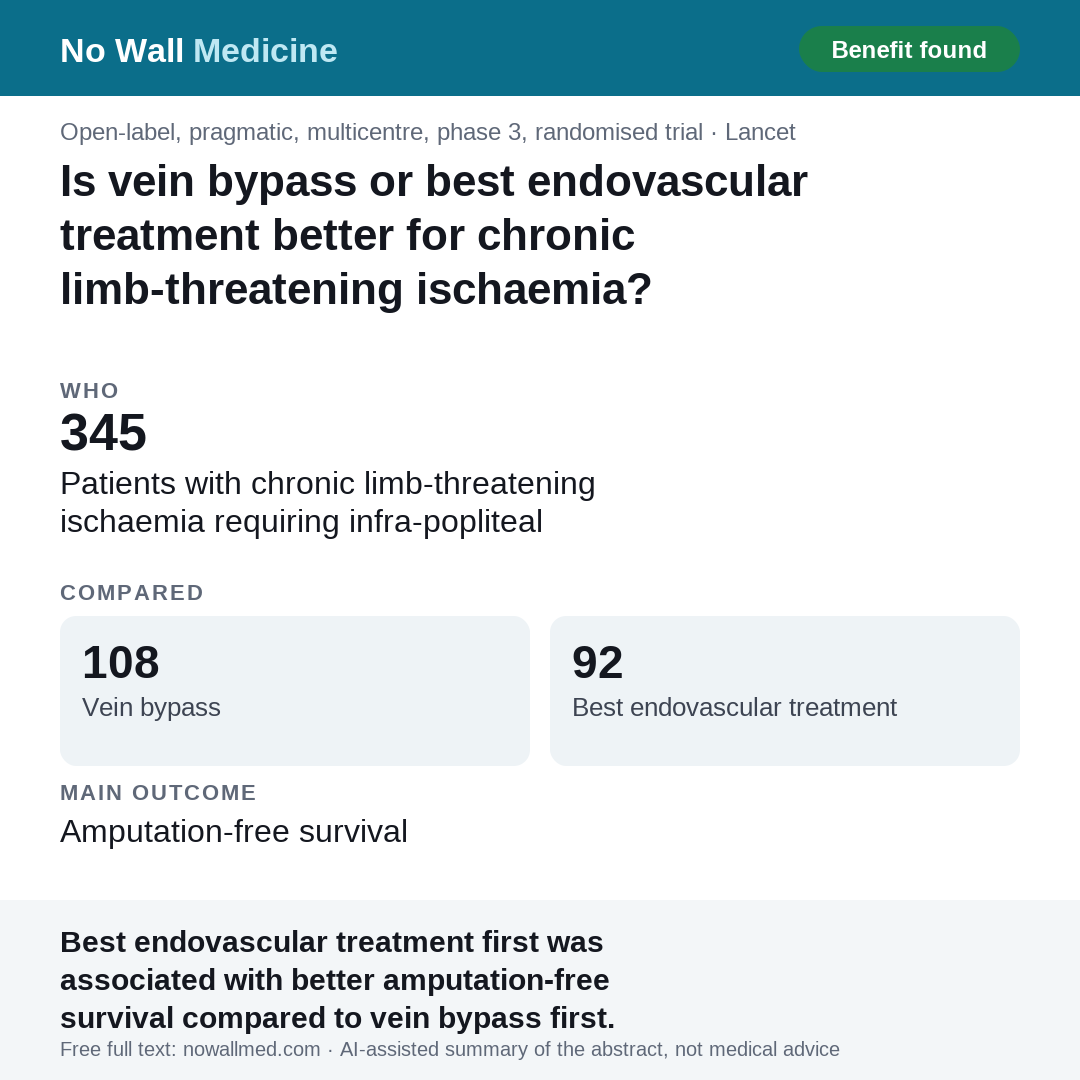
Clinical question: Is vein bypass or best endovascular treatment better for chronic limb-threatening ischaemia?
Why it matters: It is unclear whether starting with vein bypass or endovascular treatment, such as balloon angioplasty or stents, is more effective for patients with chronic limb-threatening ischaemia.
Key points
- The trial studied 345 patients with chronic limb-threatening ischaemia, comparing a vein bypass strategy to a best endovascular treatment strategy.
- Major amputation or death occurred in 63% of the vein bypass group and 53% of the endovascular group (adjusted hazard ratio 1.35; p=0.037).
- Death occurred in 53% of the vein bypass group and 45% of the endovascular group (adjusted hazard ratio 1.37).
Headline and key points written with AI from the paper’s abstract, with every number checked against it. Read the paper before relying on them.
Was this summary helpful?
Abstract
Background
Chronic limb-threatening ischaemia is the severest manifestation of peripheral arterial disease and presents with ischaemic pain at rest or tissue loss (ulceration, gangrene, or both), or both. We compared the effectiveness of a vein bypass first with a best endovascular treatment first revascularisation strategy in terms of preventing major amputation and death in patients with chronic limb threatening ischaemia who required an infra-popliteal, with or without an additional more proximal infra-inguinal, revascularisation procedure to restore limb perfusion. Methods
Bypass versus Angioplasty for Severe Ischaemia of the Leg (BASIL)-2 was an open-label, pragmatic, multicentre, phase 3, randomised trial done at 41 vascular surgery units in the UK (n=39), Sweden (n=1), and Denmark (n=1). Eligible patients were those who presented to hospital-based vascular surgery units with chronic limb-threatening ischaemia due to atherosclerotic disease and who required an infra-popliteal, with or without an additional more proximal infra-inguinal, revascularisation procedure to restore limb perfusion. Participants were randomly assigned (1:1) to receive either vein bypass (vein bypass group) or best endovascular treatment (best endovascular treatment group) as their first revascularisation procedure through a secure online randomisation system. Participants were excluded if they had ischaemic pain or tissue loss considered not to be primarily due to atherosclerotic peripheral artery disease. Most vein bypasses used the great saphenous vein and originated from the common or superficial femoral arteries. Most endovascular interventions comprised plain balloon angioplasty with selective use of plain or drug eluting stents. Participants were followed up for a minimum of 2 years. Data were collected locally at participating centres. In England, Wales, and Sweden, centralised databases were used to collect information on amputations and deaths. Data were analysed centrally at the Birmingham Clinical Trials Unit. The primary outcome was amputation-free survival defined as time to first major (above the ankle) amputation or death from any cause measured in the intention-to-treat population. Safety was assessed by monitoring serious adverse events up to 30-days after first revascularisation. The trial is registered with the ISRCTN registry, ISRCTN27728689. Findings
Between July 22, 2014, and Nov 30, 2020, 345 participants (65 [19%] women and 280 [81%] men; median age 72·5 years [62·7-79·3]) with chronic limb-threatening ischaemia were enrolled in the trial and randomly assigned: 172 (50%) to the vein bypass group and 173 (50%) to the best endovascular treatment group. Major amputation or death occurred in 108 (63%) of 172 patients in the vein bypass group and 92 (53%) of 173 patients in the best endovascular treatment group (adjusted hazard ratio [HR] 1·35 [95% CI 1·02-1·80]; p=0·037). 91 (53%) of 172 patients in the vein bypass group and 77 (45%) of 173 patients in the best endovascular treatment group died (adjusted HR 1·37 [95% CI 1·00-1·87]). In both groups the most common causes of morbidity and death, including that occurring within 30 days of their first revascularisation, were cardiovascular (61 deaths in the vein bypass group and 49 in the best endovascular treatment group) and respiratory events (25 deaths in the vein bypass group and 23 in the best endovascular treatment group; number of cardiovascular and respiratory deaths were not mutually exclusive). Interpretation
In the BASIL-2 trial, a best endovascular treatment first revascularisation strategy was associated with a better amputation-free survival, which was largely driven by fewer deaths in the best endovascular treatment group. These data suggest that more patients with chronic limb-threatening ischaemia who required an infra-popliteal, with or without an additional more proximal infra-inguinal, revascularisation procedure to restore limb perfusion should be considered for a best endovascular treatment first revascularisation strategy. Funding
UK National Institute of Health Research Health Technology Programme.
Abstract reproduced under the article’s CC BY licence.
Subject terms
Cite this article
Bradbury AW, Moakes CA, Popplewell M, Meecham L, Bate GR, Kelly L. A vein bypass first versus a best endovascular treatment first revascularisation strategy for patients with chronic limb threatening ischaemia who required an infra-popliteal, with or without an additional more proximal infra-inguinal revascularisation procedure to restore limb perfusion (BASIL-2): an open-label, randomised, multicentre, phase 3 trial. Lancet. 2023. doi:10.1016/S0140-6736(23)00462-2
Spotted a mistake? Suggest a correction
Top studies every Monday
The week’s key trials and guidelines in your specialties, plus any topics you follow. By email, free.
Get the weekly digest