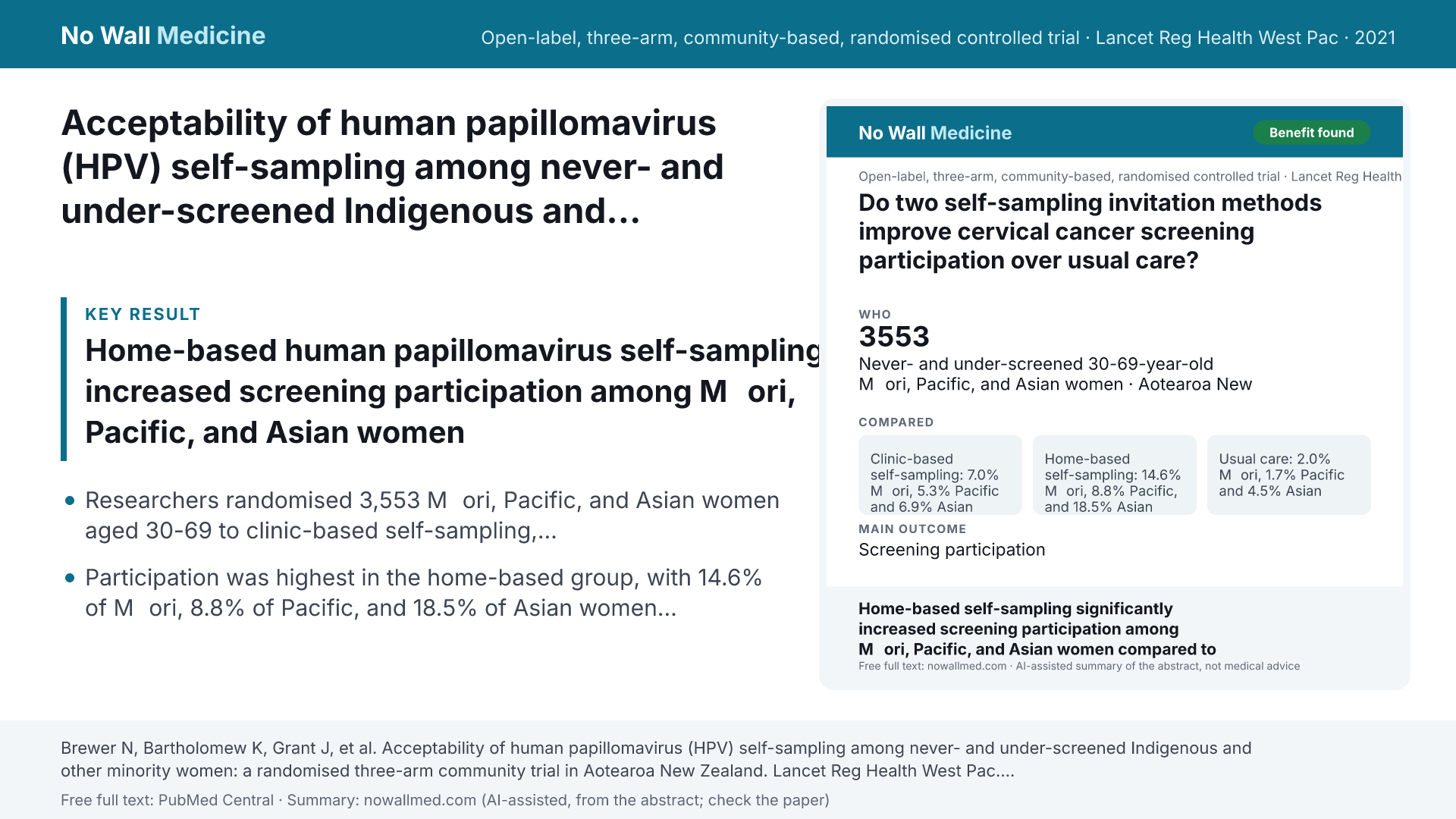
Home-based human papillomavirus self-sampling increased screening participation among Māori, Pacific, and Asian women
Acceptability of human papillomavirus (HPV) self-sampling among never- and under-screened Indigenous and other minority women: a randomised three-arm community trial in Aotearoa New Zealand
Open-label, three-arm, community-based, randomised controlled trialBenefit found
Do two self-sampling invitation methods improve cervical cancer screening participation over usual care?
Who
3553
Never- and under-screened 30-69-year-old Māori, Pacific, and Asian women · Aotearoa New Zealand
Compared
Clinic-based self-sampling: 7.0% Māori, 5.3% Pacific and 6.9% Asian
Home-based self-sampling: 14.6% Māori, 8.8% Pacific, and 18.5% Asian
Usual care: 2.0% Māori, 1.7% Pacific and 4.5% Asian
Main outcome
Screening participation
Result: Māori OR=9.7, (95%CI 3.0-31.5); Pacific OR=6.0 (1.8-19.5); and Asian OR=5.1 (2.4-10.9)
Bottom line: Home-based self-sampling significantly increased screening participation among Māori, Pacific, and Asian women compared to usual care.
Funded by: Health Research Council of New Zealand
Lancet Reg Health West Pac · 2021-09-07Download image
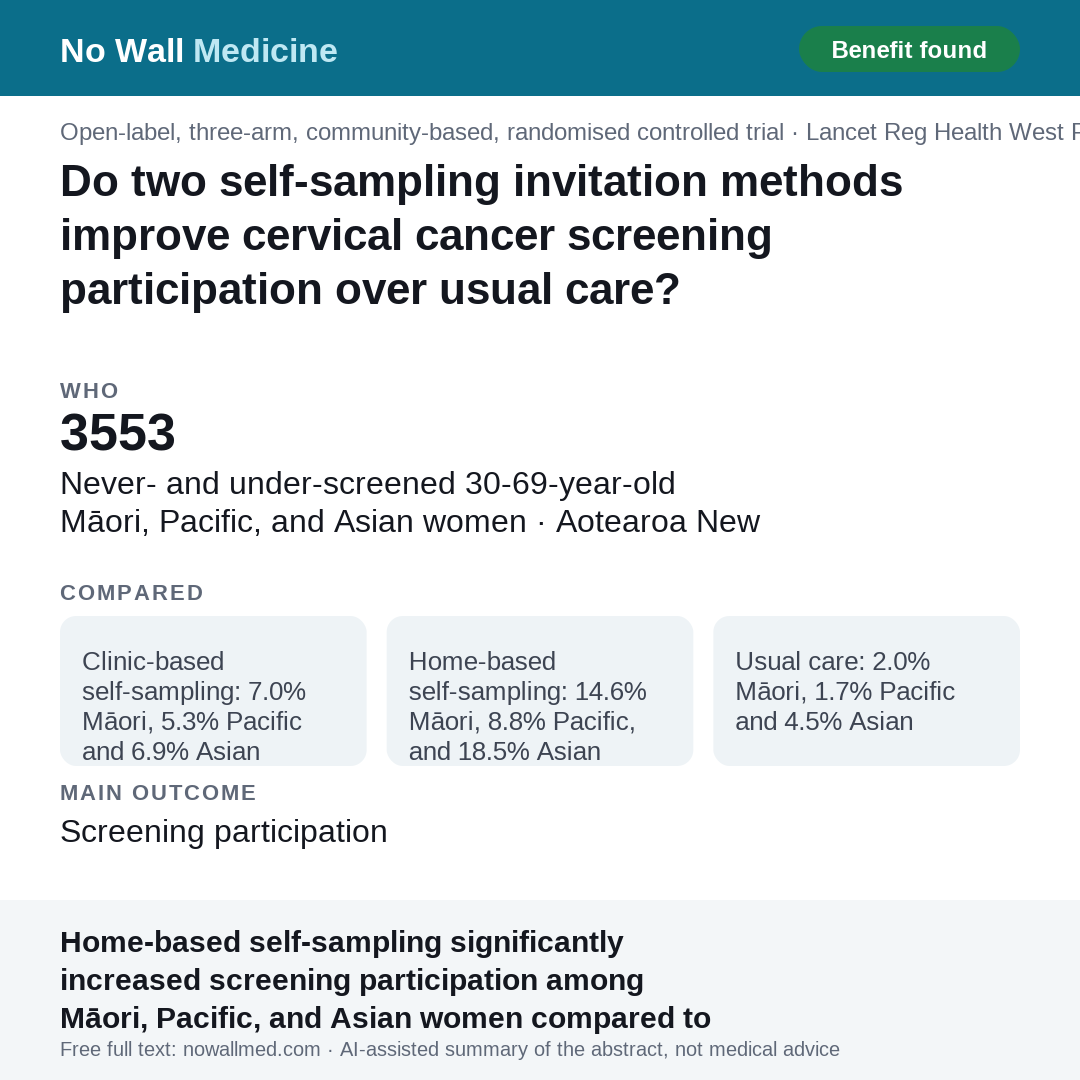
Clinical question: Do two self-sampling invitation methods improve cervical cancer screening participation over usual care?
Why it matters: Ethnic inequalities exist in cervical cancer screening, incidence, and mortality for Māori, Pacific, and Asian women in Aotearoa New Zealand.
Key points
- Researchers randomised 3,553 Māori, Pacific, and Asian women aged 30-69 to clinic-based self-sampling, home-based self-sampling, or usual care involving standard cytology samples.
- Participation was highest in the home-based group, with 14.6% of Māori, 8.8% of Pacific, and 18.5% of Asian women completing a sample.
- Compared to usual care, home-based self-sampling was associated with higher participation for Māori (OR=9.7), Pacific (OR=6.0), and Asian (OR=5.1) women.
Headline and key points written with AI from the paper’s abstract, with every number checked against it. Read the paper before relying on them.
Was this summary helpful?
Cite this article
Brewer N, Bartholomew K, Grant J, et al. Acceptability of human papillomavirus (HPV) self-sampling among never- and under-screened Indigenous and other minority women: a randomised three-arm community trial in Aotearoa New Zealand. Lancet Reg Health West Pac. 2021. doi:10.1016/j.lanwpc.2021.100265
Spotted a mistake? Suggest a correction