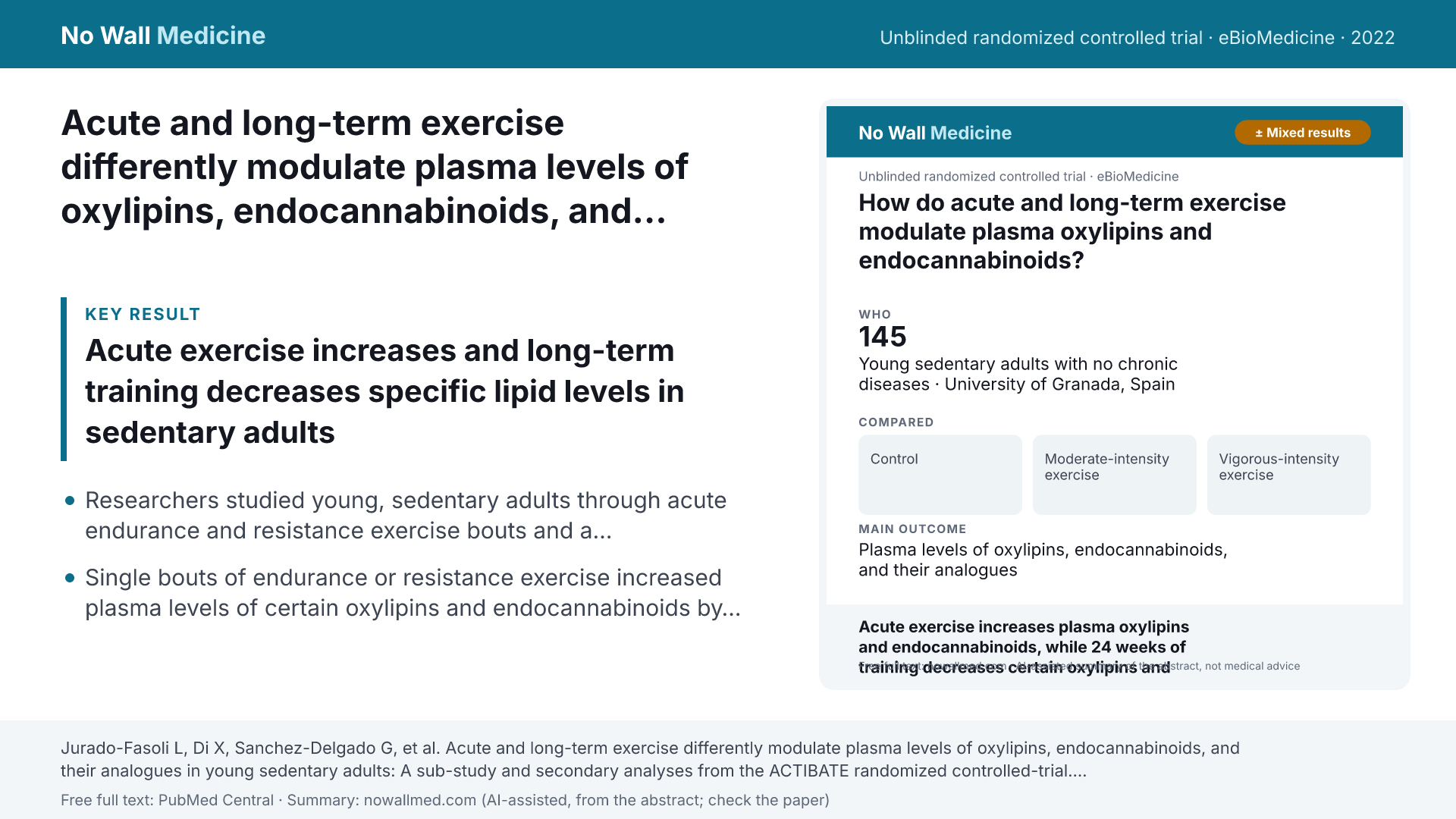
Acute exercise increases and long-term training decreases specific lipid levels in sedentary adults
Acute and long-term exercise differently modulate plasma levels of oxylipins, endocannabinoids, and their analogues in young sedentary adults: A sub-study and secondary analyses from the ACTIBATE randomized controlled-trial
Unblinded randomized controlled trialMixed results
How do acute and long-term exercise modulate plasma oxylipins and endocannabinoids?
Who
145
Young sedentary adults with no chronic diseases · University of Granada, Spain
Compared
Control
Moderate-intensity exercise
Vigorous-intensity exercise
Main outcome
Plasma levels of oxylipins, endocannabinoids, and their analogues
Bottom line: Acute exercise increases plasma oxylipins and endocannabinoids, while 24 weeks of training decreases certain oxylipins and analogues.
eBioMedicine · 2022-10-27Download image
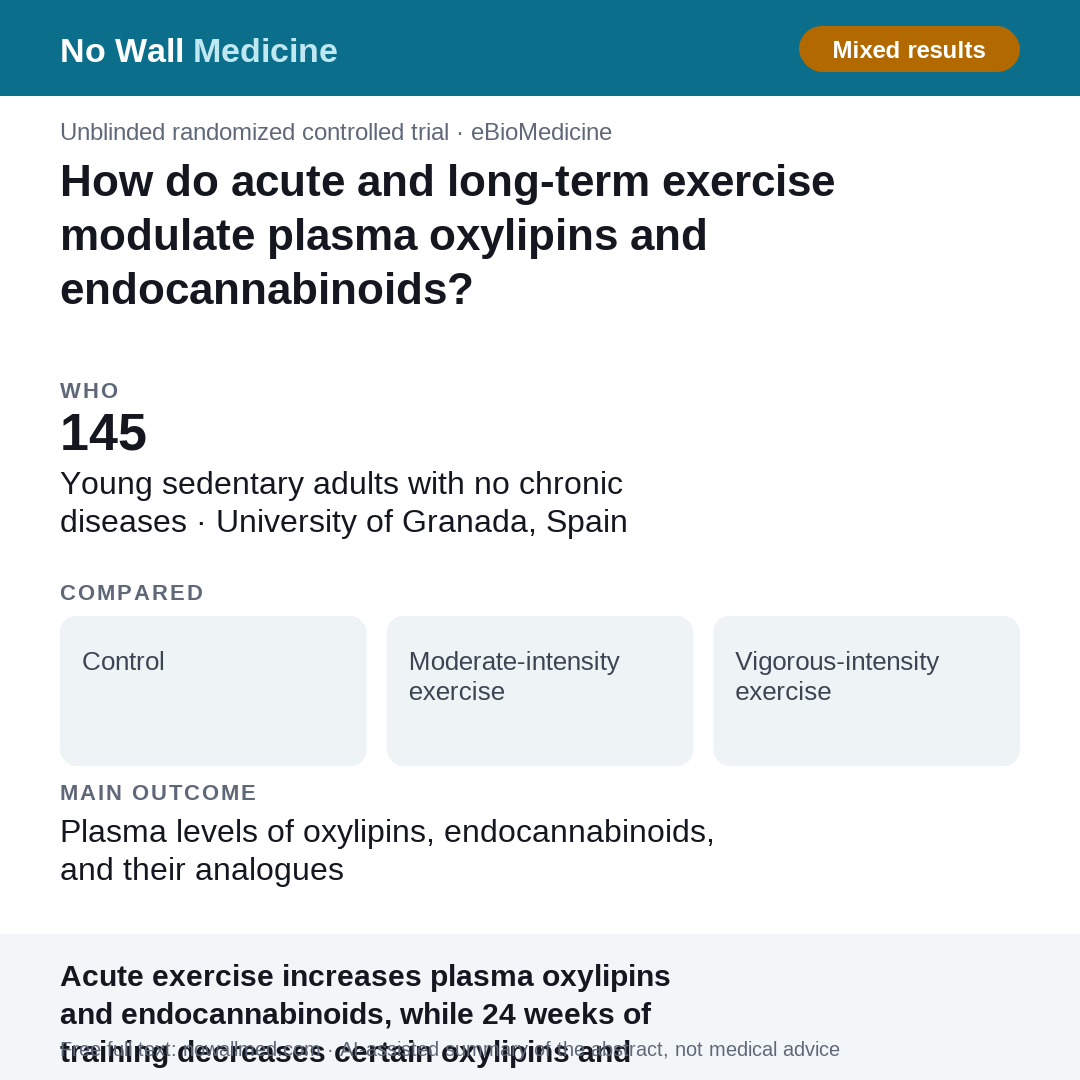
Clinical question: How do acute and long-term exercise modulate plasma oxylipins and endocannabinoids?
Why it matters: It is unknown how immediate exercise sessions versus long-term training programs differently affect the levels of inflammatory and immune-related lipid mediators.
Key points
- Researchers studied young, sedentary adults through acute endurance and resistance exercise bouts and a 24-week supervised exercise intervention.
- Single bouts of endurance or resistance exercise increased plasma levels of certain oxylipins and endocannabinoids by more than 50% and 25% respectively.
- After 24 weeks of training, moderate-intensity or vigorous-intensity exercise was associated with decreased plasma levels of specific omega-6 oxylipins and endocannabinoid analogues.
Headline and key points written with AI from the paper’s abstract, with every number checked against it. Read the paper before relying on them.
Was this summary helpful?
Subject terms
Cite this article
Jurado-Fasoli L, Di X, Sanchez-Delgado G, et al. Acute and long-term exercise differently modulate plasma levels of oxylipins, endocannabinoids, and their analogues in young sedentary adults: A sub-study and secondary analyses from the ACTIBATE randomized controlled-trial. eBioMedicine. 2022. doi:10.1016/j.ebiom.2022.104313
Spotted a mistake? Suggest a correction