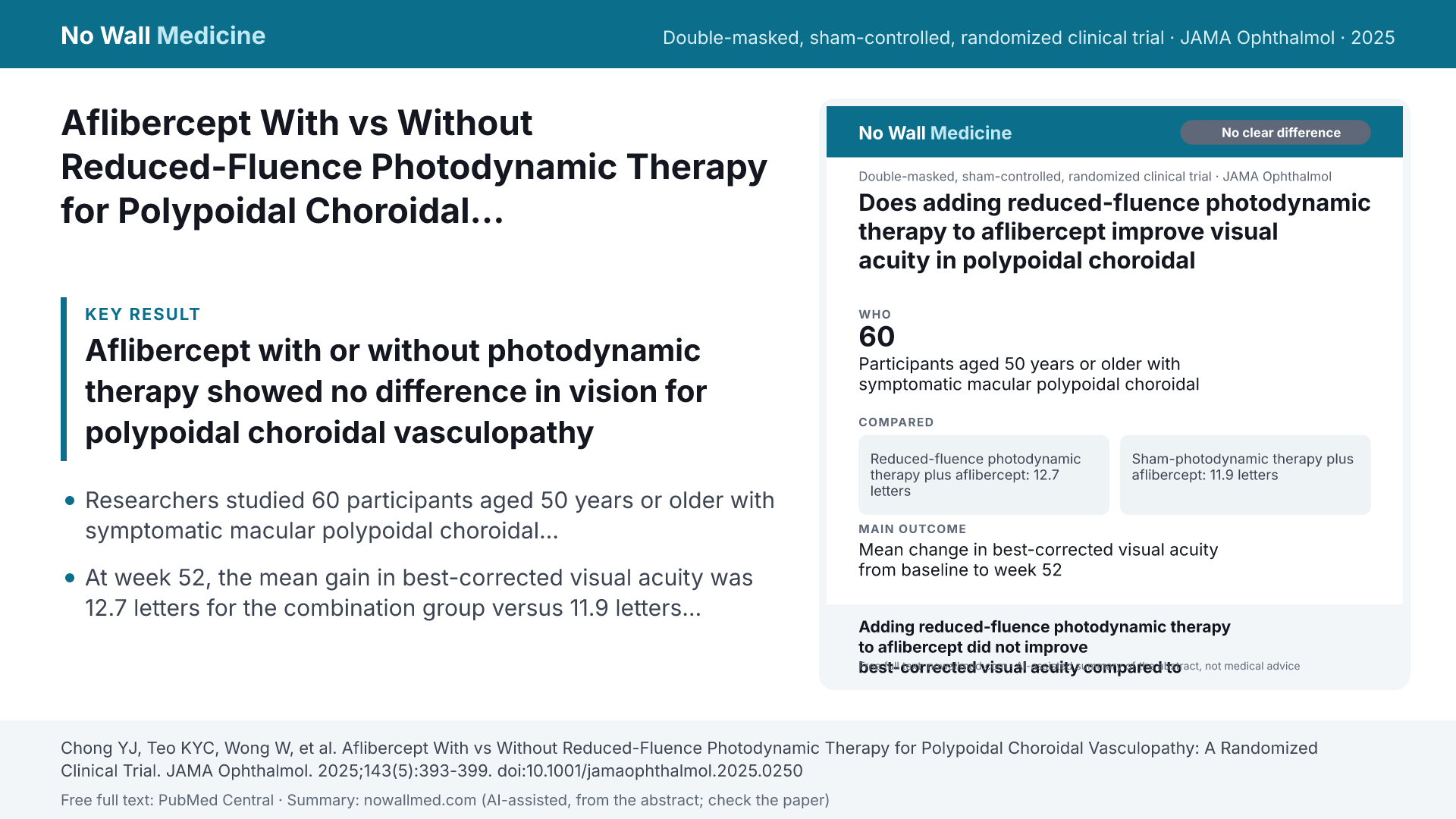
Aflibercept with or without photodynamic therapy showed no difference in vision for polypoidal choroidal vasculopathy
Aflibercept With vs Without Reduced-Fluence Photodynamic Therapy for Polypoidal Choroidal Vasculopathy: A Randomized Clinical Trial
Double-masked, sham-controlled, randomized clinical trialNo clear difference
Does adding reduced-fluence photodynamic therapy to aflibercept improve visual acuity in polypoidal choroidal vasculopathy?
Who
60
Participants aged 50 years or older with symptomatic macular polypoidal choroidal vasculopathy · 2 centers in Singapore
Compared
Reduced-fluence photodynamic therapy plus aflibercept: 12.7 letters
Sham-photodynamic therapy plus aflibercept: 11.9 letters
Main outcome
Mean change in best-corrected visual acuity from baseline to week 52
Result: difference = 0.8 letters; 95% CI, -3.0 to 6.0 letters
Bottom line: Adding reduced-fluence photodynamic therapy to aflibercept did not improve best-corrected visual acuity compared to aflibercept alone.
JAMA Ophthalmol · 2025-03-27Download image
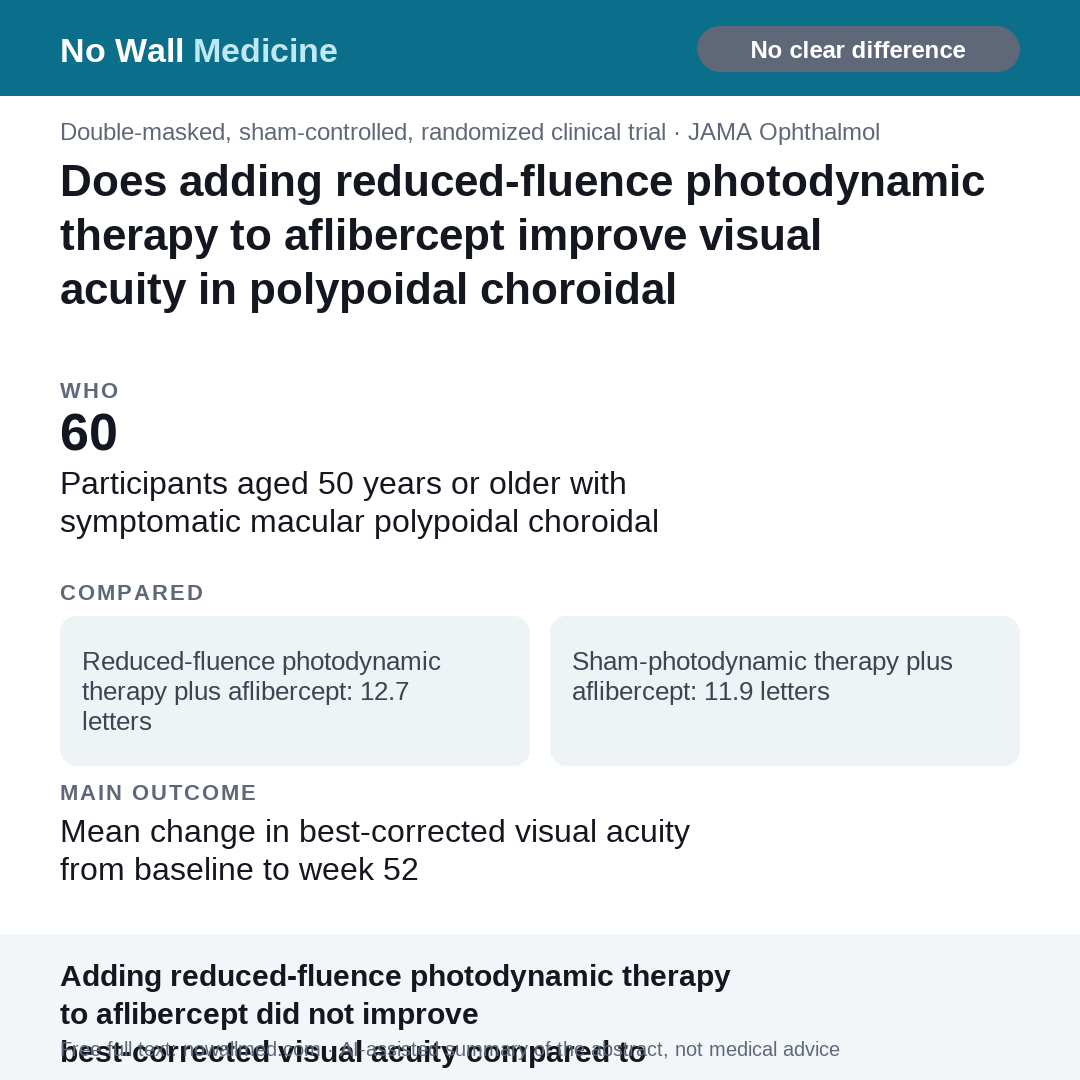
Clinical question: Does adding reduced-fluence photodynamic therapy to aflibercept improve visual acuity in polypoidal choroidal vasculopathy?
Why it matters: It is unclear if adding photodynamic therapy to aflibercept injections provides additional functional or anatomical benefits for patients with polypoidal choroidal vasculopathy.
Key points
- Researchers studied 60 participants aged 50 years or older with symptomatic macular polypoidal choroidal vasculopathy, comparing aflibercept injections alone to a combination with reduced-fluence photodynamic therapy.
- At week 52, the mean gain in best-corrected visual acuity was 12.7 letters for the combination group versus 11.9 letters for the monotherapy group, which was not a statistically significant difference.
- The proportion of eyes with polypoidal lesion closure at week 12 was 66.7% in the combination group compared to 33.3% in the monotherapy group.
Headline and key points written with AI from the paper’s abstract, with every number checked against it. Read the paper before relying on them.
Was this summary helpful?
Subject terms
Cite this article
Chong YJ, Teo KYC, Wong W, Tan ACS, Su X, Gilead N. Aflibercept With vs Without Reduced-Fluence Photodynamic Therapy for Polypoidal Choroidal Vasculopathy: A Randomized Clinical Trial. JAMA Ophthalmol. 2025. doi:10.1001/jamaophthalmol.2025.0250
Spotted a mistake? Suggest a correction
Top studies every Monday
The week’s key trials and guidelines in your specialties, plus any topics you follow. By email, free.
Get the weekly digest