Airflow speeds of 1.7 m/s or greater speed up recovery from exercise-induced breathlessness
Airflow rates and breathlessness recovery from submaximal exercise in healthy adults: prospective, randomised, cross-over study
Prospective, randomised, cross-over studyBenefit found
Do different facial airflow speeds reduce breathlessness severity and hasten postexertion recovery?
Who
9
Ten healthy adults
Compared
Control (no fan)
Airflow speeds of 1.7 m/s or greater: increased the speed of recovery from breathlessness
Main outcome
Breathlessness severity and facial skin temperature
Bottom line: Airflow rates of 1.7 meters per second or greater reduce recovery times from exercise-induced breathlessness.
BMJ Support Palliat Care · 2024-11-20Download image
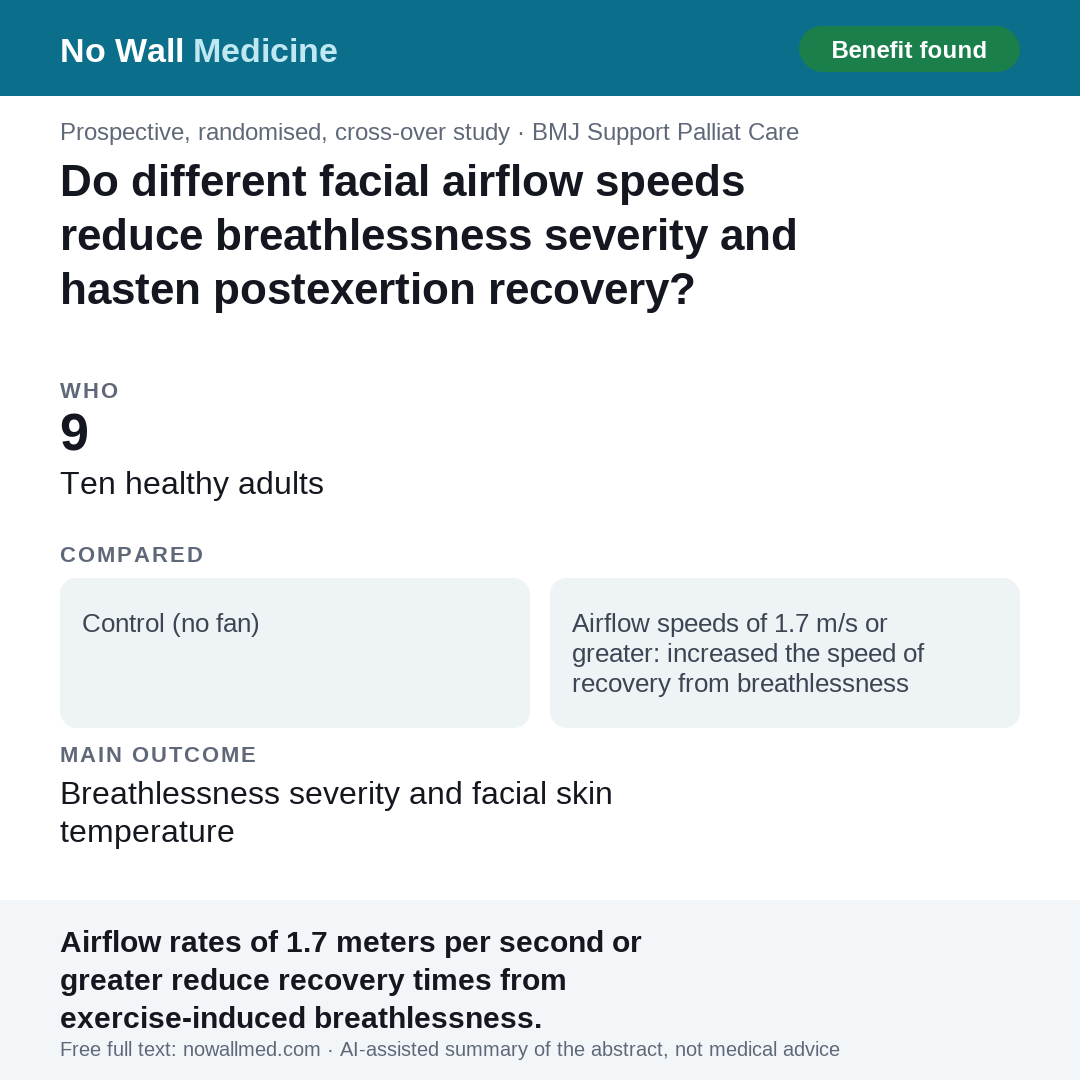
Clinical question: Do different facial airflow speeds reduce breathlessness severity and hasten postexertion recovery?
Why it matters: The optimal airflow speed for reducing the severity and duration of breathlessness after exercise is unknown.
Key points
- Nine healthy participants completed a randomized, cross-over study measuring breathlessness and facial skin temperature during a 20 min recovery phase after exercise.
- Airflow speeds of 1.7 m/s or greater were associated with faster recovery from breathlessness compared to no fan control.
- The highest airflow speeds of 2.5 m/s and 3.3 m/s were associated with the greatest amount of facial cooling.
Headline and key points written with AI from the paper’s abstract, with every number checked against it. Read the paper before relying on them.
Was this summary helpful?
Subject terms
Cite this article
Brew A, O'Beirne S, Johnson MJ, Ramsenthaler C, Watson PJ, Rubini PA. Airflow rates and breathlessness recovery from submaximal exercise in healthy adults: prospective, randomised, cross-over study. BMJ Support Palliat Care. 2024. doi:10.1136/spcare-2023-004309
Spotted a mistake? Suggest a correction
Top studies every Monday
The week’s key trials and guidelines in your specialties, plus any topics you follow. By email, free.
Get the weekly digest