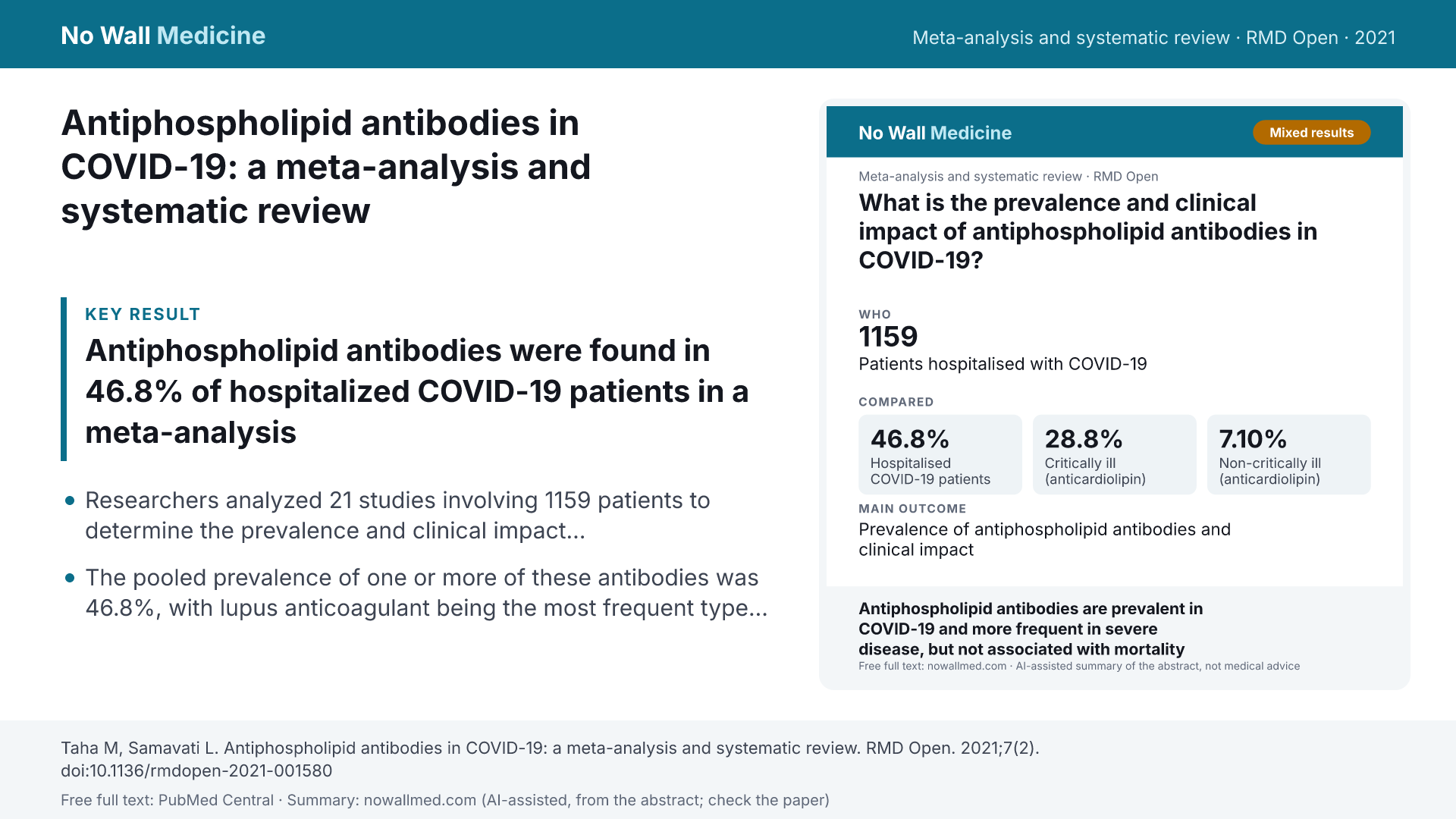
Antiphospholipid antibodies were found in 46.8% of hospitalized COVID-19 patients in a meta-analysis
Antiphospholipid antibodies in COVID-19: a meta-analysis and systematic review
Meta-analysis and systematic reviewMixed results
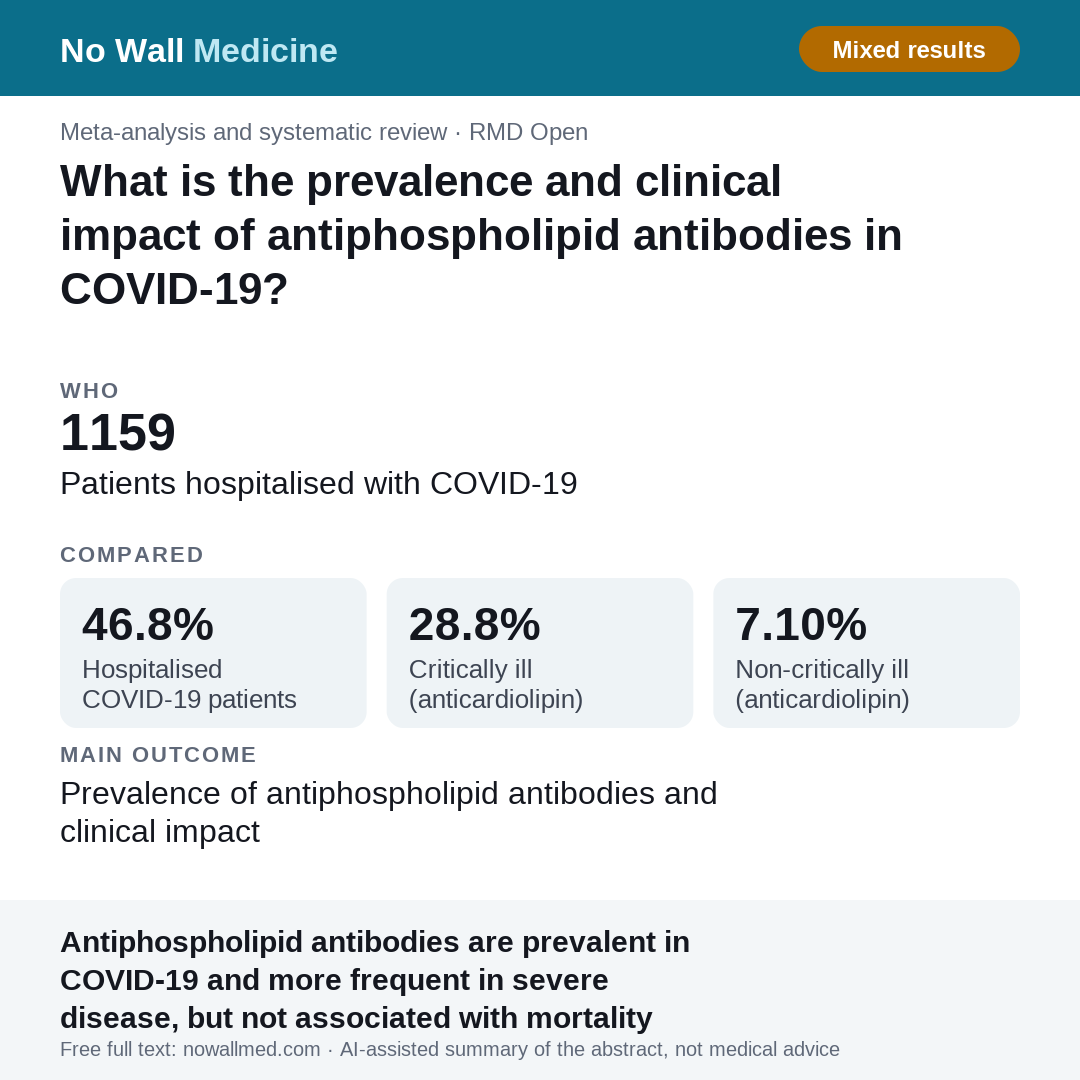
What is the prevalence and clinical impact of antiphospholipid antibodies in COVID-19?
Who
1159
Patients hospitalised with COVID-19
Compared
46.8%Hospitalised COVID-19 patients (95% CI 36.1% to 57.8%)
28.8%Critically ill (anticardiolipin)
7.10%Non-critically ill (anticardiolipin)
Main outcome
Prevalence of antiphospholipid antibodies and clinical impact
Bottom line: Antiphospholipid antibodies are prevalent in COVID-19 and more frequent in severe disease, but not associated with mortality or thrombosis.
Limitation: Further studies are required to identify the clinical and pathological role of antiphospholipid antibodies.
RMD Open · 2021-05-07Download image
Clinical question: What is the prevalence and clinical impact of antiphospholipid antibodies in COVID-19?
Why it matters: The true prevalence of antiphospholipid antibodies in COVID-19 patients and their impact on the course of the disease were unknown.
Key points
- Researchers analyzed 21 studies involving 1159 patients to determine the prevalence and clinical impact of antiphospholipid antibodies, which are proteins that can increase blood clotting risks.
- The pooled prevalence of one or more of these antibodies was 46.8%, with lupus anticoagulant being the most frequent type at 50.7%.
- Higher prevalence of certain antibodies was associated with critical illness, but antibody positivity was not linked to mortality, invasive ventilation, or venous thromboembolism.
Headline and key points written with AI from the paper’s abstract, with every number checked against it. Read the paper before relying on them.
Was this summary helpful?
Abstract
Background
Many studies reported high prevalence of antiphospholipid antibodies (aPL) in patients with COVID-19 raising questions about its true prevalence and its clinical impact on the disease course. Methods
We conducted a meta-analysis and a systematic review to examine the prevalence of aPL and its clinical impact in patients with COVID-19. Results
21 studies with a total of 1159 patients were included in our meta-analysis. Among patients hospitalised with COVID-19, the pooled prevalence rate of one or more aPL (IgM or IgG or IgA of anticardiolipin (aCL) or anti-ß2 glycoprotein (anti-ß2 GPI) or antiphosphatidylserine/prothrombin, or lupus anticoagulant (LA)) was 46.8% (95% CI 36.1% to 57.8%). The most frequent type of aPL found was LA, with pooled prevalence rate of 50.7% (95% CI 34.8% to 66.5%). Critically ill patients with COVID-19 had significantly higher prevalence of aCL (IgM or IgG) (28.8% vs 7.10%, p<0.0001) and anti-ß2 GPI (IgM or IgG) (12.0% vs 5.8%, p<0.0001) as compared with non-critically ill patients. However, there was no association between aPL positivity and mean levels of C reactive protein (mean difference was 32 (95% CI -15 to 79), p=0.18), D-dimer (mean difference was 34 (95% CI -194 to 273), p=0.77), mortality (1.46 (95% CI 0.29 to 7.29), p=0.65), invasive ventilation (1.22 (95% CI 0.51 to 2.91), p=0.65) and venous thromboembolism (1.38 (95% CI 0.57 to 3.37), p=0.48). Conclusions
aPLs were detected in nearly half of patients with COVID-19, and higher prevalence of aPL was found in severe disease. However, there was no association between aPL positivity and disease outcomes including thrombosis, invasive ventilation and mortality. However, further studies are required to identify the clinical and pathological role of aPL in COVID-19.
Abstract reproduced under the article’s CC BY NC licence.
Subject terms
Cite this article
Taha M, Samavati L. Antiphospholipid antibodies in COVID-19: a meta-analysis and systematic review. RMD Open. 2021. doi:10.1136/rmdopen-2021-001580
Spotted a mistake? Suggest a correction