Gradual antipsychotic dose reduction showed no difference in social functioning compared to maintenance treatment
Antipsychotic dose reduction and discontinuation versus maintenance treatment in people with schizophrenia and other recurrent psychotic disorders in England (the RADAR trial): an open, parallel-group, randomised controlled trial
Open, parallel-group, randomised trialNo clear difference
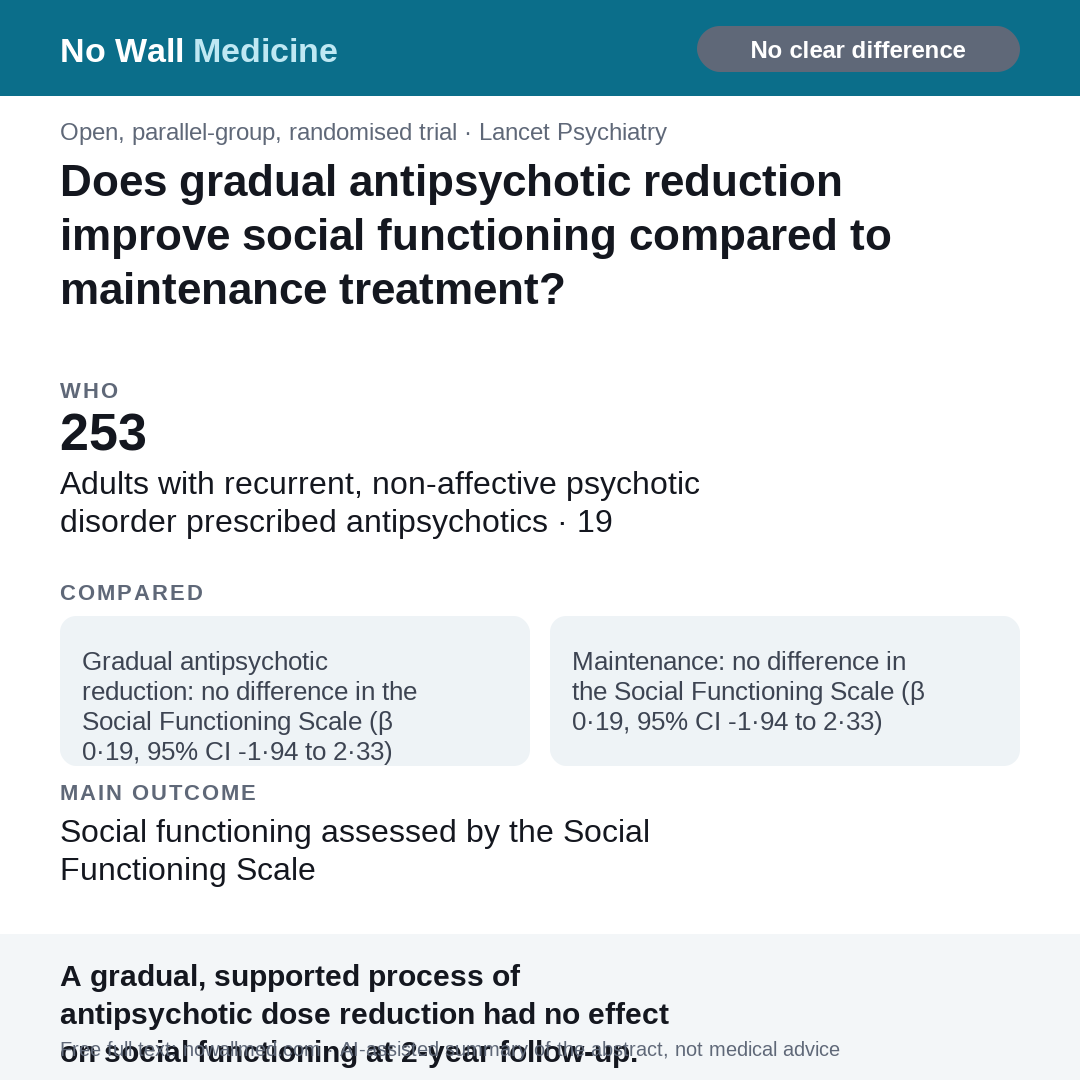
Does gradual antipsychotic reduction improve social functioning compared to maintenance treatment?
Who
253
Adults with recurrent, non-affective psychotic disorder prescribed antipsychotics · 19 National Health Service Trusts in England
Compared
Gradual antipsychotic reduction: no difference in the Social Functioning Scale (β 0·19, 95% CI -1·94 to 2·33)
Maintenance: no difference in the Social Functioning Scale (β 0·19, 95% CI -1·94 to 2·33)
Main outcome
Social functioning assessed by the Social Functioning Scale
Result: β 0·19, 95% CI -1·94 to 2·33
Bottom line: A gradual, supported process of antipsychotic dose reduction had no effect on social functioning at 2-year follow-up.
Funded by: National Institute for Health Research
Lancet Psychiatry · 2023-09-28Download image
Clinical question: Does gradual antipsychotic reduction improve social functioning compared to maintenance treatment?
Why it matters: It is unknown if a gradual process of reducing antipsychotic medication improves social functioning or increases relapse compared to staying on a stable dose.
Key points
- The trial randomized 253 adults with recurrent psychotic disorders to either gradual antipsychotic reduction or maintenance treatment over 2 years.
- At the 24-month follow-up, there was no difference in social functioning scores between the reduction group and the maintenance group.
- The reduction group had 93 serious adverse events affecting 49 individuals, while the maintenance group had 64 events affecting 29 individuals.
Headline and key points written with AI from the paper’s abstract, with every number checked against it. Read the paper before relying on them.
Was this summary helpful?
Abstract
Background
Maintenance antipsychotic medication is recommended for people with schizophrenia or recurrent psychosis, but the adverse effects are burdensome, and evidence on long-term outcomes is sparse. We aimed to assess the benefits and harms of a gradual process of antipsychotic reduction compared with maintenance treatment. Our hypothesis was that antipsychotic reduction would improve social functioning with a short-term increase in relapse. Methods
RADAR was an open, parallel-group, randomised trial done in 19 National Health Service Trusts in England. Participants were aged 18 years and older, had a diagnosis of recurrent, non-affective psychotic disorder, and were prescribed an antipsychotic. Exclusion criteria included people who had a mental health crisis or hospital admission in the past month, were considered to pose a serious risk to themselves or others by a treating clinician, or were mandated to take antipsychotic medication under the Mental Health Act. Through an independent, internet-based system, participants were randomly assigned (1:1) to gradual, flexible antipsychotic reduction, overseen by treating clinicians, or to maintenance. Participants and clinicians were aware of treatment allocations, but assessors were masked to them. Follow-up was for 2 years. Social functioning, assessed by the Social Functioning Scale, was the primary outcome. The principal secondary outcome was severe relapse, defined as requiring admission to hospital. Analysis was done blind to group identity using intention-to-treat data. The trial is completed and has been registered with ISRCTN registry (ISRCTN90298520) and with ClinicalTrials.gov (NCT03559426). Findings
4157 people were screened, of whom 253 were randomly allocated, including 168 (66%) men, 82 (32%) women, and 3 (1%) transgender people, with a mean age of 46 years (SD 12, range 22-79). 171 (67%) participants were White, 52 (21%) were Black, 16 (6%) were Asian, and 12 (5%) were of other ethnicity. The median dose reduction at any point during the trial was 67% in the reduction group and zero in the maintenance group; at 24 months it was 33% versus zero. At the 24-month follow-up, we assessed 90 of 126 people assigned to the antipsychotic dose reduction group and 94 of 127 assigned to the maintenance group, finding no difference in the Social Functioning Scale (β 0·19, 95% CI -1·94 to 2·33; p=0·86). There were 93 serious adverse events in the reduction group affecting 49 individuals, mainly comprising admission for a mental health relapse, and 64 in the maintenance group, relating to 29 individuals. Interpretation
At 2-year follow-up, a gradual, supported process of antipsychotic dose reduction had no effect on social functioning. Our data can help to inform decisions about the use of long-term antipsychotic medication. Funding
National Institute for Health Research.
Abstract reproduced under the article’s CC BY licence.
Subject terms
Cite this article
Moncrieff J, Crellin N, Stansfeld J, Cooper R, Marston L, Freemantle N. Antipsychotic dose reduction and discontinuation versus maintenance treatment in people with schizophrenia and other recurrent psychotic disorders in England (the RADAR trial): an open, parallel-group, randomised controlled trial. Lancet Psychiatry. 2023. doi:10.1016/S2215-0366(23)00258-4
Spotted a mistake? Suggest a correction
Top studies every Monday
The week’s key trials and guidelines in your specialties, plus any topics you follow. By email, free.
Get the weekly digest