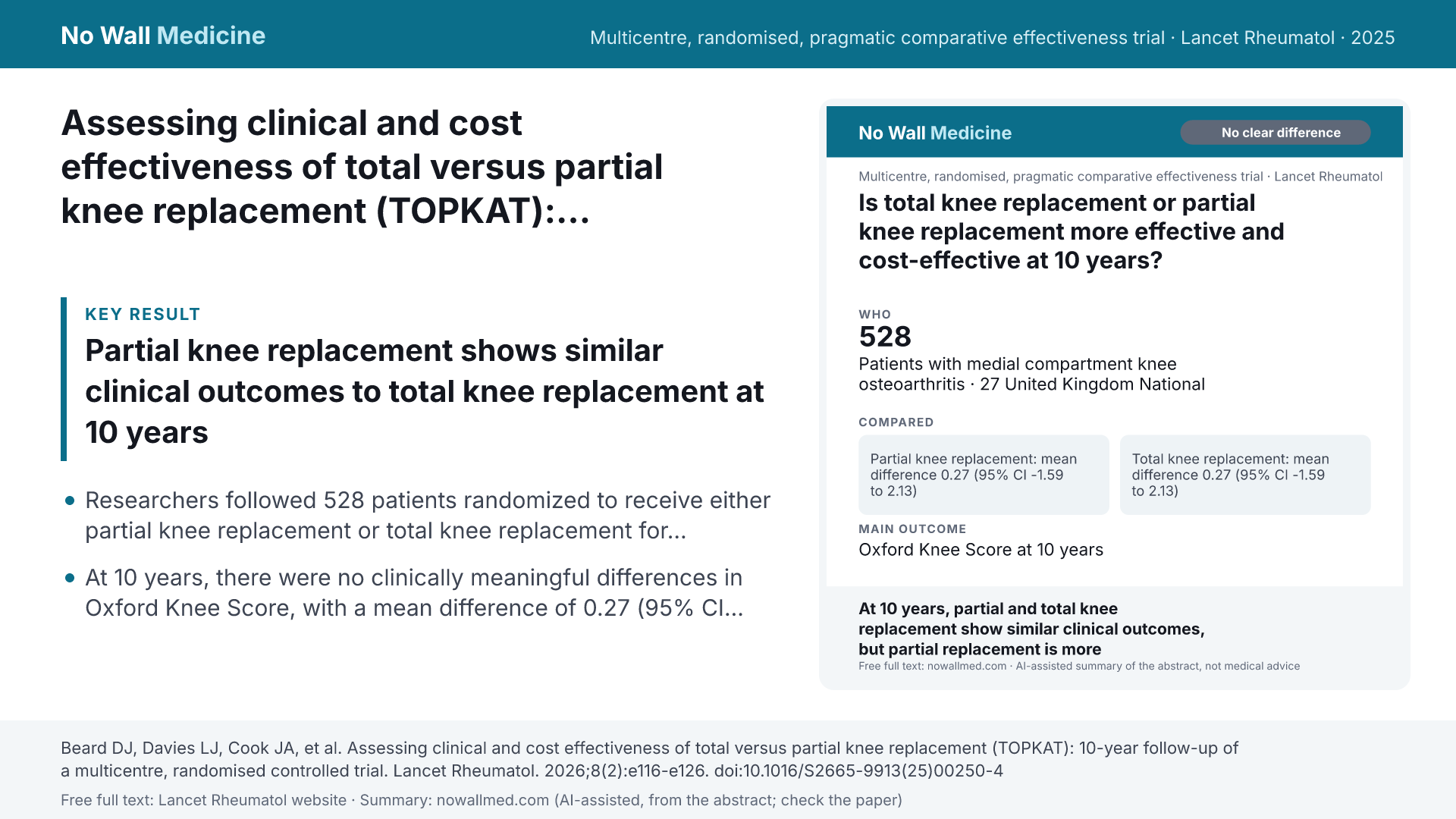
Partial knee replacement shows similar clinical outcomes to total knee replacement at 10 years
Assessing clinical and cost effectiveness of total versus partial knee replacement (TOPKAT): 10-year follow-up of a multicentre, randomised controlled trial
Multicentre, randomised, pragmatic comparative effectiveness trialNo clear difference
Is total knee replacement or partial knee replacement more effective and cost-effective at 10 years?
Who
528
Patients with medial compartment knee osteoarthritis · 27 United Kingdom National Health Service hospitals
Compared
Partial knee replacement: mean difference 0.27 (95% CI -1.59 to 2.13)
Total knee replacement: mean difference 0.27 (95% CI -1.59 to 2.13)
Main outcome
Oxford Knee Score at 10 years
Result: mean difference 0.27 (95% CI -1.59 to 2.13)
Bottom line: At 10 years, partial and total knee replacement show similar clinical outcomes, but partial replacement is more cost-effective.
Funded by: National Institute for Health and Care Research
Lancet Rheumatol · 2025-11-18Download image
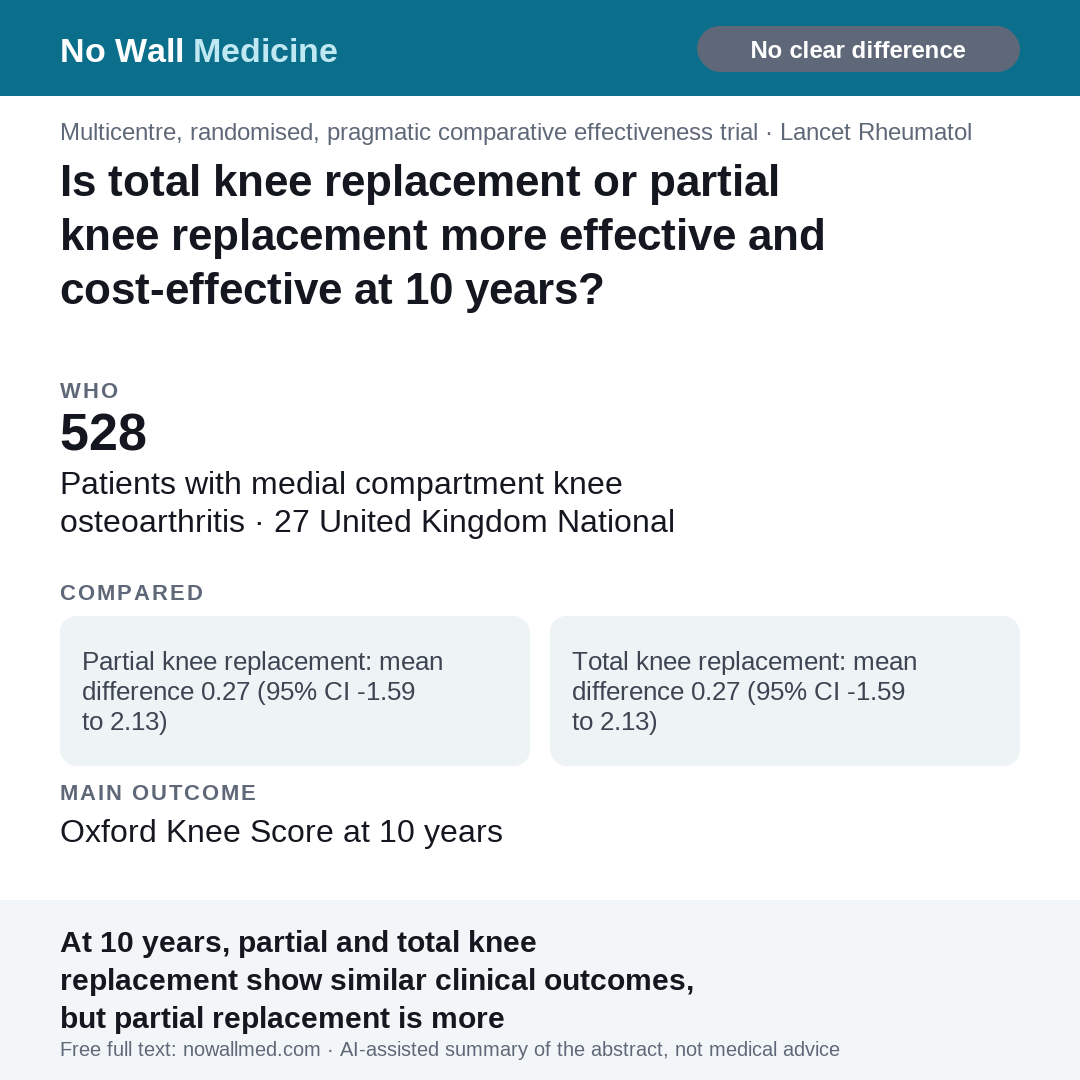
Clinical question: Is total knee replacement or partial knee replacement more effective and cost-effective at 10 years?
Why it matters: Extended follow-up is required to fully evaluate the long-term efficacy and cost-effectiveness of partial versus total knee replacement for late-stage knee osteoarthritis.
Key points
- Researchers followed 528 patients randomized to receive either partial knee replacement or total knee replacement for medial compartment knee osteoarthritis.
- At 10 years, there were no clinically meaningful differences in Oxford Knee Score, with a mean difference of 0.27 (95% CI -1.59 to 2.13).
- Partial knee replacement was associated with lower health-care costs, with a mean difference in cost of -£731 (95% CI -1352 to -110).
Headline and key points written with AI from the paper’s abstract, with every number checked against it. Read the paper before relying on them.
Was this summary helpful?
Abstract
Background
The Total or Partial Knee Arthroplasty Trial (TOPKAT) aimed to evaluate the difference between total knee replacement (TKR) and partial (unicompartmental) replacement (PKR) for treatment of late-stage medial compartment knee osteoarthritis. As longevity is a key issue for joint replacement, extended follow-up periods are required to fully evaluate the long-term efficacy. In this analysis, we report the 10-year follow-up of the TOPKAT trial. Methods
TOPKAT was a multicentre, randomised, pragmatic comparative effectiveness trial including an expertise component. Patients with medial compartment knee osteoarthritis were enrolled from 27 UK National Health Service (NHS) hospitals and randomly assigned (1:1) to receive PKR or TKR by surgeons who were either expert in and willing to perform both surgeries or by a surgeon with particular expertise in the allocated procedure. Neither surgeons, patients, nor follow-up assessors were masked to allocation, but the implant type was not highlighted at any stage. The primary long-term endpoint was the Oxford Knee Score (OKS) in the intention-to-treat population at 10 years. Cost effectiveness was also assessed. Individuals with relevant lived experience were involved in the study design. This trial is registered with ISRCTN03013488 and ClinicalTrials.gov, NCT01352247, and is complete. Findings
Between Jan 18, 2010, and Sept 30, 2013, of 962 patients assessed for eligibility, 528 patients (306 [58%] male, 222 [42%] female, mean age 65 years [SD 8·7]) were randomly assigned (PKR n=264; TKR n=264). Follow-up primary outcome response rate for eligible patients (excluding those who had died or withdrew) at 10 years was 326 (73%) of 444. Both operations provided good outcome. The between-group estimates ruled out any individually clinically meaningful differences in mean OKS scores (mean difference 0·27, 95% CI -1·59 to 2·13) or cumulatively over 10 years in the area under the curve analysis (mean difference 0·45, 95% CI -0·98 to 1·88). At 10 years, by treatment received, complications were 53 (22%) of 245 for PKR and 74 (27%) of 270 for TKR, reoperations (including revision) were 21 (9%) for PKR and 23 (9%) for TKR, and revision rates were 15 (6%) for PKR and 11 (4%) for TKR. By treatment allocated, for PKR and TKR respectively, complication occurred in 55 (21%) of 263 and 72 (29%) of 252, reoperations in 20 (8%) and 24 (10%), with revisions in 13 (5%) and 13 (5%) patients. PKR was more cost-effective compared with TKR, being associated with increased health benefits (mean difference in quality-adjusted life years of 0·322, 95% CI -0·069 to 0·712) and lower health-care costs (mean difference in cost -£731, 95% CI -1352 to -110). Interpretation
10-year results comparing TKR and PKR show similar clinical outcomes, reoperation rates, and revision rates, but cost effectiveness is in favour of PKR. Funding
National Institute for Health and Care Research Health Technology Assessment Programme.
Abstract reproduced under the article’s CC BY licence.
Subject terms
Cite this article
Beard DJ, Davies LJ, Cook JA, MacLennan G, Hudson J, Price AJ. Assessing clinical and cost effectiveness of total versus partial knee replacement (TOPKAT): 10-year follow-up of a multicentre, randomised controlled trial. Lancet Rheumatol. 2025. doi:10.1016/S2665-9913(25)00250-4
Spotted a mistake? Suggest a correction
Top studies every Monday
The week’s key trials and guidelines in your specialties, plus any topics you follow. By email, free.
Get the weekly digest