Five maneuvers for assessing fluid responsiveness in mechanically ventilated patients were analyzed in a meta-analysis
Assessment of fluid responsiveness using pulse pressure variation, stroke volume variation, plethysmographic variability index, central venous pressure, and inferior vena cava variation in patients undergoing mechanical ventilation: a systematic review and meta-analysis
Systematic review and meta-analysisBenefit found
How effective are different maneuvers for assessing fluid responsiveness in mechanically ventilated patients?
Who
2711
Mechanically ventilated patients
Compared
Pulse pressure variation: AUC 0.87 (0.84-0.90)
Stroke volume variation: AUC 0.87 (0.84-0.91)
Plethysmographic variability index: AUC 0.88 (0.82-0.94)
Central venous pressure: AUC 0.77 (0.69-0.87)
Main outcome
Predicting fluid responsiveness
Bottom line: Pulse pressure variation, stroke volume variation, and plethysmographic variability index are superior to central venous pressure and inferior vena cava variation.
Limitation: There is no data supporting any of the mentioned maneuvers as being the best.
Crit Care · 2024-08-31Download image
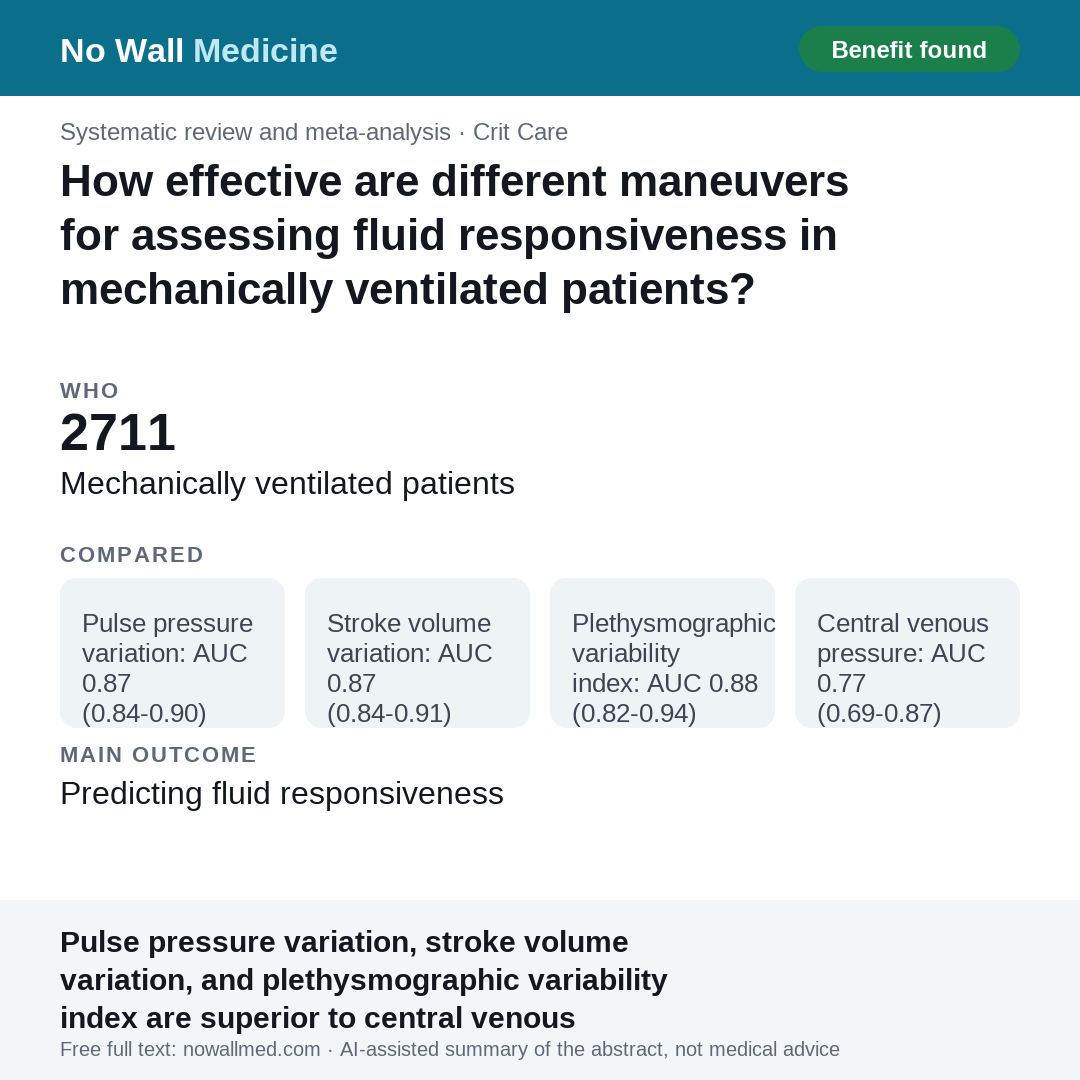
Clinical question: How effective are different maneuvers for assessing fluid responsiveness in mechanically ventilated patients?
Why it matters: It is unknown which specific maneuvers are most reliable for assessing fluid responsiveness in patients receiving mechanical ventilation.
Key points
- Researchers analyzed 69 studies involving 2711 patients and 3185 fluid challenges to evaluate different methods for predicting fluid responsiveness.
- Pulse pressure variation, stroke volume variation, and plethysmographic variability index were associated with higher accuracy than central venous pressure or inferior vena cava variation.
- The mean threshold for pulse pressure variation was 11.5% and the area under the receiver operating characteristics curve was 0.87.
Headline and key points written with AI from the paper’s abstract, with every number checked against it. Read the paper before relying on them.
Topics
Cite this article
Chaves RCF, Barbas CSV, Queiroz VNF, Serpa Neto A, Deliberato RO, Pereira AJ. Assessment of fluid responsiveness using pulse pressure variation, stroke volume variation, plethysmographic variability index, central venous pressure, and inferior vena cava variation in patients undergoing mechanical ventilation: a systematic review and meta-analysis. Crit Care. 2024. doi:10.1186/s13054-024-05078-9
Spotted a mistake? Suggest a correction
Top studies every Monday
The week’s key trials and guidelines in your specialties, plus any topics you follow. By email, free.
Get the weekly digest