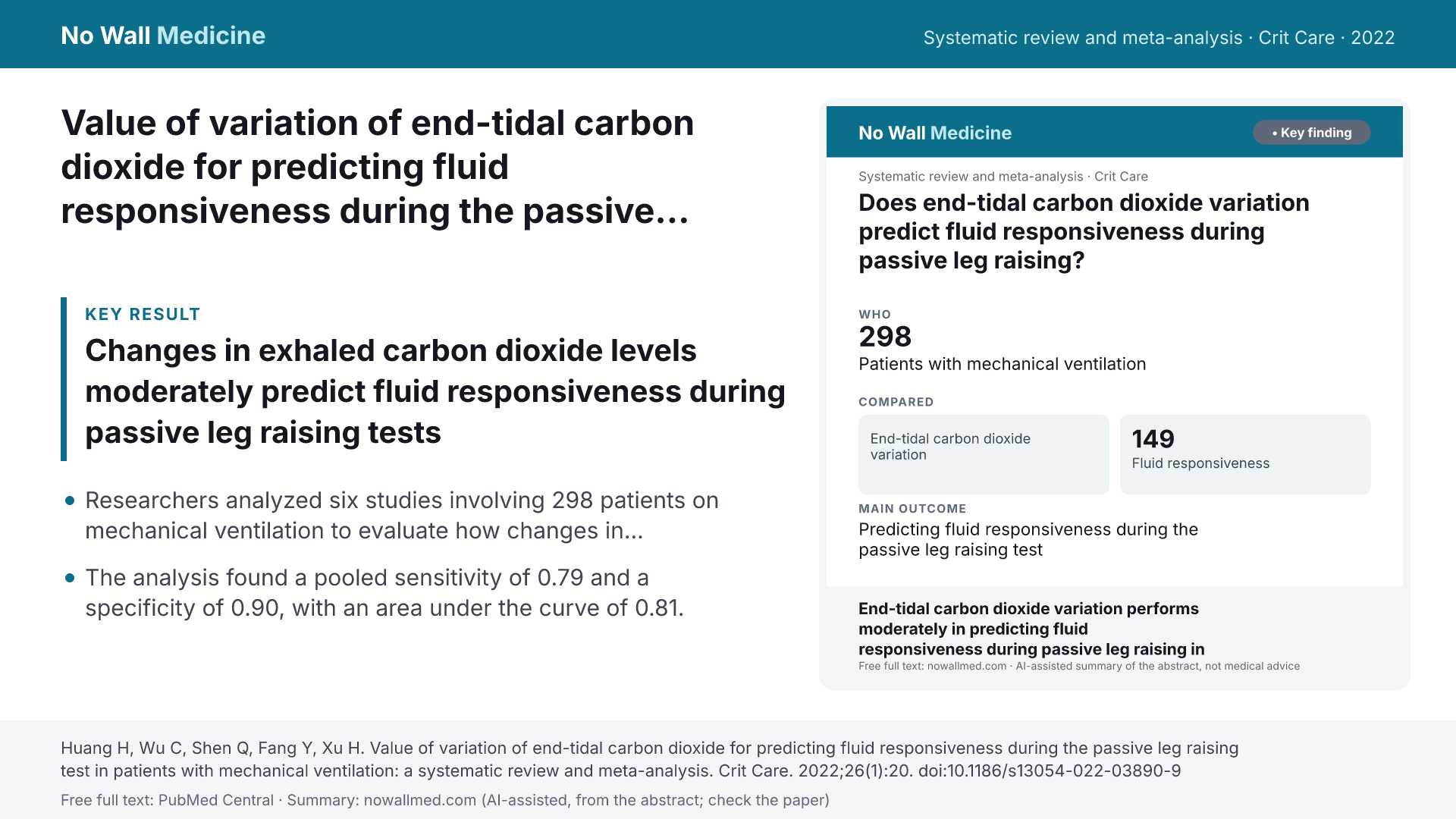
Changes in exhaled carbon dioxide levels moderately predict fluid responsiveness during passive leg raising tests
Value of variation of end-tidal carbon dioxide for predicting fluid responsiveness during the passive leg raising test in patients with mechanical ventilation: a systematic review and meta-analysis
Systematic review and meta-analysisKey finding
Does end-tidal carbon dioxide variation predict fluid responsiveness during passive leg raising?
Who
298
Patients with mechanical ventilation
Compared
End-tidal carbon dioxide variation
149Fluid responsiveness (50%)
Main outcome
Predicting fluid responsiveness during the passive leg raising test
Result: area under the curve 0.81 (95% CI 0.77-0.84)
Bottom line: End-tidal carbon dioxide variation performs moderately in predicting fluid responsiveness during passive leg raising in mechanically ventilated patients.
Limitation: Limited number of studies included and study heterogeneity.
Crit Care · 2022-01-14Download image
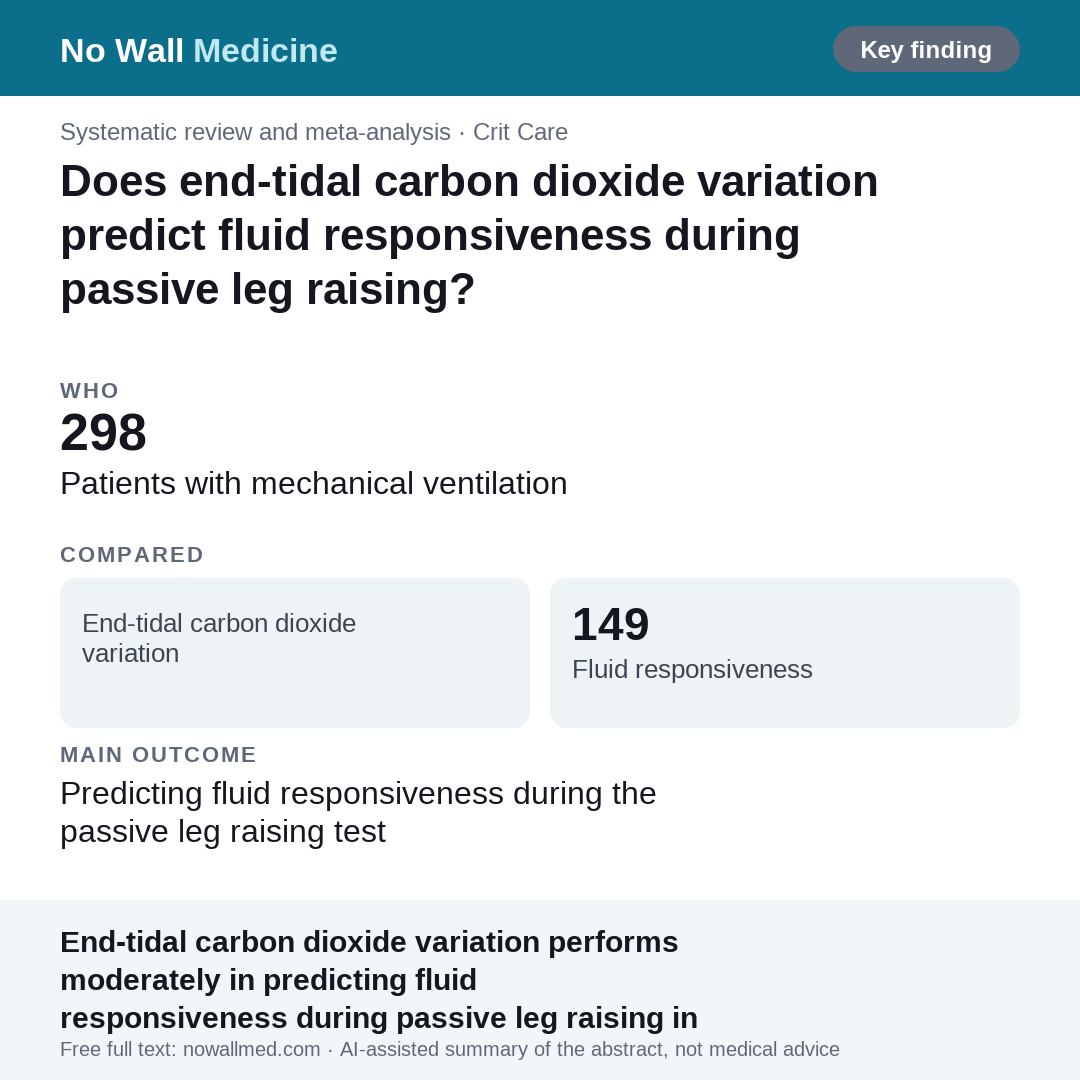
Clinical question: Does end-tidal carbon dioxide variation predict fluid responsiveness during passive leg raising?
Why it matters: Conflicting results exist regarding whether changes in end-tidal carbon dioxide can accurately predict if a patient on mechanical ventilation will respond to intravenous fluids.
Key points
- Researchers analyzed six studies involving 298 patients on mechanical ventilation to evaluate how changes in end-tidal carbon dioxide predict fluid responsiveness during a passive leg raising test.
- The analysis found a pooled sensitivity of 0.79 and a specificity of 0.90, with an area under the curve of 0.81.
- Of the 298 patients included in the review, 149 (50%) were found to be fluid responsive.
Limitation the authors note: The authors noted a limited number of studies and heterogeneity between the included studies.
Headline and key points written with AI from the paper’s abstract, with every number checked against it. Read the paper before relying on them.
Was this summary helpful?
Subject terms
Headline, design, result, key points, caveat and citation as plain text.
Cite this article
Huang H, Wu C, Shen Q, Fang Y, Xu H. Value of variation of end-tidal carbon dioxide for predicting fluid responsiveness during the passive leg raising test in patients with mechanical ventilation: a systematic review and meta-analysis. Crit Care. 2022. doi:10.1186/s13054-022-03890-9
Spotted a mistake? Suggest a correction